
Table of Contents
- Gravity as the oldest tool in the oil mill
- The anatomy of the layers
- Diagnostics - how to read the sediment
- Tank geometry, or why the shape of the vessel governs the time
- The settling tank as an everyday working tool
- The second life of what stays on the bottom
- A working rhythm built on patience
- Summary
- Frequently Asked Questions
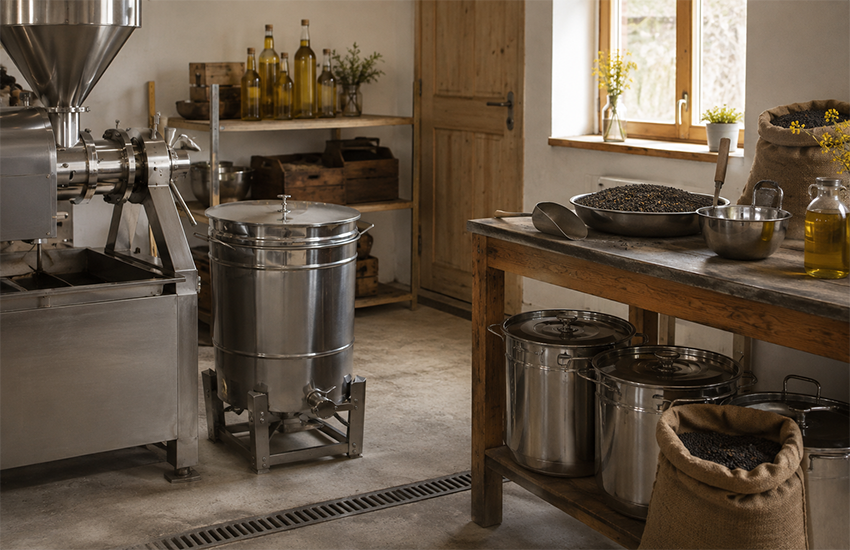
When freshly pressed oil first enters a tank, it looks like a single, warm, faintly steaming suspension. A dozen hours later, that same liquid has begun to divide itself into zones. A clear and steadily brightening column forms at the top, a milky band sits below it, and a dark, dense deposit gathers on the floor of the vessel. Most producers treat this division as nothing more than a technical stage - something to wait out before the oil goes into bottles. In reality, what settles at the bottom of a sedimentation tank is one of the richest sources of information available to anyone who presses oil.
Sediment is a record. It records how dry the seed was, how hard the press screw was working, what temperature prevailed in the pressing chamber, whether the hull was properly separated, and how long the oil stood undisturbed. The layers arrange themselves in reverse order of particle size, at a rate that betrays viscosity and temperature. A geologist reads the history of a landscape from a rock profile, a dendrologist reads it from tree rings, and an oil producer can read the course of a pressing run from a sediment profile.
This article is not another guide to clarifying oil. It is an account of where the gravity method came from, what actually happens inside a still column of liquid, and how to turn the bottom of a tank into a diagnostic instrument that tells you what to change on the next run.
Gravity as the oldest tool in the oil mill
Long before anyone invented filter cloth, filter plates or centrifuges, the oil maker had exactly one purification tool at his disposal - time. And he used it with surprising precision.
Roman clarification basins and the art of separating fractions
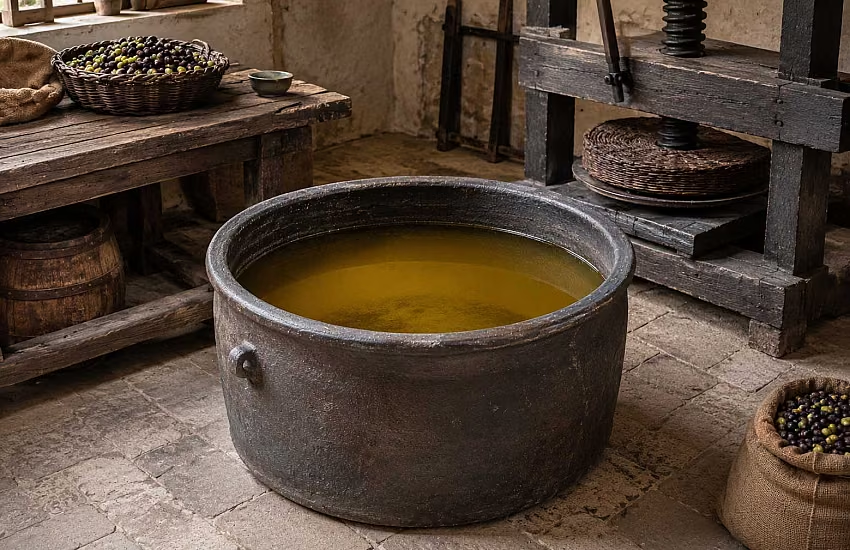
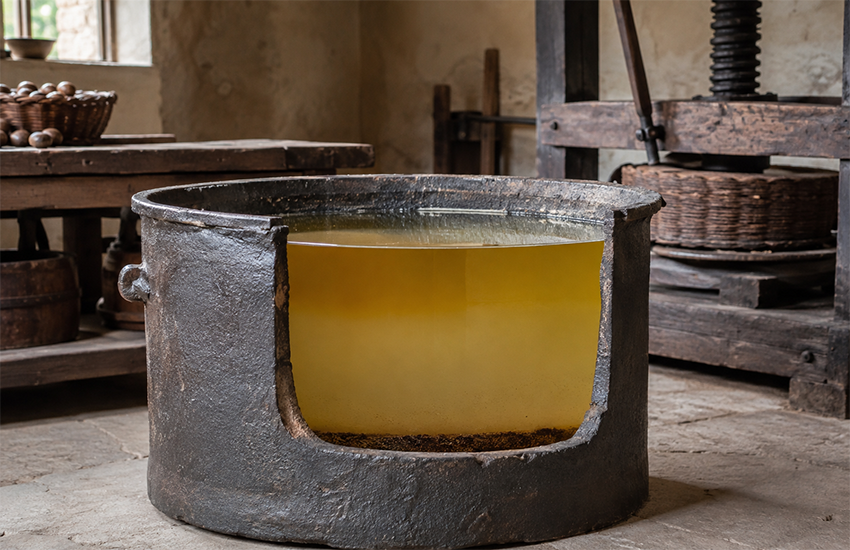
A Roman olive estate was, in effect, a sedimentation plant. After pressing, the mixture of oil and watery plant fraction flowed not into a single vessel but into a cascade of shallow basins cut into stone or lined with mortar. The Romans called that watery, bitter fraction amurca, and they understood perfectly well that the longer it remained in contact with the oil, the worse the final result would be.
Cato the Elder, in his treatise on agriculture, recommended decanting oil frequently and consistently, moving it from vessel to vessel as the fractions separated. The point was not speed but repetition - every transfer left another portion of impurities behind in the previous container. This is precisely what we now call cascade decanting, executed with stone basins instead of valves.
Roman agricultural writers also described special two-chambered vessels known as gemellaria, whose construction allowed cleaner oil to be skimmed from above while the heavier fraction accumulated below. That was, in essence, the ancestor of today's settling tank with a valve positioned above the floor.
Vessel shape as technology
Ceramic vessels used in antiquity to transport and store fats and wine very often had a narrowed, pointed base. This is usually explained by the convenience of stowing them in ships' holds, but a side effect of the geometry was just as significant - the taper collected sediment into a small volume, away from the main body of liquid. Anyone who poured carefully left the impurities exactly where they had gathered.
The same logic survived in European farmhouse oil mills, where linseed and rapeseed oil was decanted into demijohns and stoneware jars kept in cool cellars. In the traditional oil houses of East Asia, working with wooden wedge presses, oil settled in earthenware urns placed in shaded rooms. Different cultures, different raw materials, the same conclusion - a still, cool, dark vessel does work that no amount of haste can replace.
Farmhouse oil mills and the memory of stoneware
Across central and eastern Europe, linseed, rapeseed and poppy seed oil was pressed for centuries in small mills driven by water wheels or draught animals. Freshly pressed oil went into demijohns and stoneware jars that stood in the cellar for several weeks, after which it was carefully decanted into smaller vessels, leaving a dark layer behind on the bottom.
Two details of this practice deserve attention. First, oil was always drawn off from the top, never by tipping the vessel to the last drop - the oil trapped in the sediment was accepted as the natural price of purity. Second, stoneware has considerable thermal inertia, which meant that daily temperature swings in the cellar barely reached the interior of the vessel. Without any concept of convection, those oil makers intuitively chose the arrangement that suppressed thermal currents in the clarifying liquid.
Why old oil houses were cool and dark
Historic oil mills were located in cellars and north-facing rooms not for lack of better options, but because experience showed how quickly oil kept in warmth and light lost its freshness. Nobody knew the term photo-oxidation or the free radical mechanism, but the outcome was observable - oil from a bright room went rancid sooner.
Today we know why, and we can apply that knowledge deliberately. Stainless steel, unlike glass, completely blocks light from reaching the clarifying column while remaining chemically inert. In this respect a modern tank is an improved version of the cellar jar rather than a rejection of it.
The anatomy of the layers
Sediment is not a uniform mass. It is a layered structure that forms in a definite order, and every layer has a different origin.
Layer one - coarse plant material
The lowest and fastest-settling layer consists of the largest particles: hull fragments, crumbs of endosperm, pieces of seed tissue torn loose by the press screw. These particles measure tenths of a millimetre and settle within the first minutes and hours after the tank is filled. They form a distinctly granular layer, close in colour to press cake, and easy to recognise because a gentle nudge to the vessel does not raise a cloud - the layer shifts as a body.
How much of this fraction appears depends mainly on how finely the raw material was broken down and how tightly the press screen assembly was working. A thick, loose layer means more material passed through the slots than should have.
Layer two - phospholipids, mucilage and the so-called gums
Above the granular material a layer of an entirely different character takes shape: smooth, greasy, often stringing behind a spoon. This is the domain of phospholipids, proteins and plant mucilage - substances known collectively in the oil trade as gums. Phospholipids are amphipathic molecules, with one end that favours fat and another that favours water, and this makes their behaviour in oil unusually contrary.
As long as the oil is essentially free of water, phospholipids remain dispersed and refuse to settle. But a trace of moisture is enough for them to start binding it, swelling and forming heavier and heavier aggregates that eventually sink. This is why oil pressed from insufficiently dried seed leaves a much thicker, tackier layer on the bottom than oil from well prepared material. In linseed oil this layer is visibly slimy, in rapeseed oil dense and greenish, in pumpkin seed oil almost tar-dark.
Layer three - water and whatever dissolved in it
Right at the bottom, beneath everything else, a thin aqueous layer can collect. It comes from the moisture in the seed, which passes into the oil during pressing as microscopic droplets. Those droplets coalesce slowly, because the density difference between water and oil is small and the viscosity of the oil effectively restrains their movement.
From the standpoint of shelf life this layer is the most problematic, since water is the medium in which enzymes and microorganisms can act. It is also the most instructive - its presence is an unambiguous message that the raw material was too moist, or that the press was not fully dry when the run began.
The layer that appears late
There is one more fraction that gives no sign of itself for the first few days and then suddenly clouds the entire batch. These are waxes - substances originating in the outer layers of the seed coat, which stay dissolved at room temperature and begin to crystallise on cooling. The phenomenon is most pronounced in sunflower oil, but it occurs to a lesser degree in most oils pressed from seeds with a hard coat.
The practical consequence is that oil clarified in a warm room in summer can turn cloudy in a cold store in winter, even though nothing has gone wrong with it. Wax crystallisation is reversible - warmed back to room temperature, the oil regains its clarity. Producers who want a stable appearance year round deliberately chill a batch before the final clarification stage, forcing the waxes to precipitate earlier, in the tank rather than later, in a bottle on a shelf.
The fraction that will never settle
Finally, part of the suspension will never settle, however long the tank stands undisturbed. This concerns particles smaller than roughly one micrometre. On objects that small, the chaotic impacts of oil molecules - Brownian motion - exert a force comparable to gravity. Instead of descending, the particle drifts in place.
Completely transparent oil is therefore not a product of sedimentation alone, and a faint opalescence after two weeks of settling is not a sign of error. It is the physical limit of the gravity method, and it can only be crossed by filtration or centrifugal force. Recognising that limit saves a great many producers from needless frustration and from needlessly extending the process.
Diagnostics - how to read the sediment
This is where it becomes interesting. Since every layer has a different origin, its thickness, colour and consistency amount to feedback from the entire production process. All that is needed is to learn to read them.
Thick, granular sediment the colour of press cake
If a disproportionately thick, crumbly layer of plant material collects after a run, the message concerns the mechanics of the press. It usually means a nozzle set too loose, a worn screw, or excessively broken-down raw material passing through the screen slots instead of forming a compact cake.
The practical consequence is twofold. First, more solid material in the oil means longer clarification and more oil trapped in the sediment. Second, sediment like this indicates that the cake is leaving the press too crumbly, which affects what can be done with it afterwards.
Dark, faintly bitter sediment with a greasy sheen
Sediment noticeably darker than the oil itself, with a greasy sheen and a slightly scorched note when rubbed between the fingers, points to temperature. A press working too aggressively, a nozzle set too narrow, or an overly long uninterrupted run all raise the temperature in the pressing chamber beyond the range where cold pressing can still be claimed.
Thermal degradation products and colour compounds then pass into the oil and settle together with the rest of the suspension. Dark sediment from a pale raw material is a signal to slow down on the next batch, let the machine cool, or adjust the nozzle.
A cloudy suspension that refuses to separate
Sometimes, after several days, the oil still looks like diluted milk and the boundary between the clear and cloudy zones is blurred and refuses to move downward. This is almost always an emulsion problem - a stable dispersion of water droplets in oil, held together by phospholipids acting as natural emulsifiers.
The cause is often moist raw material, but just as often it is washing the press shortly before a run and leaving traces of water inside. Two things are worth checking: seed moisture before pressing, and whether the machine was completely dry at the start.
Sediment that appears only after bottling
It also happens that oil leaves the tank perfectly clear and, two weeks later, shows a few millimetres of deposit at the bottom of the bottle. This is not a failure of the process but its natural continuation - sedimentation does not stop the moment oil is decanted, because the finest fraction keeps settling slowly.
Two scenarios are worth distinguishing, though. A light, gradual haze building up over time is ordinary continued clarification and a mark of an unrefined product. A thick, dark deposit forming within a few days means the oil was drawn off too early, or that the bottom layer was disturbed during transfer. Watching bottles from the same batch stored in several locations quickly establishes which case applies.
A sharp boundary and a rapidly clearing column
Not every signal is a warning. If a distinct, almost flat boundary between a clear upper zone and compact sediment is visible within a dozen or so hours, and that boundary keeps descending, everything worked as it should. A dry, well prepared batch of seed, a stable pressing temperature and calm settling conditions produce exactly this picture.
It is worth documenting - note the pressing parameters and photograph the tank. Repeatability comes from reproducing what worked, not only from avoiding what did not.
Tank geometry, or why the shape of the vessel governs the time
Sedimentation is a process in which a particle must physically travel from wherever it happens to be down to the bottom. That obvious fact has very concrete consequences for the choice of vessel.
The height of the oil column
A particle suspended just below the surface in a tank half a metre deep has half a metre to travel. In a flat basin ten centimetres deep, ten times less. The settling velocity is identical in both cases, so the time required to reach the bottom differs by a factor of ten.
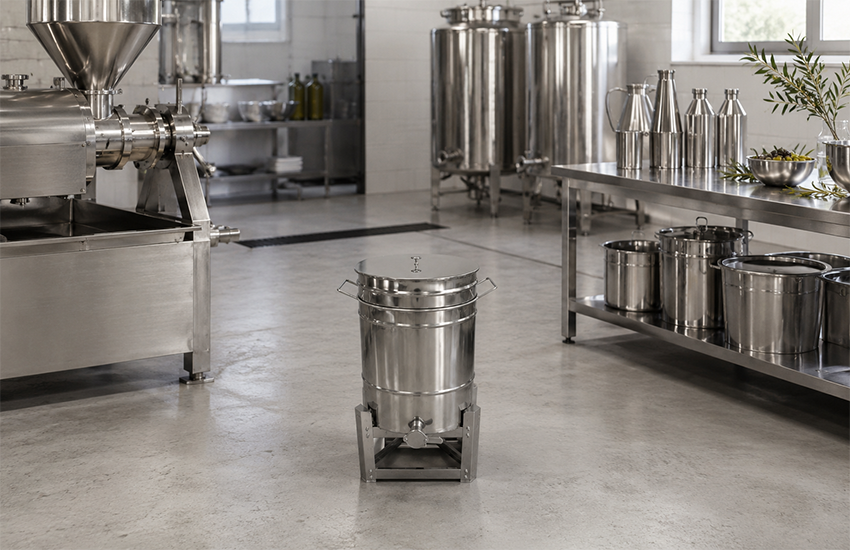
This gives wide, shallow vessels a theoretical advantage. In practice, though, that shape means an enormous oil-to-air contact area and therefore faster oxidation, plus the difficulty of separating clarified oil from a thin layer of sediment spread over a large surface. Tanks used in working oil mills are therefore a compromise - tall enough to limit air contact and concentrate sediment in a small volume, and proportioned so that the column is not excessively deep. A tank measuring 410 by 540 millimetres sits squarely in that practical window.
Invisible currents in still oil
There is another factor that is rarely discussed and can undo several days of patient settling - thermal convection. If a tank stands in a room where the temperature varies over the daily cycle, the walls of the vessel heat and cool faster than its contents. A temperature difference arises, and with it a slow circulation of liquid along the walls and through the middle of the column.
This circulation is invisible to the eye but strong enough to lift the finest particles back upward. It is why oil settled in a room with large temperature swings clarifies more slowly than the same oil in a stable cellar, even when the average temperature is identical. Stability of temperature often matters more than its value.
Valve placement as a design decision
A valve set exactly in the floor of a tank allows sediment to be drained, but every opening disturbs the layer and mixes it with the oil immediately above. A valve set a few centimetres higher allows clarified oil to be drawn off without touching the bottom, at the cost of leaving a certain volume of oil with suspension in the tank.
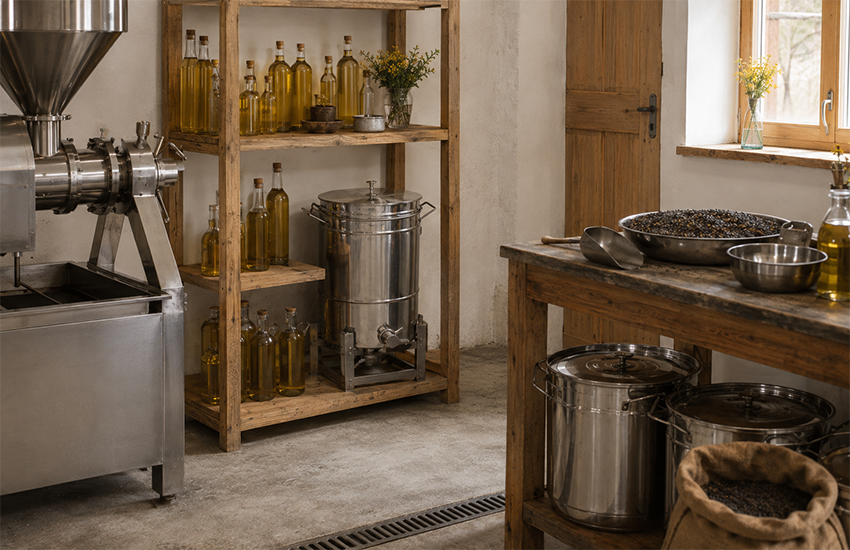
In the stainless steel sedimentation tank with a 70 litre capacity, the 6/4 inch drain valve can be fitted at any point during production. This is not a catalogue detail but a genuine technological decision - the height of the valve determines which fraction is treated as product and which as sediment, and it should be matched to the raw material most often pressed. With oils carrying an abundant mucilage fraction, such as linseed or pumpkin seed, a higher valve position makes sense far more often than it does with rapeseed.
The settling tank as an everyday working tool
A sedimentation tank is one of those pieces of equipment that photograph poorly and determine the consistency of a product more than most of the spectacular machines around it.
Why stainless steel rather than plastic
Stainless steel releases nothing into the oil, absorbs no odours and does not age on contact with fat. It also has a property no plastic can match - the surface stays smooth after years of use, and the micro-scratches in which traces of oxidised oil could lodge essentially do not form. A tank made from 0.8 millimetre sheet keeps its walls rigid, which matters when moving a full vessel and when cleaning it.
The opacity that some producers initially perceive as a drawback is in fact an advantage. Oil clarifying without exposure to light retains more of its natural antioxidants, and in any case the progress of the process is best judged by drawing a small controlled sample rather than by looking through the wall of the vessel.
When 70 litres is the right scale
Choosing a tank capacity is not a matter of picking the largest vessel available. The point is to match the volume to a single pressing run, because only then does the entire contents share one history and clarify to one rhythm. Topping up a tank in which sedimentation is already under way sets the process back - the incoming liquid stirs the layers and raises the temperature of the column.
Fill level matters too. A tank filled to half depth means half the distance for particles to travel, but also twice the oil surface exposed to air relative to volume. A tank filled almost to the brim limits oxidation but lengthens the clearing of the upper layers. In practice a fill of around three quarters works best, leaving headroom for the foam that forms when warm oil arrives straight from the press.
A capacity of 70 litres corresponds to a day's output from a press rated at fifteen to twenty kilograms per hour running for several hours. That is a typical scale for a holding that presses regularly through the season and for a small manufactory wanting to close one batch in one vessel. The tank weighs 11 kilograms, and the handles and stand allow it to be positioned securely and moved empty without a second pair of hands.
Two tanks and the cascade principle
The oldest known method of improving clarification - the same one the Roman agronomists described - is decanting oil between vessels. Two tanks make a simple rhythm possible: the first receives fresh oil from the press and collects the coarsest fraction over the first two or three days, after which the clarified column passes through the valve into the second tank, where it settles undisturbed for several days more.
The result is distinctly better than one vessel and a longer wait, because in the second tank the oil no longer has a layer above it that might be disturbed, nor sediment beneath it from which dissolved compounds could migrate back. A professional oil sedimentation tank works alternately in such a setup, and the whole cycle can be tuned to the rhythm of pressing.
The second life of what stays on the bottom
Sediment is a by-product only if it is treated as one. Through most of the history of oil making it was regarded quite differently.
Amurca on the Roman estate
The watery fraction separated from olive oil in Roman basins did not go into a ditch. Pliny the Elder devotes extensive passages to it, listing uses that range from fertilising and protecting trees, through treating timber and leather, to preserving surfaces around the farm. The Romans considered it a raw material rather than waste, and stored it in dedicated vessels.
That perspective is worth recovering. Sediment from oil clarification is a concentrated combination of phospholipids, proteins, seed particles and residual oil - a nutritionally dense material that finds use on a farm as a feed supplement or a component of organic fertiliser.
Sediment as a deliberate element of flavour
In several culinary traditions, cloudy oil with suspension is not an inferior version of the clear product but a separate one. The suspension carries aromatic compounds that occur at lower concentration in the clear fraction, so unsettled oil tends to be more intense and more bitter. Some craft producers deliberately leave a small amount of natural suspension in the bottle and say so on the label.
The degree of clarity is therefore a flavour decision as much as a technical one. A tank with the valve at a chosen height gives full control over that decision, because it allows the process to be halted at precisely the intended point.
Why oil recovered from sediment needs separate handling
The fraction remaining at the bottom holds a significant quantity of oil trapped between particles. The temptation to recover it is understandable, but it is worth remembering that this oil has a completely different stability profile from the main batch - a higher share of water, phospholipids and oxidation products. It should not go back into the tank with the clear oil, nor be bottled alongside it. If it is recovered, it should be handled as a separate batch with a shorter expected shelf life.
A working rhythm built on patience
All the mechanisms described above lead to one practical conclusion - clarification is a stage that cannot be shortened by decision, only made more efficient by organisation.
The oil maker's notebook
Recording the pressing date, the type and moisture of the raw material, the room temperature and the appearance of the sediment after one day, three days and a week builds a body of knowledge in a single season that no guide can replace. After a dozen or so batches, patterns emerge that are specific to one press, one room and one raw material.
Photographs are particularly valuable. The colour and structure of sediment are hard to describe in words, but comparing two images taken a month apart shows the difference immediately. Photographing a drawn sample in the same glass vessel, under the same lighting and from the same distance, produces a comparable series by the end of the season.
A simple way to make the record even clearer is to take a small sample after each run into a narrow, transparent tube or a slim jar and leave it standing beside the tank. A small-diameter column clarifies to the same rhythm as a large one, but the layers within it are far more visible, and the sample can be kept as a witness to that batch for many weeks.
A permanent place for the tank
Vibration is to sedimentation what a draught is to a candle. Every tremor in the floor sets the finest particles moving just as they were beginning to settle. A tank should have a fixed position away from working machinery, walkways and doors, on stable ground, in a room with as even a temperature as possible.
It is also worth remembering that stability of temperature counts for more than its exact value, and that limiting the oil's contact with air - covering the tank without sealing it during the first day - has a greater effect on shelf life than additional days of settling.
Summary
A settling tank is a device in which nothing moves, nothing heats and nothing makes a sound, and which nevertheless determines how the oil will look, how it will taste and how long it will stay fresh. Gravity does its work without human intervention, but the way that work is organised - the shape of the vessel, the height of the valve, the stability of the temperature, the rhythm of decanting - changes the outcome to a degree that is hard to expect from such a simple process.
The layers accumulating on the bottom are, meanwhile, the most honest report available on the whole production process. The granular layer speaks about the mechanics of the press, the tacky one about the moisture of the raw material, the dark one about pressing temperature, and a thin film of water at the very bottom about seed preparation. Learning to read these signals costs one season of attentive observation and repays it with a consistency that no amount of equipment selection alone can deliver.
Roman oil makers moved their oil between stone basins because they knew that time and stillness are active ingredients in the process. Two thousand years later the materials, the valves and the precision of manufacture have changed, but the principle has not.
Frequently Asked Questions
Why is my oil still slightly opalescent after two weeks in the tank?
Because part of the suspension is too fine to settle under gravity. Particles smaller than about one micrometre are affected strongly enough by Brownian motion that they effectively stop descending, no matter how long the tank stands undisturbed. A delicate opalescence after a full settling cycle is a natural limit of the gravity method, not a sign of error. Full transparency is achieved only through filtration or centrifugation.
Can the appearance of the sediment tell me anything about seed quality?
Yes, and fairly precisely. A tacky, stringing layer of large volume points to high moisture in the raw material, because phospholipids bind water and swell. A large quantity of loose, granular material says more about particle size and the state of the hull than about the seed itself. Sediment noticeably darker than the oil suggests an excessive temperature in the pressing chamber.
Where does the thin layer of water at the very bottom come from?
From moisture in the seed, which passes into the oil during pressing as microscopic droplets. Those droplets coalesce slowly because the density difference between water and oil is small. A distinct aqueous layer signals that the raw material was too moist, or that the press was not fully dried after washing. It should be drained off first and never mixed with oil intended for bottling.
Does the height of the oil column affect clarification time?
Directly. A particle descends at a given velocity, so the taller the column, the longer the journey. Wide, shallow vessels clarify faster but expose far more surface to air and make it harder to separate oil cleanly from sediment. Tanks used in oil mills are a compromise between these two factors.
Why does oil from roasted seed clarify differently from oil from raw seed?
Heat treatment changes the state of proteins and phospholipids in the seed and lowers its moisture content, which alters the composition and structure of the suspension. Oil from roasted material tends to be darker, usually carries a smaller mucilage fraction and often clarifies faster, though the sediment is more compact. The differences are pronounced enough to justify keeping separate notes for roasted and unroasted raw material.
How often and with what should a sedimentation tank be cleaned?
After every batch, before sediment residues dry and adhere to the walls. Hot water with a food-grade detergent and a soft sponge is enough for stainless steel - wire pads and abrasive powders create micro-scratches where oxidised oil accumulates. The thread and the interior of the valve deserve particular attention, since the mucilage fraction lodges there most readily. The tank must be completely dry before the next use.
Can different types of oil be clarified in the same tank?
They can, provided the tank is thoroughly washed and dried between batches. Stainless steel does not absorb odours, so there is no risk of the permanent aroma transfer that occurs with plastics. It is worth thinking about sequence, though - strongly flavoured oils such as pumpkin seed or black cumin are better pressed and clarified after delicate ones rather than before them.