
Table of Contents
- What seed moisture actually means
- Why a seed is never dry once and for all
- What happens in the chamber when there is too much water
- The other extreme - seed that is too dry
- The moisture window - why the figure of ten percent keeps appearing
- Every seed carries its own water
- The craft of drying and conditioning
- Moisture and the fate of the oil after pressing
- How this was handled before electronic meters
- A simple protocol for your own oil mill
- Water as part of the craft
- Frequently Asked Questions
Sooner or later, every oil press has the same day. The same machine, the same rapeseed from the same field, the same temperature setting, the same nozzle. And yet the oil runs differently. Instead of a steady, calm stream there is an interrupted, dripping trickle. The press cake that came out last week as hard, dry tubes now spills out as a damp, greasy crumble. The press runs more quietly, but the yield drops. Nothing has broken, nothing has been readjusted. Something has changed that cannot be seen with the naked eye and that no indicator on the control panel will show: the amount of water inside the seed.
Moisture is the most underrated parameter in the entire pressing process. We talk about varieties, roasting temperatures, nozzle diameters, screw speeds, filtration and settling tanks. Meanwhile the difference between two and three percent of water in the grain can decide whether a day's work will be satisfying or whether it will end with dismantling the pressing chamber and cleaning a blocked screw. This water is invisible. A seed at fourteen percent moisture looks and pours exactly like a seed at seven percent. Only the press reveals the difference, and it does so without mercy.
This article is about that invisible water. About where it comes from, why a seed is never dry once and for all, what exactly happens inside the pressing chamber when there is too much or too little of it, and why traditional oil mills across Europe had their own ways of judging moisture long before electronic meters existed.
What seed moisture actually means
When we say that rapeseed has a moisture content of eight percent, we mean something very specific: if all the water were evaporated from that grain, it would lose eight percent of its mass. One hundred kilograms of seed contains eight kilograms of water and ninety-two kilograms of dry matter - proteins, fats, carbohydrates, fibre and minerals. A definition that is simple to write down and surprisingly difficult to capture in practice, because water inside a seed is not uniform.
Free water and bound water
Food technologists divide water in biological material into several categories, but for pressing the distinction between two of them matters most. Free water fills intercellular spaces and capillaries, behaves like an ordinary liquid, evaporates easily, migrates easily, and is responsible for most of the trouble inside a press. Bound water, by contrast, is attached to protein and carbohydrate molecules by electrostatic forces, forms part of the seed's structure, and cannot be removed without destroying the tissue.
A seed in typical storage condition contains mostly bound water and only a little free water. A seed straight after harvest, especially after a rainy September, has far more of it. And it is precisely this surplus, free water that the press feels most strongly. It turns to steam in a hot chamber, it acts as a lubricant between the grain and the barrel wall, and it reappears later in the bottle as a cloudy suspension.
How moisture is measured in a small oil mill
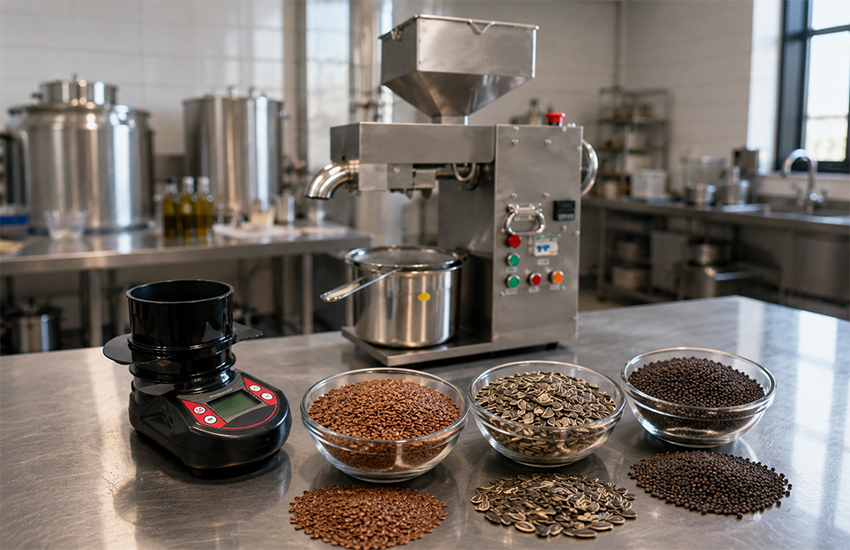
In a laboratory this is done by the oven method: a sample is weighed, dried under strictly defined conditions, weighed again, and the difference calculated. Accurate, but requiring several hours and an analytical balance. In practice, small producers use electronic moisture meters that measure the electrical properties of a sample - water behaves in an electric field quite differently from fat and protein, so the measurement is indirect, but very fast and reliable enough.
The most common approach is the capacitive method. A measured volume of whole seeds is poured into a measuring chamber which is essentially a capacitor, and the device reads the change in electrical capacitance caused by the presence of water. The whole measurement takes a few seconds and requires neither grinding nor destroying the sample, which matters if the same batch is about to go into the press.
Why calibration for oilseeds matters
This is where the most common error in small oil mills appears. Most popular moisture meters are calibrated for cereals, and oilseeds behave differently, because a large part of their volume is occupied by fat, which barely conducts electricity and distorts the reading. A value for rapeseed or flax taken on a cereal instrument can be off by several percentage points, and with a working window as narrow as the one we are discussing, that is the difference between a successful and a failed pressing run.
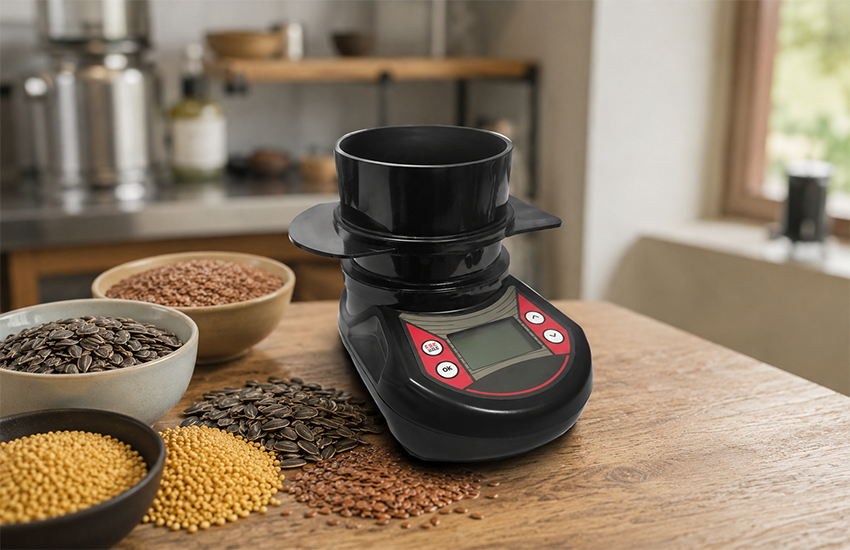
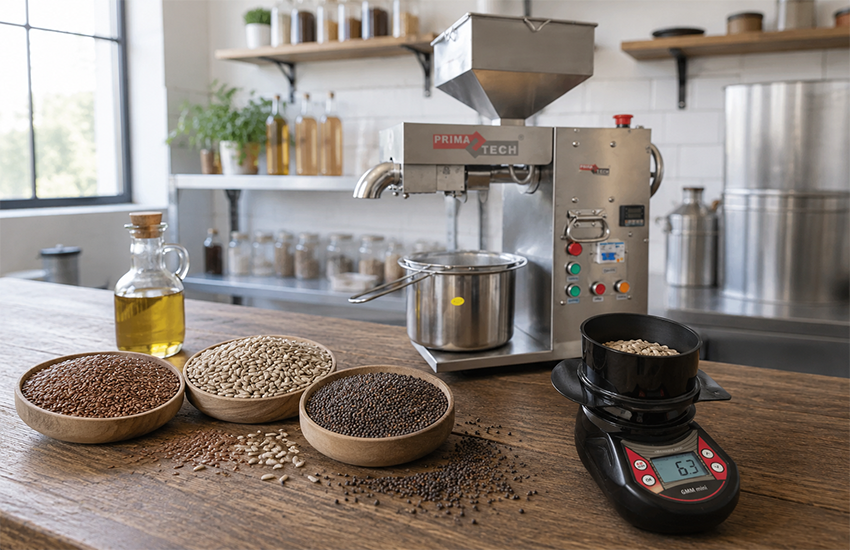
The solution is an instrument with calibration curves developed specifically for oil-bearing raw materials. One example of such a tool is the Dramiński GMM mini II moisture meter for oilseeds, made in Poland and prepared for fourteen basic species used in oil pressing. It covers rapeseed from four to thirty percent, flax from five and a half to twenty and a half, hulled and unhulled sunflower, hulled pumpkin seed and pumpkin seed in the shell, black cumin, milk thistle, sesame, hemp, soy, almonds, and both hazelnuts and walnuts. In other words, practically the entire repertoire of a typical small pressing facility.
A few details are worth noting, because they matter in daily work. The declared accuracy is about one percentage point in the range up to ten percent, which is exactly where the game is played in pressing, and slightly lower above that value. The display resolution is one tenth of a percent, which allows small differences between batches to be caught. The sample is measured with a supplied dispenser holding two hundred and seventy millilitres, so every reading is taken on an identical volume - a condition of repeatability that is easy to forget when seed is poured in by eye.
Temperature, the second measurement trap
The second classic mistake is ignoring sample temperature. Seed brought from a cold store into a warm room will give a different reading from the same seed after an hour of warming up, because the electrical properties of water change with temperature. Better instruments solve this with a sensor placed directly in the measuring chamber and automatic compensation, so the result does not depend on whether you are measuring in an unheated barn in November or in a warm kitchen. The meter mentioned above reads grain temperature from minus ten to plus eighty-five degrees Celsius with an accuracy of half a degree and shows it on the display next to the moisture value, which incidentally provides useful information about the state of the store.
The practical advantage of pocket instruments is that the measurement can be taken where the seed actually lies - by the silo, on the trailer, in the shed with the sacks - rather than only after carrying a sample to the room with the press. A device weighing seven hundred grams, powered by two ordinary AA batteries and running for over one hundred and fifty hours without backlight, is simply a tool you can carry with you. The ability to update calibration data over a USB connection means the instrument does not age along with its species database, which matters more than it might seem given the growing interest in less conventional raw materials.
Whatever the class of equipment, one rule applies: always measure the same way. The same sample volume, the same filling procedure, similar conditions where possible. A moisture meter becomes more valuable the more consistently it is used, because only then does it allow today's batch to be compared with one from a month ago and conclusions drawn from the difference.
Why a seed is never dry once and for all
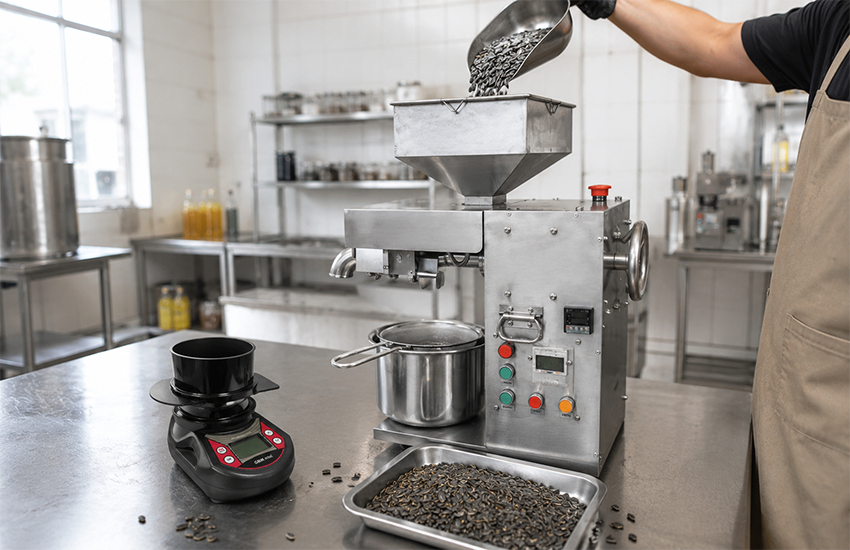
This is the fact that surprises newcomers to pressing most. A seed is not a stone. It is a hygroscopic material, meaning it constantly exchanges water with the surrounding air. If the air is more humid than the seed, the grain takes water in. If it is drier, the grain gives water off. The process only stops when the two systems reach equilibrium.
Equilibrium moisture and sorption curves
This state has a name - equilibrium moisture content - and it looks different for every species. The relationship between the relative humidity of the air and the moisture of the seed is expressed as a sorption curve, which has the characteristic shape of a stretched letter S. In the middle range, with air humidity between forty and seventy percent, the curve is relatively flat, meaning that fluctuations in the store make little difference. But above seventy-five percent the curve rises sharply and the seed begins to absorb water very quickly.
The practical consequence is that rapeseed stored in an unventilated room through a wet November week can gain a percentage point and a half of moisture with no human intervention at all. Nobody did anything, the sack stood in the same place, and the material is already different. This is why experienced operators measure moisture not once a season, but before every larger pressing run.
The rhythm of the year in the store
It helps to think of a seed store as something that breathes along with the seasons. In summer, with dry warm air, seeds lose water. In autumn, as relative humidity rises and temperatures fall, the material starts to absorb. In winter, in an unheated building, an additional phenomenon appears - moisture migration inside the heap. The temperature difference between the core and the outer layer drives water vapour movement and causes it to condense in the cooler zones. The top layer of a silo can be several percent wetter than the middle, even though the entire batch went in identical.
For this reason a sample taken from a single spot can be misleading. If you press from larger stocks, it is worth taking material from several levels and mixing it before measuring, and better still before pressing.
What happens in the chamber when there is too much water
A screw press does not work by pressure alone. It works by friction. Material entering the chamber must be held back, compressed and forced through an ever narrower space, and this is only possible when there is sufficient resistance between the seed mass and the barrel wall. Water destroys that resistance.
Slipping instead of gripping
Surplus free water acts inside the pressing chamber exactly like a lubricant. Seed particles begin to slide over one another and over the barrel surface instead of being held back by it. The screw turns, the material moves along, but the pressure needed to rupture the cell walls and push out the oil never builds up. The effect is paradoxical: the press runs more lightly, the motor draws less current, everything sounds calmer, and there is less oil.
This is one of the most misleading signals in the whole process. A quiet, smoothly running press intuitively suggests good work. In this particular case, however, the quiet means that material is passing through the chamber too freely and taking a significant share of the oil with it into the cake.
Steam, cloudy oil and a hot screw
The second consequence of excess water shows up in hot pressing. The chamber is hot and the water boils. The resulting steam increases the volume of the material, pushes it back towards the inlet and disturbs the even build-up of pressure. In extreme cases steam and particles of the mass escape through the hopper, which is alarming and entirely avoidable.
That same water also ends up in the oil. Freshly pressed oil from wet raw material is noticeably cloudier and does not clear as it should, because fine water droplets stabilise the suspension of solid particles. Instead of sediment settling to the bottom of the tank within a few dozen hours, we get a persistent, milky emulsion that can hold for weeks.
The cake that will not come out
The third symptom concerns the press cake. At correct moisture the cake leaves the nozzle as hard, compact, dry fragments that snap with a characteristic crack. With excess water the cake becomes plastic, damp and greasy to the touch, and sometimes begins to stick to the nozzle and form a plug. Such cake also keeps far less well - moisture plus fat is an ideal environment for mould, so material intended as animal feed or as raw material for flour can spoil within days.
The other extreme - seed that is too dry
Because excess water is so troublesome, it is easy to conclude that the drier the seed, the better. This is a mistake, and an expensive one.
Crumbling instead of flowing
For oil to be squeezed out, the seed mass must behave in the chamber in a way that is to some degree plastic. It must compress into a coherent plug in which pressure builds and transmits further. Over-dried seed loses this ability. Instead of deforming under load it shatters into small hard fragments with voids between them. Instead of building, the pressure dissipates, and instead of flowing, the material simply pours.
The symptoms are characteristic dusting at the inlet, fine particles running out together with the oil, and cake leaving the machine not as compact fragments but as a loose meal. Oil from such a run carries a great deal of fine suspension and needs much longer to clear.
Overheating and scorching
Over-dried material also generates more dry friction and therefore more heat. With no water to absorb energy through evaporation and stabilise the temperature, all the frictional heat goes straight into the seed mass. The temperature at the nozzle can rise by several dozen degrees above its usual value, producing darker oil, a pronounced roasted note, sometimes a slightly bitter aftertaste, and scorched edges on the cake.
If the goal is cold-pressed oil, where the point is to preserve delicate aromatic compounds and unsaturated fatty acids, over-drying the raw material is one of the simplest ways to undermine that goal without realising it. The press does not need its heater switched on at all for the oil to come out hot.
Faster wear of working parts
Hard, dry, sharp seed fragments act inside the chamber like a mild abrasive. The screw and the barrel work under increased friction and elevated temperature, which translates into faster wear of the working surfaces. This effect is spread out over time and hard to notice day to day, but experienced producers know that keeping raw material within a sensible moisture window is also a form of care for the machine itself.
The moisture window - why the figure of ten percent keeps appearing
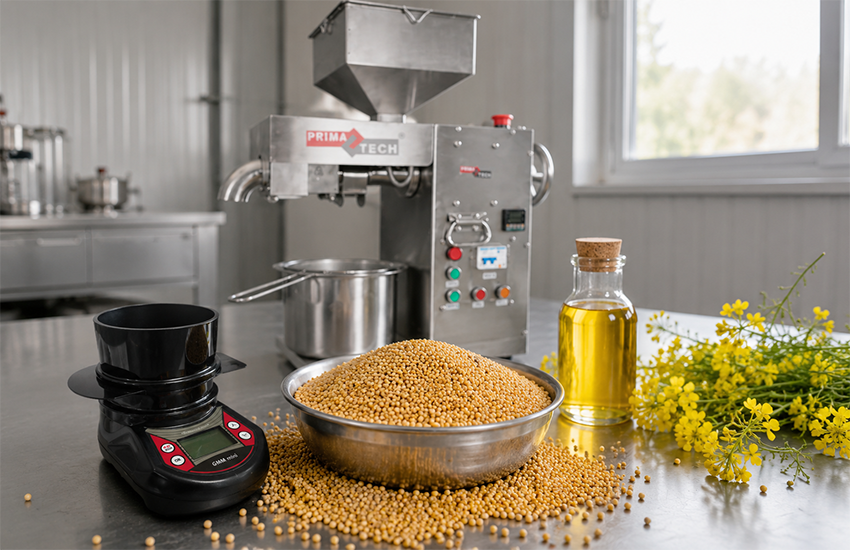
Press manufacturers usually give two boundary conditions for the raw material: oil content above fifteen percent and moisture below ten percent. This is also the case with the semi-industrial oil press with a capacity of 15-20 kg/h, a machine proven in small oil mills and family farms across Europe, which under these conditions leaves up to five percent oil in the cake. The ten percent threshold is not arbitrary - it is the point above which the slipping effect described earlier begins to dominate over friction, and process efficiency drops noticeably.
It is worth understanding, however, that ten percent is a ceiling, not a target. The optimum for most oilseeds lies lower, somewhere between six and eight percent, and varies with species, degree of particle breakdown and whether we are pressing cold or hot. Seed destined for hot pressing tolerates slightly higher moisture, because part of the water evaporates in the chamber before the material reaches the zone of highest pressure. In cold pressing, where the temperature stays low, the water has no way of disappearing and its influence is direct.
A practical rule worth remembering: if seed is dry enough to store safely through a season, it is usually also in good condition for pressing. For oil crops, storage moisture and processing moisture are ranges that largely overlap.
Every seed carries its own water
General principles are one thing, the behaviour of specific raw materials is another. Species differ in seed coat structure, fat content and tendency to absorb moisture, so they react to the same moisture level in quite different ways.
Rapeseed
Rapeseed is a rewarding and predictable raw material. Its small, spherical seeds have a hard coat and high oil content, which lets them form a stable plug inside the chamber. It presses best at around seven percent moisture. Above nine percent the yield falls clearly; below five, dusting appears along with a marked rise in temperature at the outlet. Rapeseed also has the advantage that its condition is easy to judge by touch - a handful of dry rapeseed pours through the fingers with a characteristic rustle, while wet seed feels distinctly heavier and less free-flowing.
Flax
Flax is a capricious raw material because of the mucilage contained in its seed coat. This mucilage - a polysaccharide layer that swells on contact with water - makes flax react to excess moisture far more violently than other species. Wet flax tends to stick in the hopper and form bridges that block even feeding. The target moisture for flax is around seven percent, and once nine percent is exceeded the problem becomes visible very quickly.
Sunflower
Sunflower behaves differently depending on whether we press hulled or unhulled seed. The hull acts as a natural draining material and absorbs part of the moisture, so unhulled sunflower is more forgiving. Hulled seed, with very high fat content and a soft structure, is considerably more sensitive and, given excess water, turns very quickly into a paste that refuses to form a plug.
Pumpkin seeds
With pumpkin, the moisture problem begins before the press. The seeds are large, flat and carry a high water content straight after extraction from the fruit, so drying is not an option here but a necessity. They are dried slowly, at temperatures not exceeding the mid-forties, so as not to destroy their characteristic nutty aroma. Well-dried seeds snap with an audible crack; under-dried ones bend and stay flexible.
Hemp, black cumin, milk thistle
Small seeds with hard coats - black cumin, milk thistle, hemp - are usually less sensitive to moisture fluctuations than soft raw materials, but they have a different problem. Given excess water they tend to glaze, forming a smooth, compacted surface layer that makes it harder for pressure to penetrate deeper into the mass. This shows up as a drop in yield with no other clear symptoms, which can be confusing.
Nuts
Shelled nuts are a category of their own, because their moisture depends not only on storage but also on how long ago they were shelled. Freshly shelled nuts contain more water than ones that have been sitting for several weeks. Roasted nuts are by definition drier, which incidentally explains why roasting so often improves the course of pressing - it is not only about aroma and loosening the cell structure, but also about removing part of the free water.
The craft of drying and conditioning
Given that moisture matters so much, and that the material drifts towards it on its own, the question becomes how to control it.
Slow drying, not rapid drying
The basic rule for drying seed destined for pressing is: slowly and at low temperature. Rapid drying at high temperature makes the seed surface dry far faster than the interior and form a crust that blocks further evaporation. The result is a seed that appears dry from the outside and is still wet within - the worst possible state, because the meter shows values lower than reality and the water only reveals itself inside the pressing chamber.
For raw material intended for cold-pressed oil, a sensible limit is a drying air temperature of around forty degrees Celsius. Above that, changes begin in the fatty acid profile along with the loss of volatile aromatic compounds, which is precisely what cold pressing exists to preserve. In drying, airflow matters more than temperature - a layer of seed a few centimetres deep in a well-ventilated room will dry more effectively than a thick heap in a warm but still atmosphere.
Equalising after drying
After drying, it is worth letting the material rest. A freshly dried batch contains a moisture gradient - the outer layers of seed are drier than the inner ones, and the seed at the edge of the batch is drier than the seed in the middle. A dozen or so hours in a closed but not airtight container lets the water distribute evenly. This step, often called conditioning or equalisation, is the one most frequently skipped and the one that takes the greatest revenge, because the press then receives inhomogeneous material and runs unevenly.
Adding water on purpose
This sounds contrary to everything said so far, but with over-dried raw material a deliberate increase in moisture is often the best solution. The procedure involves adding a small, precisely measured amount of water to the material, mixing thoroughly and leaving it for several to a dozen hours so the water penetrates the seed structure rather than remaining on the surface.
The key word is precision. We are talking about fractions of a percent of the mass - adding too much water produces the opposite of the intended effect and creates material that is stuck together on the outside and dry within. The procedure makes particular sense for seed stored for a very long time, transported through a dry hot period, or dried too aggressively.
A short test before pressing
Before running an entire batch, it is worth putting a small amount of material through the press and looking carefully at what comes out. The cake says more about moisture than any instrument. Hard, dry, brittle fragments of uniform colour mean things are right. Damp, plastic, greasy to the touch means too much water. Loose, fine meal with scorched edges means too dry. This simple observation makes it possible to correct the process before dozens of kilograms of raw material are wasted.
Moisture and the fate of the oil after pressing
Water does not end its role the moment the oil leaves the nozzle. On the contrary, that is when its most insidious work begins.
Hydrolysis, or the slow breakdown of fat
Chemically, fat is an ester - a combination of glycerol with fatty acids. In the presence of water, especially at elevated temperature, that bond can be broken. The process is called hydrolysis and its products are free fatty acids, which manifest in oil as rising acidity, a sharper smell and a markedly shorter shelf life.
This is why oil pressed from wet raw material spoils faster even when stored in ideal conditions - in a dark bottle, cool, with no air contact. The water inside it works from within. Droplets visible at the bottom of a bottle after a few weeks are not a cosmetic flaw but a signal that a process is under way which can no longer be stopped.
Water and clarification
Gravity clarification, the quiet settling of suspended matter to the bottom of a tank, relies on the density difference between solid particles and oil. The presence of water disrupts this mechanism, because water droplets surround solid particles and change their effective density, while also forming stable emulsions at the phase boundary. Oil from wet raw material clears more slowly, less completely, and more often needs filtration to reach acceptable clarity.
Water and the cake as a product
Cake from properly dried raw material has low moisture of its own and, stored correctly, keeps for many weeks. The same cake from wet raw material is an environment in which moulds develop rapidly, and if the press cake is destined as animal feed or as material for milling into flour, the consequences reach far beyond the loss of the material itself. Controlling seed moisture is therefore simultaneously a way of controlling the safety of the second product leaving the press.
How this was handled before electronic meters
Seed moisture is not a discovery of modern food technology. People have been pressing oil for thousands of years, and for most of that time they had no measuring instruments at all - what they had were their senses and generations of observation.
The oldest and still surprisingly effective method is the tooth test. A dry seed breaks under pressure with a clear snap and shatters into sharp fragments. A wet seed deforms, squashes and crushes into a paste, and the taste is noticeably different - rawer, less nutty. An experienced miller could judge moisture this way to within one or two percentage points.
The second method is sound. A stream of dry seed poured into a metal vessel sounds high, sharp and dry, like fine hail. Wet seed produces a lower, duller, more muffled sound. It sounds like folklore, but the phenomenon is purely physical - a wet seed is heavier and more elastic, so it dissipates impact energy differently.
The third method is watching how the mass behaves under the hand. Dry seed poured through the fingers flows freely and forms no structures. Wet seed tends to form clumps and hold its shape after being squeezed. Traditional oil mills across Europe had specific terms for material that stayed lumped together after being pressed in a fist - such a batch was sent back for further drying.
What is interesting is that all these methods appeal to exactly the same physical properties that are measured electronically today: density, elasticity and the way energy is conducted. The tool has changed, not the phenomenon.
A simple protocol for your own oil mill
From all of the above, a handful of habits can be derived that require neither specialist equipment nor extra time, yet can markedly improve the repeatability of the work.
First, measure moisture before every larger pressing run rather than once a season. Material changes in storage, and a reading from two months ago says nothing about today.
Second, take samples from several points in the batch and mix them before measuring. Moisture in a heap is never uniform, especially after a change in the weather.
Third, keep a simple logbook. Date, species, moisture, outlet temperature, appearance of the cake, quantity of oil obtained. After one season such a record becomes the most valuable document in the facility, because it shows how one particular machine behaves with one particular raw material. Universal tables found online are a starting point, but your own notes are the truth.
Fourth, treat the cake as an indicator. It is the fastest, cheapest and most reliable feedback a press provides, and it is available in real time.
Fifth, be patient when drying. Seed that dries slowly and evenly presses better than seed brought to the right number of percent within a few hours.
It is also worth remembering that the ability to switch freely between cold and hot pressing is a genuine tool for responding to the condition of the raw material. Designs fitted with interchangeable screws and an adjustable heater, such as the cold and hot oil press for farms and small oil mills mentioned earlier, allow the process to be adapted to whatever batch happens to be in the store, instead of waiting for the raw material to reach an ideal state by itself.
Water as part of the craft
There is something appealing in the fact that the most advanced parameter in pressing is also the simplest - ordinary water, present in every living seed from the moment it began ripening on the plant. A seed accumulates oil as an energy reserve for a future germinating plant, and keeps its water at a level low enough to survive winter without spoiling and high enough to remain alive. Pressing oil is, in essence, interrupting that plan at a very specific moment and intercepting a reserve that was meant for something else entirely.
Understanding moisture means understanding that the seed in the hopper is not a raw material with fixed properties, but biological material in continuous dialogue with its surroundings. That dialogue continues whether or not we observe it. It can be ignored, and uneven results blamed on the whims of the machine, or it can be learned and read - from touch, from sound, from the look of the cake and from the number on the moisture meter.
Producers who master this single parameter usually notice that a great many other problems have quietly disappeared. Because behind most mysterious drops in yield, cloudy oils, blocked nozzles and scorched cake stands the same invisible cause: a few percent of water that nobody counted.
Frequently Asked Questions
What is the optimal seed moisture for oil pressing?
For most oilseeds the optimum falls between six and eight percent, with ten percent being the upper safety limit for most screw presses. Rapeseed and flax work best around seven percent, hulled sunflower slightly lower, while seed destined for hot pressing tolerates values closer to the upper limit, because part of the water evaporates in the chamber before the material reaches the zone of highest pressure.
How can I check seed moisture without specialist equipment?
The simplest test is biting a few seeds - dry material snaps clearly and shatters into sharp fragments, while wet material squashes and deforms. Watching how seed behaves when poured through the fingers also helps: dry seed flows freely, wet seed forms clumps and holds its shape after being squeezed. The most reliable feedback, however, is the appearance of the cake after test-pressing a small quantity.
Why is the press running more quietly while producing less oil?
This is a classic symptom of excess moisture. Water acts inside the pressing chamber as a lubricant, so the material slides along the barrel wall instead of being held back by it. The pressure needed to rupture the cell structure never builds, so the press runs lighter and quieter while a significant share of the oil leaves with the cake.
Can seed be over-dried, and what are the risks?
Yes, and it is a problem just as serious as excess water. Over-dried seed loses plasticity, crumbles instead of forming a compact plug, and pressure dissipates rather than building. Dry friction also increases, raising the temperature at the outlet and potentially producing darker, slightly bitter oil and scorched cake edges. In addition, hard fragments accelerate wear of the screw and barrel.
At what temperature should seed for cold-pressed oil be dried?
A sensible limit is around forty degrees Celsius for the drying air. Above that, changes begin in the fatty acid profile along with the loss of volatile aromatic compounds - precisely the qualities cold pressing is chosen for. Airflow matters more than temperature: a thin, well-ventilated layer will dry more effectively than a thick heap in a warm but motionless room.
Why is oil from wet seed cloudy and quick to spoil?
Water transfers from the seed into the oil and stabilises the suspension of fine solid particles, forming a persistent emulsion that will not settle in the tank. Moreover, in the presence of water the fat undergoes hydrolysis, splitting esters into glycerol and free fatty acids. This shows up as rising acidity, a sharper smell and a markedly shortened shelf life, even under ideal storage conditions.
Does seed moisture change during storage?
Very much so. Seeds are hygroscopic and constantly exchange water with the surrounding air as they move towards equilibrium. A batch kept in an unventilated room through a damp autumn week can gain a percentage point and a half without any intervention. In larger heaps there is also moisture migration driven by temperature differences, which can leave the upper layers considerably wetter than the core. This is why moisture is worth measuring before every pressing run, with samples taken from several points in the batch.