
Table of Contents
- A press room worth listening to
- Where the sound in a screw press comes from
- The acoustic map of a single pressing run
- Sounds that warn
- Why every seed sounds different
- The physics behind it
- The operator's ear versus instruments
- Building your own ear for the press room
- Room acoustics, the part that gets forgotten
- A press that sounds predictable
- When sound lies
- Summary
- Frequently Asked Questions
In a working oil press room, the smell registers first, then the colour of the stream running into the bucket, and only afterwards the sound. Yet sound is the element of the process that changes fastest and warns earliest that something is going wrong. Experienced operators can often tell from the next room whether the press is running on rapeseed or sunflower, whether the seed is too dry, and whether the nozzle is beginning to choke. There is nothing mysterious about it. There is, instead, some very concrete physics, a handful of recognisable noise-generating mechanisms, and a skill that can be built deliberately over a few seasons.
This article is an attempt to organise what happens in a press room from an acoustic point of view. Not to turn oil producers into acousticians, but because hearing is the cheapest and fastest diagnostic instrument any of us carries at all times. Before a gauge shows anything, before the motor heats up, before the press cake changes consistency - the sound has already changed.
A press room worth listening to
It is worth starting with an observation that anyone who has spent more than a single working day in a press room will confirm: a screw press does not make one sound. It makes a dozen at once, and what we hear is the sum of overlapping sources. Some of them are constant and dull - motor, gearbox, cooling fan. Others shift with the raw material, the moisture content, the chamber temperature and the wear state of the working components. The skill of listening consists of separating the first group from the second.
There is historical continuity here. In old oil mills, where power came from a water wheel or a belt transmission, sound was practically the only indicator of machine condition. There were no temperature sensors and no load indicators. The operator stood by the press and listened for whether the ram travelled evenly, whether the stampers struck in the same rhythm, whether anything was starting to grind. That practice did not disappear with electrification - it was simply transferred to different machinery.
A modern screw press is a rewarding subject in this respect. It runs continuously, at stable speed, with a predictable working characteristic, so any departure from normal stands out clearly against the steady background hum. This is precisely the opposite of cyclic machinery, where noise is irregular by nature and anomalies are much harder to pick out.
There is one more reason to practise attentive listening. Oil pressing is a process in which most of what matters happens inside a closed steel chamber that cannot be observed. We see only what enters the hopper and what leaves the nozzle and the cage slots. Everything in between is hidden. Sound is one of the few signals that escape from that interior in real time.
Where the sound in a screw press comes from
Before anything can be diagnosed, it helps to know what is actually making noise. A screw press has three distinct acoustic layers that overlap and have entirely different causes.
Motor and gearbox - the baseline tone
This is the lowest and most constant layer. An electric motor supplied at 400 V and 50 Hz produces a steady hum with a pronounced low-frequency component, joined by the sound of the cooling fan and the bearings. The gearbox adds a tone tied to gear meshing - regular, repetitive, and strictly linked to rotational speed.
This layer should be boring. If it is not - if pulsation appears, or unevenness, or clear pitch changes without any change in load - it is worth looking further. A fluctuating motor tone under steady feeding usually means the load in the chamber is not stable, and the cause lies further down the chain.
Screw, chamber and seed - the true voice of pressing
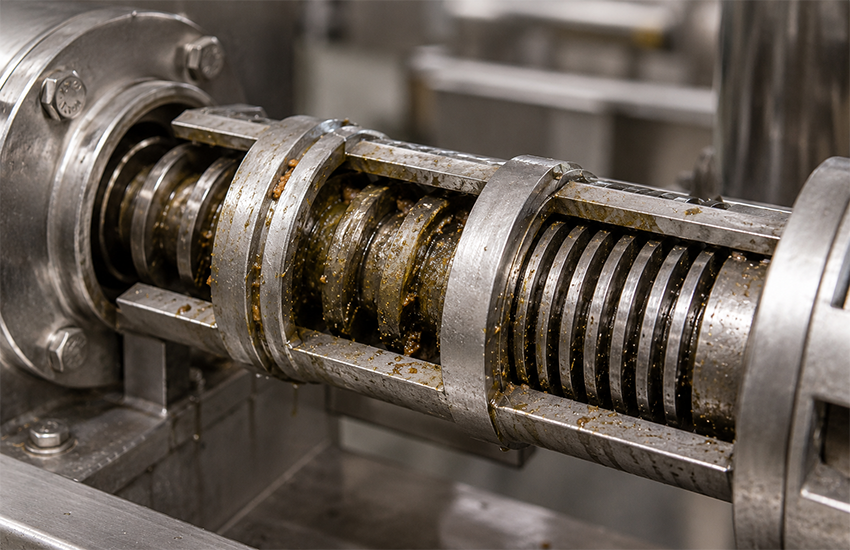
This is the most interesting layer, because it carries information about the process itself. As the screw moves material towards the nozzle, the seed is simultaneously crushed, sheared and forced through a narrowing space. The result is a continuous broadband hiss - something between a rustle and coarse friction - whose intensity rises with the degree of compression.
In a well-running press this sound is even and dense. It has no pronounced peaks, it does not pulse, and it does not rise and fall in waves. That evenness is in practice the best confirmation that the material in the chamber is forming a stable plug and that pressure is distributing predictably along the working assembly.
In designs with multi-stage pressing, where the material passes through zones of progressively smaller cross-section, the layer is richer. Each stage has a slightly different signature, and the ear gradually learns to distinguish them - you can hear that the material is already compressed before it reaches the nozzle.
Nozzle and press cake - the most eloquent part of the acoustic picture
The most revealing events happen at the outlet. Press cake leaving the nozzle does not flow out - it breaks off. The compressed cake fractures under its own internal stress, detaches in fragments and falls. Each fracture is a short, dry crack, perfectly audible against the continuous hiss.
The rhythm and timbre of those cracks carry a surprising amount of information. Regular, small, frequent cracks usually indicate correct seed moisture and an appropriately set nozzle clearance. Infrequent, loud fractures suggest the cake is leaving in oversized, hard pieces - most often with over-dry seed or an over-tightened nozzle. Soft, damp slaps without a distinct crack point to the opposite problem: too much water in the material, which never reaches full compression in the chamber.
The sound of the oil itself is a separate matter. On a well-running press, oil seeps through the cage slots almost silently, and the only audible thing is the drip and stream falling into the receiver. If hissing or bubbling appears, however, it means water vapour is escaping through the slots along with the oil - and that is information about temperature and moisture worth taking seriously.

The acoustic map of a single pressing run
Sound in a press room is not constant over time. A working day has its own dramaturgy, which can be described in stages. Knowing them helps separate normal change from cause for concern.
Dry start-up
A press started without material sounds nothing like a press under load. What you hear is essentially the motor, the gearbox and the screw turning in an empty chamber. The sound is metallic, fairly high, and lacking depth. This is a good moment for mechanical diagnostics, because nothing is masking possible knocks, grinding or bearing irregularities.
It is worth building the habit of listening to the press for ten or fifteen seconds at this stage, before the first handful of seed reaches the hopper. It is a brief window, and it yields information that cannot be recovered later from underneath the pressing hiss.
First seed in the hopper
The moment material enters the chamber is instantly audible. The pitch drops, roughness appears, and the motor visibly takes up load. For the first tens of seconds the sound is still unstable, because the material plug is only just forming inside the chamber.
This is the stage where transient noises most often show up - isolated crunches, brief squeals, uneven hiss. In themselves they are not alarming. What is alarming is when they persist after two or three minutes of running and the sound never settles into an even, dense hiss.
Steady running
This is the state in which the press should spend most of the day. It is characterised by an even pressing hiss, a constant motor tone, a regular rhythm of cake breaking away and calm oil flow. Everything sounds monotonous, and monotony is exactly the point.
It is worth memorising this sound as precisely as possible, because it becomes the reference for all further diagnostics. Many operators record it on a phone once a season, with a known raw material and known settings, and treat the recording as a baseline.
Shutting down and emptying the chamber
The end of a run has its own acoustics. Once feeding stops, the chamber gradually empties, the pitch returns towards the no-load signature, and the cake cracks become rarer and quieter. This is a moment when things become audible that were not audible before.
If metallic grinding or irregularity appears during emptying that was absent at dry start-up, it is a sign that something changed during the working day - most often residual material sitting where it should not, or a working component beginning to show wear.
Sounds that warn
The practical value of listening lies in recognising departures from normal. Below are the most common categories of sound that should attract attention in a press room - with the caveat that every machine has its own character, and the final interpretation always has to be adjusted to the specific unit.
Squeals and whistles
A high, piercing sound appearing during operation almost always means friction where there should be none, or flow through an excessively narrow gap. In the first case the source tends to be a working component contacting the housing; in the second, material forcing its way through an over-tightened nozzle.
Characteristically, squeals are rarely constant. They usually rise and fade, which is itself a clue - the variability suggests the cause depends on the momentary state of material in the chamber rather than on permanent mechanical damage.
Crunches and knocks
A single loud, hard impact during otherwise even running is one of the few sounds that justifies stopping the machine immediately. The most common cause is a foreign object that entered the hopper with the raw material - a stone, a fragment of metal, a piece of wood from transport. Oilseeds are rarely perfectly clean, and a screw press is not a machine that tolerates such contaminants without consequence.
This is also the strongest argument for careful cleaning and screening of the raw material before pressing. Sound warns, but it warns at the moment something is already happening - better not to let it get that far.
Growing rumble and vibration
Low-frequency rumble that was not there before and gradually intensifies usually points to a problem with balance, mounting or the way the machine is seated. A press with a body mass in the hundreds of kilograms, standing on uneven ground or on a floor of insufficient stiffness, can set an entire room vibrating.
The phenomenon can be misleading, because its intensity depends on room acoustics rather than machine condition. The same press on a concrete slab and on a timber floor will sound entirely different. It is worth remembering that before treating rumble as a symptom of a fault.
Silence where there should be hiss
The hardest signal to notice is the absence of sound. If the pressing hiss weakens while material is still being fed, it most often means the material has stopped being moved effectively - the chamber is not building pressure, the seed is rotating with the screw instead of advancing, or the hopper has bridged over.
A press going quiet under a full hopper is always a call to intervene. Continuing to run in that state overheats the material in the chamber and degrades oil quality very quickly.

Why every seed sounds different
One of the more surprising discoveries in a press room is that changing the raw material alters the sound of the machine more than changing most settings does. The reason is simple: seeds differ in hull hardness, oil content, size, shape and behaviour under pressure.
Rapeseed
Small, spherical, with a relatively thin hull and high fat content. It sounds smooth - the hiss is even, dense, free of sharp components. The cake leaves in small, regular fragments, giving a characteristically fast crack rhythm. Acoustically this is a good reference material, because its sound is exceptionally repeatable.
Flax and camelina
Flax seeds are slippery and tend to form a mucilaginous layer on contact with moisture, which changes the way material advances through the chamber. The sound is correspondingly more variable - smoother in places, almost sliding in others. Flax cake often leaves in larger, more cohesive pieces, so the cracks are rarer and deeper.
Sunflower with hull
The loudest of the common raw materials. The hull is hard and fibrous, and crushing it produces a pronounced crunch that dominates the pressing hiss itself. Running on sunflower sounds coarse and uneven, which can be misleading on first encounter - it is easy to mistake normal operation for a symptom of trouble.
Pumpkin, nuts and hemp
Pumpkin seed, because of its size and structure, produces sound with noticeably larger acoustic grain - you can hear individual seeds entering the compression zone. Nuts, high in fat and soft in structure, sound surprisingly quiet and smooth. Hemp sits somewhere between, with a clear component from the shell.
The practical conclusion is that there is no single template for the sound of correct operation. There is a template for a specific machine running a specific raw material at specific settings - and that combination is what has to be committed to memory.
The physics behind it
For completeness it helps to know where each component of the sound originates, because that turns intuition into knowledge.
The primary mechanism is dry friction and the associated phenomenon of sticking and slipping. Material in the chamber does not advance smoothly - it alternately adheres to and releases from the steel surface, thousands of times a second, on a microscopic scale. The sum of those events creates broadband noise, in much the same way as chalk squeaking on a board, only with a completely different frequency signature.
The second mechanism is brittle fracture. The seed coat, the compressed cake and hard structural fragments break suddenly, releasing energy as short impulses. These produce every crack and crunch. Their spectrum is broad and their duration very short, which makes them easy to identify against the continuous hiss.
The third is structural resonance. The housing, guards and frame are not acoustically neutral - they amplify some frequencies and damp others. This is why two identical presses installed in different rooms can sound noticeably different even though the processes inside the chamber are identical. Stainless steel components have a different signature from powder-coated parts, which also shapes the perceived sound.
The fourth, often overlooked, is flow. Oil forcing its way through the cage slots, water vapour escaping the chamber and air drawn in with the raw material all create flow-type sounds - hissing, rustling, bubbling. This group carries the most information about moisture and temperature.
The operator's ear versus instruments
The natural question is: if sound carries so much information, why not measure it with instruments? The answer is that you can, but it is not always worth it.
The simplest tool is a phone with a spectrum analyser app. It shows how acoustic energy is distributed across frequency bands and lets you compare today's recording with one from a month ago. For catching slow changes - the kind the ear misses because they happen gradually - it is a surprisingly effective instrument.
The second is an ordinary mechanic's stethoscope, or a long screwdriver held against the housing. It lets you listen to a specific point on the structure while excluding ambient noise. This method has centuries of tradition in machine diagnostics and still has no good substitute when it comes to locating a noise source.
The third is simply systematic recording. A short twenty-second clip taken always from the same spot, with the same raw material, at the start and end of each season, builds an archive over time that says more about the machine than any single measurement.
One important caveat, though: instruments do not replace attention. Spectrum analysis will show that something has changed, but not what it means. Interpretation still belongs to the person who knows their machine and their raw material.
Building your own ear for the press room
The skill described here is not innate and does not require a musical ear. It does require consistency.
The starting point is establishing a baseline. Through the first season it is enough to listen deliberately at every start-up and note how the press sounds with each raw material and each setting. The notes can be very simple - a few words of description plus the working conditions. After a dozen or so entries, patterns start to emerge.
The second step is deliberately inducing change. It is worth listening once, under controlled conditions, to how the press sounds with a slightly looser nozzle, slightly damper seed, slower feeding. That way, when the same situation arises by accident during normal work, the sound will already be familiar.
The third is patience. Recognising subtle differences requires exposure, and exposure takes time. After two or three seasons most people working regularly at a press can assess its state by ear faster than they can look at the indicators.
It is also worth listening to other people's machines. A short visit to another press room teaches more than a week at your own, because it lets you hear how the same process sounds in a different design and a different building.
Room acoustics, the part that gets forgotten
The sound we hear originates in the machine but reaches us through the room. Hard walls, a concrete floor and a high ceiling create strong reverberation that blurs detail and makes everything sound louder and less distinct. A room with timber elements, sacks of raw material along the walls and a lower ceiling absorbs more and lets the nuances through.
This has practical consequences. If we want to use hearing as a diagnostic tool, it is worth keeping the listening position fixed - always listening from the same place and the same distance. Moving two metres can change the perceived sound more than a real change in machine behaviour.
The second consequence concerns health. Continuous work beside a machine of several kilowatts, in a room with hard surfaces, means hours of noise exposure. Hearing protection is obvious here, but it is worth choosing protectors that attenuate evenly across the spectrum rather than only the high frequencies - otherwise you lose exactly the part of the information that is diagnostically most valuable. A good compromise is working in protectors and removing them for short, deliberate listening checks.
The third concerns comfort. A press room where people can talk without raising their voices is simply a better place to work. Simple measures - a mat under the machine, absorption on the wall behind the press, separating the bottling area from the pressing area - improve both comfort and the ability to catch unusual sounds.
A press that sounds predictable
From an acoustic standpoint, the best quality a machine can have is repeatability. A design that sounds the same every time at the same settings with the same raw material is simply easier to run - because any departure from normal immediately catches the ear.
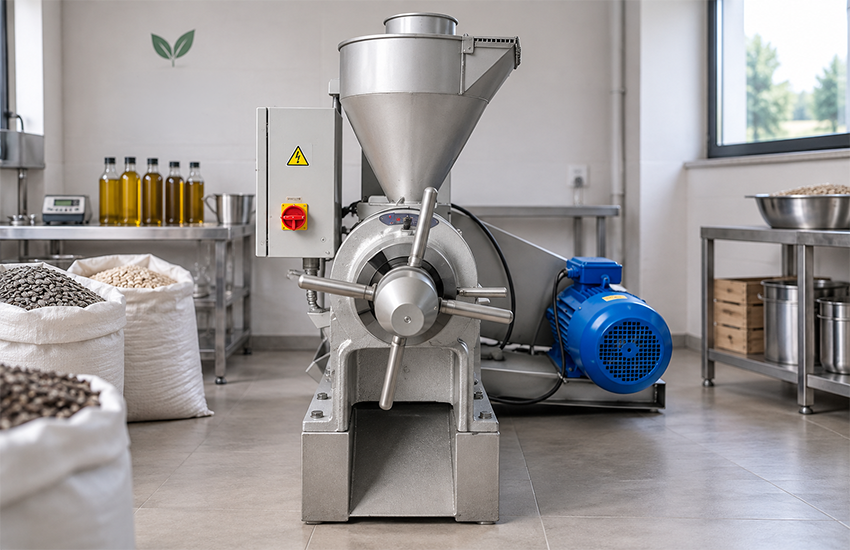
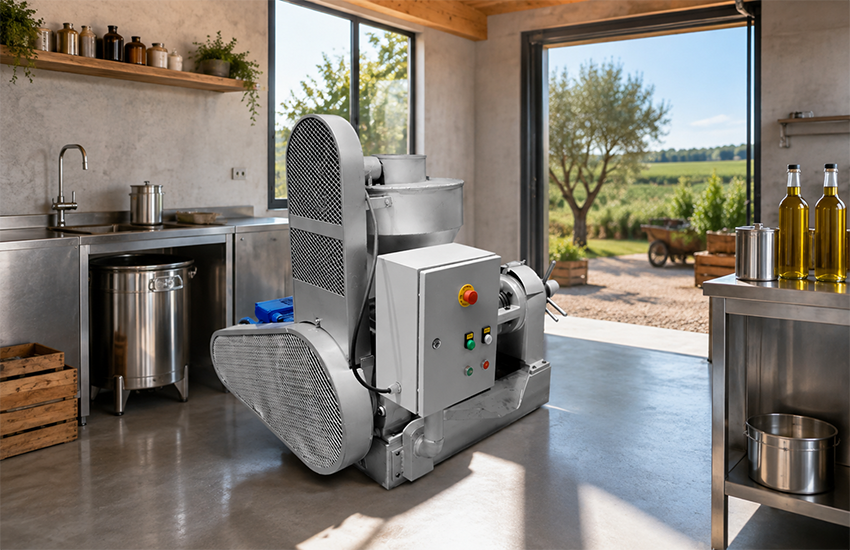
A workshop-class machine built for continuous operation illustrates this well. The screw oil press with a capacity of 2.6 - 3 tonnes per 24 hours is the YZYX90-2 model, driven by a 5.5 kW motor on a 400 V 50 Hz supply, with a press body weighing 285 kg and three-stage pressing. Each of those parameters translates into sound. Body mass damps vibration and limits structural resonance. Three-stage pressing spreads compression across successive zones, so the hiss is more uniform and less prone to abrupt load spikes. A motor rated for continuous duty holds a stable speed, and that in turn stabilises the background tone against which everything else is heard.
The stated oil residue in the cake of up to 8 percent also matters practically. It indicates the machine works in a relatively intensive compression regime - and that regime produces the clearest outlet acoustics, with a regular, fine rhythm of cake breaking away. The stainless steel drip tray and chamber cover, in turn, influence how sound escapes from the machine into the room.
If the scale of production is smaller but the same running consistency is wanted, it is worth considering the smaller screw press rated at 1.4 - 2 tonnes per 24 hours, which keeps the same design logic at a lower noise level and with less demanding floor requirements. In both cases the principle holds: the more predictable the machine, the more its sound has to say.
When sound lies
Honesty requires acknowledging that hearing can be unreliable - and it is worth knowing when.
First, the ear adapts. Changes that occur very slowly, over weeks, are practically invisible to us, because each time we compare today's sound with yesterday's rather than with the state at the start of the season. This is the main reason to record.
Second, fatigue and background noise alter perception. At the end of a long day we hear differently than in the morning. The same press may seem louder or rougher even though nothing about it has changed.
Third, expectations shape what we hear. If we expect a problem, we will find it in the sound. So with any serious doubt it is worth seeking independent confirmation - a temperature reading, an inspection of the cake, an assessment of the oil stream.
Fourth, some faults have no acoustic signature at all. Slow wear of working components or gradual changes in chamber geometry can go audibly unchanged for a long time while clearly affecting oil parameters. Hearing is an excellent early-warning tool, but it does not replace inspections.
Summary
Oil pressing is a process that takes place largely out of sight - inside a closed steel chamber that cannot be observed while it runs. Sound is one of the few channels through which information escapes that interior in real time, and it costs nothing at all.
Learning to listen to your own press requires no equipment and no special aptitude. It requires attention, notes and a few seasons of practice. In return it gives something no single sensor can provide - a whole-process feel for the state of the operation, working instantly and covering machine, raw material and working conditions at once.
Next time you start the press, try spending the first minute not looking at it, only listening. Surprisingly often it turns out we knew what was happening before we had a chance to see it.
Frequently Asked Questions
Should a screw press run loudly?
There is no single correct volume - there is a correct character. A properly running press produces an even, dense, monotonous sound in which you can hear a stable motor tone, a continuous pressing hiss and a regular rhythm of cake breaking away. Volume itself depends on raw material, design and room acoustics, so comparing your press to another machine in a different building means very little. The reference should be how this particular machine sounds with this particular raw material under normal conditions.
How can you tell by ear that the seed is too dry?
Over-dry material usually gives three signals at once. The pressing hiss becomes sharper and crunchier, the motor tone indicates a higher load, and the cake leaves less frequently in larger, harder fragments, producing louder cracks spaced further apart. A squeal may also appear as material is forced through too narrow a passage. Confirmation should always come from the cake itself - it should be cohesive rather than crumbling to dust.
What does hissing from around the cage mean?
Hissing or bubbling in the area where oil emerges most often indicates water vapour. It means the raw material contains more moisture than it should, or that chamber temperature has risen above the intended level. Both affect oil quality - water vapour accelerates oxidation and shortens shelf life. The sensible response is to stop, check seed moisture and let the machine cool before restarting.
Does every new sound mean a fault?
Definitely not. A great many acoustic changes have entirely harmless causes: a different batch of raw material, different moisture, a different ambient temperature, a change in nozzle setting, even something being moved in the room. The genuine alarm signals are sudden, hard sounds - a single loud impact, metallic grinding, an abrupt change in motor tone. Sounds that build gradually are worth watching but rarely require stopping the machine immediately.
Can a press be diagnosed from a phone recording?
To a limited extent yes, and the method is far more valuable than it might seem. A phone will not capture the full spectrum faithfully, but it is excellent for comparing recordings made under identical conditions. If a clip from the start of the season and one from last week differ clearly, that is information in itself, even without spectrum analysis. The key is keeping conditions constant: same spot, same distance, same raw material, same phase of operation.
Why does sunflower sound so much louder than rapeseed?
The hull is responsible. The sunflower seed coat is hard and fibrous, and it fractures brittly under compression, generating a great many short broadband impulses. Rapeseed, with its thin coat and small spherical shape, deforms in the chamber far more smoothly, which is why its sound is gentler. The difference is entirely normal and indicates no problem with either the machine or the material.
Is it worth wearing hearing protection if the point is to listen to the machine?
Yes, and there is no contradiction. Hearing protection is a priority during long hours near a machine of several kilowatts, and hearing loss is irreversible. The sensible arrangement is to work in protectors most of the time and take short, deliberate listening checks at key moments - at dry start-up, as the first material enters, and once running has stabilised. It also helps to choose protectors with a reasonably flat attenuation curve, since these distort the machine's acoustic picture less.