
Table of Contents
- The seed as a microscopic fat warehouse
- A short history of grinding - from querns to cast iron discs
- The physics of grinding - what actually happens to the seed
- Particle size and pressing yield
- Moisture - the hidden partner in grinding
- Grinding, flavour, colour and shelf life
- Seeds and their temperaments
- The other face of grinding - what happens after pressing
- Practice - setting up grinding in a small mill
- Curiosities worth knowing
- Grinding as a deliberate choice, not an intermediate step
- Frequently Asked Questions
Look at a handful of rapeseed, flax or pumpkin seeds and you see something that appears finished. Pour it into the hopper, start the press, wait for the oil. That instinct is broadly correct, but it skips over the most underrated variable in the whole process - the degree to which the material has been broken down before it enters the press. Particle size influences yield, colour, aroma and shelf life more powerfully than almost any other parameter discussed in small oil mills day to day.
The history of grinding oilseeds is far older than the history of the screw press. Long before anyone imagined a helical shaft turning inside a perforated barrel, people knew that a seed had to be destroyed before it would release its fat. Stone querns, mortars, edge runner mills turned by oxen - all of them served a single purpose: rupturing cell walls to free what the seed carefully hides. This article is about that invisible part of the process. The physics, the biology and the practice of comminution, and why a well-adjusted grinder is often as important to a small oil mill as the press itself.
The seed as a microscopic fat warehouse
To understand why particle size matters, it helps to look inside a seed. From the outside it looks like a uniform little pellet. In reality it is a densely packed cellular structure in which the oil is not lying loose but sealed inside thousands of microscopic containers.
Oleosomes - droplets wrapped in a membrane
In seed cells, fat accumulates in structures called oleosomes, also known as oil bodies. These are spherical, usually between half a micrometre and a few micrometres across, surrounded by a single layer of phospholipids studded with stabilising proteins. Their job is to protect the plant's energy reserve from oxidation and premature breakdown until germination. The plant, in other words, has built an outstanding packaging system - and at pressing time that system becomes our main adversary.
A single rapeseed weighing a few milligrams contains tens of thousands of cells, and each of those cells holds hundreds of oleosomes. The oil is dispersed throughout, not pooled in one reservoir. So the press is not performing one simple task of cracking a shell. It has to create conditions in which millions of tiny droplets merge into a continuous phase capable of flowing out through the drainage slots.
Why a whole seed resists the press
The cell wall of oil-bearing plants is built mainly from cellulose, hemicelluloses and pectins. It is a surprisingly tough material, especially when it holds a certain amount of water, which makes it elastic rather than brittle. Pressing whole seeds ruptures some cells under pressure, but a substantial share merely deforms. The oil stays locked in and leaves the press inside the cake.
There is a second problem: distance. Even when a cell bursts deep inside a large seed fragment, the droplet still has to force its way through neighbouring, intact layers of tissue to reach the surface. The longer that path, the greater the resistance and the higher the chance the oil is simply adsorbed onto the surrounding solids. Grinding shortens the path - and that is its fundamental role.
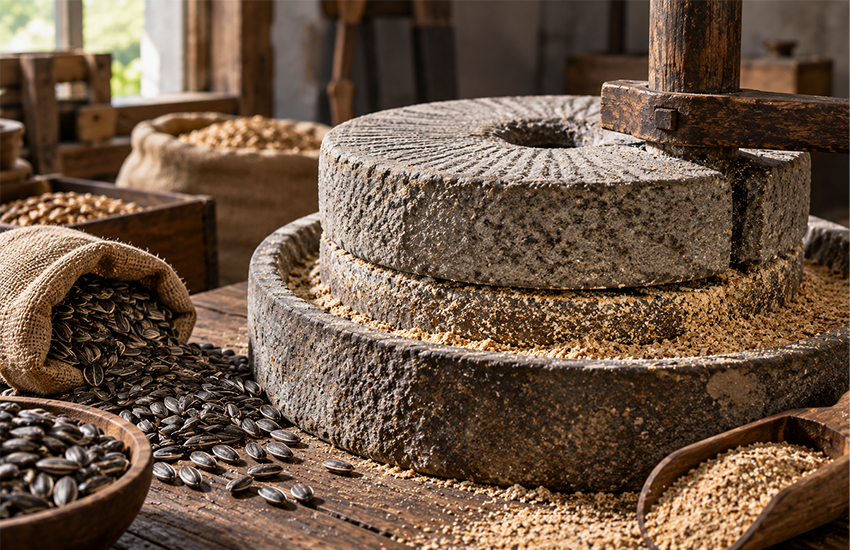
A short history of grinding - from querns to cast iron discs
Breaking down oilseeds is one of the oldest technological operations in human history. Older than industrial-scale flour milling, and probably as old as the cultivation of oil crops themselves.
The stone that was the first oil mill machine
The earliest tools were flat stones with a hollow, plus a pestle. Seeds were ground by hand into a fatty paste, which was then warmed and squeezed through cloth. Finds from the Near East, Egypt and the Mediterranean basin show that this sequence - grind, warm, press - was repeated almost identically in cultures thousands of kilometres apart. Nobody knew the word oleosome, but everyone knew from experience that the more thoroughly the paste was worked, the more oil would flow.
Worth noting: ancient processors were not aiming for a powder. Too fine a paste clogged the cloth and blocked drainage. What emerged was an empirical optimum, refined across generations of observation - precisely the same optimum we now look for with laboratory sieves and microscopes.
Edge runner mills and the age of the rolling stone
The next step was the edge runner, also called a kollergang: a vertical stone wheel rolling around a circular bed. Powered first by animals, later by water, finally by an electric motor, it dominated European oil mills for centuries. Its advantage was that it did not so much grind as knead and smear the material, combining size reduction with a degree of oil release already at the preparation stage.
This working method had an interesting sensory consequence. Stone runs slowly and generates comparatively little localised heat, so the mass does not spike in temperature. Many traditional mills, particularly around the Mediterranean, still deliberately keep stone edge runners, arguing that they give oils a gentler, less aggressive flavour profile. In olive oil the effect is especially well documented and relates to the rate at which phenolic compounds are released.
Rollers, hammers and discs - the age of mechanisation
Industrialisation brought roller mills, in which seeds pass through the gap between rotating cylinders. Rollers do not so much crush as flatten, turning a seed into a thin flake with a large surface area and a very short diffusion path for the oil. This remains standard in large rapeseed and soybean plants from Germany to Ukraine.
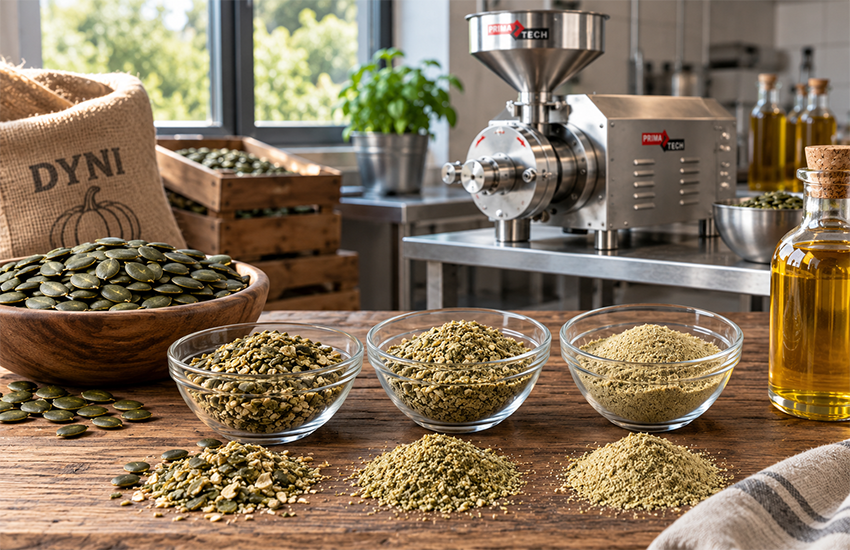
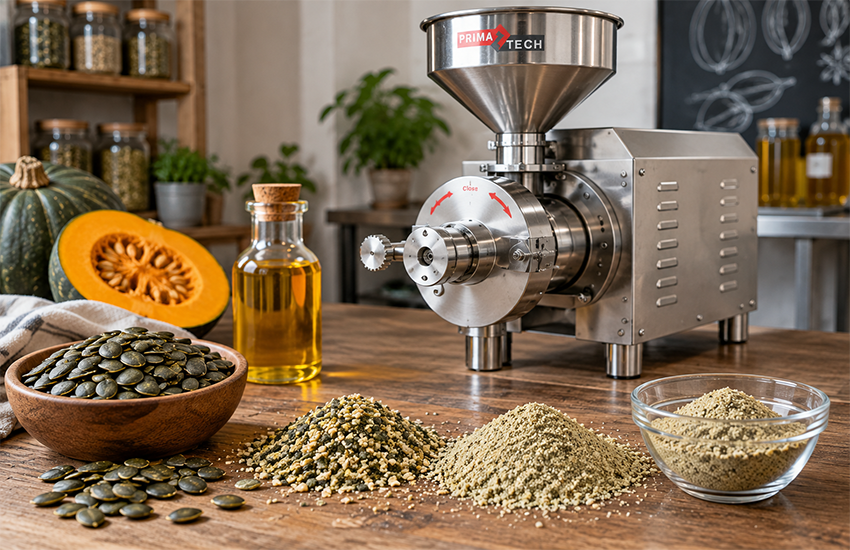
In parallel came hammer mills, where material is shattered by freely swinging beaters, and disc or burr mills, where grain is abraded between two plates. The latter proved especially versatile at small scale. A design with cast iron grinding discs and an adjustable gap lets a single machine handle both hard cereal grain and sticky, fat-laden press cake - which in a small mill matters enormously in practice.
The physics of grinding - what actually happens to the seed
Grinding looks like a brutal, unsubtle operation. In fact it is one of the best-described and simultaneously least predictable processes in food technology.
Energy, surface area and the laws of comminution
The basic principle is that reducing a particle means creating new surface, and creating surface costs energy. The classic comminution laws - Rittinger, Kick and Bond - describe this in different ways, but all lead to the same conclusion: energy cost rises non-linearly as particles get smaller. Splitting a seed in half is cheap. Grinding the halves down to a few hundred microns costs many times more. Going below a hundred microns can cost more than every earlier stage combined.
For an oil mill this has a concrete meaning. Specific surface area - the total surface of all particles in a kilogram of material - climbs sharply with fine grinding. Halve the particle size and you roughly double the surface area. That is simultaneously an advantage and a hazard, as we will see.
The heat nobody sees
A large share of the energy delivered to a grinder does not become new surface; it becomes heat. In typical comminution systems the energy efficiency, measured as the ratio of energy spent creating surface to energy drawn by the motor, is remarkably low. The rest dissipates as friction, vibration and rising material temperature.
This is why mills working to a cold-pressed standard treat grinding as a critical control point. Seed can enter the grinder at room temperature and leave it noticeably warmer, especially at fine settings during long continuous runs. If we are watching a temperature threshold in cold-pressed oil, it is worth remembering that the clock starts at the grinding discs, not in the press barrel. Short breaks in operation, cooling the material before pressing, and avoiding an unnecessarily tight gap are the simplest ways to limit the effect.
Brittleness and plasticity - why not every seed grinds the same way
Materials grind well when they are brittle. Brittleness means that under load the material fractures rather than deforms. Dry cereal grain is brittle. An oilseed with high fat content and elevated moisture is not.
High oil content makes material behave plastically. Instead of fracturing, it smears and sticks to working surfaces. Anyone who has tried to finely grind a walnut or fresh black cumin cake knows the outcome: instead of flour you get a fatty paste that coats the discs and blocks the outlet. So with very oily seeds, grinding is normally run more gently, at a coarser setting, with the material chilled beforehand. Lowering the temperature raises the viscosity of the oil and restores some brittleness - a simple but highly effective trick.
Particle size and pressing yield
Now to the heart of it. How does particle size translate into the amount of oil leaving the press? The relationship is not linear and has a clear maximum, whose position depends on the raw material and the press design.
Too coarse - the oil that stays inside
With oversized particles the problem is obvious. Many cells stay intact, and oil from those that did rupture has a long journey through surrounding tissue. The cake leaving the press feels damp to the touch and greasy inside, and breaking it open reveals a darker, saturated core. This is the single most common cause of disappointing yields in small mills - and it is easier to diagnose by looking at the cake than by analysing the press.
Coarse material also changes how the screw works. The mass compacts poorly, slips against the barrel wall, and pressure builds unevenly in the pressing zone. The result is often a pulsing, irregular oil flow.
Too fine - when the mass stops working
Instinct suggests that if finer is better, finest must be best. Practice says the opposite. Below a certain threshold the material starts behaving like a dense, plastic mass with no channels to carry oil away. Particles pack tightly, fill every void and seal the system. Instead of flowing along drainage gaps, the oil is pushed in all directions along with the solids.
On top of that, very fine fractions pass straight through the drainage slots and land in the tank as sediment. The oil comes out cloudy, needs longer settling, and yield measured after filtration falls even though the flow from the press looked generous. In extreme cases the fine dust blinds the slots, pressure spikes, and the press starts to overheat.
The sweet spot and the role of particle size distribution
The optimum usually sits where the material is clearly broken down but still free-flowing and gritty to the touch, rather than dusty or pasty. Importantly, it is not only the average particle size that counts, but the spread. Material with a narrow distribution, made up of similarly sized particles, keeps voids between them through which oil can escape. Material with a wide distribution, where fines fill the gaps between coarse fragments, packs far more densely.
This is why two batches with identical average particle size can behave completely differently in the press. A grinder with a stable, repeatable working characteristic is therefore more valuable than one that produces a pleasing average alongside a large share of both dust and coarse chips. Gap adjustment and the condition of the grinding surfaces are decisive here.
Moisture - the hidden partner in grinding
You cannot discuss grinding in isolation from water. Moisture content simultaneously changes how readily seed breaks down and how the material behaves in the press.
Seed that is too moist is elastic. It does not fracture, it deforms, sticks to the discs and clumps. In the press it forms a mass that compacts poorly, while the excess water lowers effective pressure and encourages the oil to emulsify. The result is cloudy oil with heavy sediment and a cake with an unpleasant, clay-like consistency.
Over-dried seed, by contrast, is excessively brittle. It shatters into a large volume of dust, and in the press the mass lacks the cohesion needed to build pressure. The cake crumbles and falls out too freely, and the oil carries a lot of fine particles with it.
Optimal moisture ranges differ between species, but in the practice of a small mill the most important thing is repeatability. Raw material stored in stable conditions, with similar moisture batch to batch, lets you set the machine once and return to those settings without constant experimentation. A change in weather, an aired storeroom or a purchase from a new supplier is a far more common cause of a sudden drop in results than any machine fault.
Grinding, flavour, colour and shelf life
Particle size is not only a question of yield. It is one of the main forces shaping the sensory profile of an oil - often more influential than seed variety.
Surface area in contact with oxygen
An intact seed is almost perfectly protected against oxidation. Grinding reverses that situation in seconds. Material that had a few square centimetres of external surface per handful can, once ground, have many times more. All the oil that was shielded by membranes and cell walls suddenly has access to air.
The consequence is simple: ground material ages far faster than whole seed. Grinding in advance, days before pressing, is one of the most frequent and most costly mistakes in small mills. Oil pressed from material that sat in an open sack is noticeably less fresh on the nose, and its shelf life shortens before bottling even begins. The rule is straightforward - grind immediately before pressing, in quantities matched to current output.
Enzymes that wake up when a cell is cut open
Seeds contain enzymes that, in intact tissue, are physically separated from their substrates. Grinding removes that separation and triggers reactions which barely occur in a whole seed. Lipases begin breaking fats down into free fatty acids, lipoxygenases initiate oxidation of polyunsaturated fatty acids, and in brassica seeds myrosinase acts on glucosinolates to form compounds with a sharp, distinctive aroma.
These reactions account for a large part of the character of freshly pressed oil - both the qualities we want, such as the green bite of linseed oil or the peppery edge of rapeseed oil, and the faults that appear when ground material is held too long. The interval between grinding and pressing is therefore a genuine technological tool. Shorten it and the oil comes out milder and cleaner. Extend it and it becomes sharper, but also less stable.
Colour as a by-product of grinding
Particle size also affects colour intensity. Finer material releases more pigment from the covering tissues, including chlorophylls and carotenoids. Oil from finely ground seed tends to be darker and more saturated, which some see as a virtue and others as a flaw, depending on whether the range values delicacy or boldness. It is one of those parameters a mill can steer deliberately rather than accept as given.
Seeds and their temperaments
Every raw material has its own requirements and its own traps. Here are some of the most common in central and northern European mills.
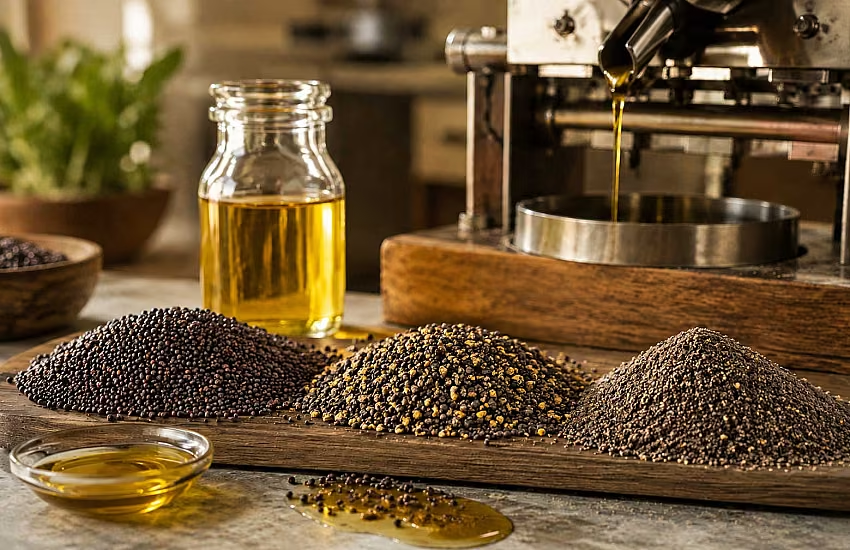
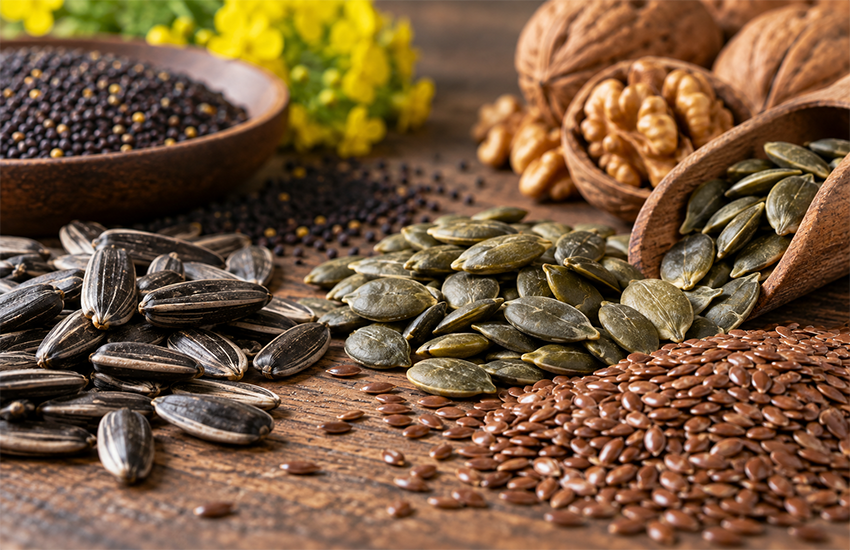
Rapeseed is a relatively forgiving material. Small, hard seeds break down readily and stay free-flowing at the right moisture. Their small size does mean, though, that some of the batch can pass through the grinder unchanged if the gap is set too wide. Checking whether the ground mass still contains whole, glossy seeds is the simplest quality test there is.
Flax demands noticeably more care. The high mucilage content in the seed coat means the material starts to stick as soon as it meets moisture. Grinding flax too finely produces a mass that behaves unpredictably in the press and readily seals the system.
Sunflower behaves very differently depending on whether you press hulled kernels or whole seed. The hull acts as a natural drainage aid, improving oil flow, but it also abrades working surfaces and increases the load of solids in the oil. Particle size for the two variants is chosen along entirely different lines.
Pumpkin, especially hull-less varieties, is high in fat and strongly inclined to compact into a paste. Chilling and a coarser grinder setting help here.
Hemp and sesame have small seeds and high oil content, so they turn pasty quickly. Black cumin can be awkward because of its essential oils, which alter the behaviour of the mass and release intensely during grinding itself.
Nuts - walnuts, hazelnuts, almonds - are a category of their own. With fat content above half their mass, any overly vigorous treatment turns them into butter. Grinding here is very gentle, often limited to breaking the kernel into a few fragments.
The other face of grinding - what happens after pressing
A detail that often escapes people starting out with their own oil is that grinding appears twice in a mill. Once before the press, when preparing the seed. And again after it, when hot, compacted cake emerges from the barrel.
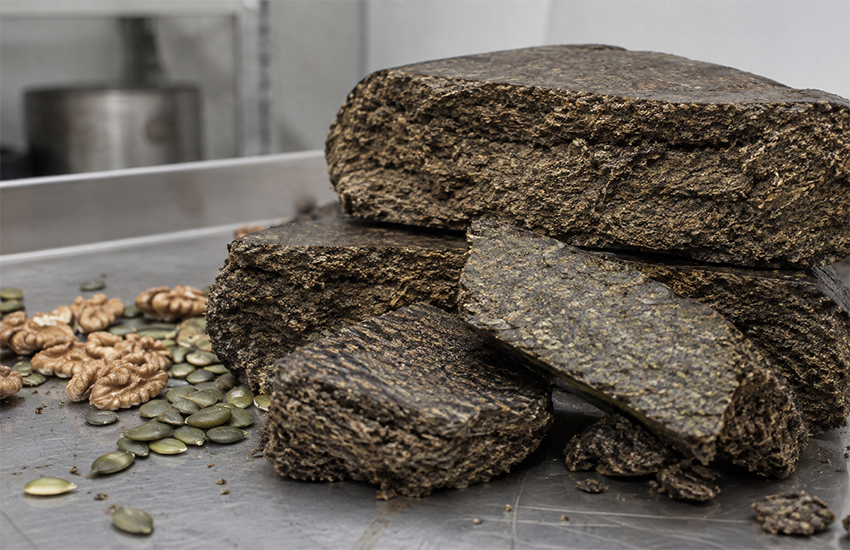
Cake leaving the press is hard, irregular and practically useless in that form for anything beyond animal feed. Only grinding turns it into a product: baking flour, a coarser meal for muesli, a topping, an ingredient in blends. Same raw material, but depending on the grinder setting it becomes something entirely different. In small-scale production, a machine that handles both roles works well - for example the multifunctional seed, grain and oil cake grinder rated at 30-40 kg/h, fitted with cast iron grinding discs and an adjustable particle size range of roughly 60 to 200 microns. A 2.2 kW drive on a single-phase 230 V supply means it fits into an ordinary farm building or workshop back room, while a weight of around 42 kg and dimensions of 60 x 29 x 45 cm let it stand beside the press without rebuilding the workstation.
It is worth remembering that cake grinds differently from seed. Fresh, warm cake still holds a fair amount of residual oil and stays plastic, so it readily coats working surfaces. Cooled, and ideally lightly dried, it crumbles far more easily and yields a cleaner, more uniform fraction. That one simple observation - wait until it cools - saves an enormous amount of cleaning time.
If a mill works mainly with oilseeds and wants a station dedicated purely to seed preparation ahead of the press, it often makes sense to split the two jobs and add a dedicated oilseed grinder. Two machines with distinct purposes remove the need to constantly reset the gap and clean between stages, and they also reduce the risk of carrying aromas from one raw material into the next.
Practice - setting up grinding in a small mill
Theory is interesting, but the real value appears when it translates into specific actions at the machine.
A test you can run without a laboratory
You do not need a particle size analyser to judge grind quality. A handful of ground material and a moment's attention will do. Spread on a light surface, it should be clearly irregular in shape but similar in size. There should be no whole seeds and no visible airborne dust.
The second test is to squeeze a handful. Well-ground material forms a loose clump that falls apart when you open your hand. Material that is too fine or too moist forms a dense, plastic ball that holds together. Material that is too coarse will not bind at all.
The third signal comes from the press itself. A steady, continuous stream of oil, a consistent cake with a repeatable shape and no fluctuation in motor load is the best confirmation that particle size is right. Sudden pulsing, a rising barrel temperature or a change in cake colour almost always originate earlier, at the preparation stage.
The condition of the grinding surfaces
Grinding discs wear, and they wear imperceptibly. The surface gradually smooths, which means that at the same dial position the material comes out coarser, spends longer in the grinding zone and heats up more. Mills that run the same settings for years often fail to notice that they are slowly drifting away from the optimum.
It is worth treating a disc change as routine rather than a repair. Regular inspection of the working surfaces and cleaning after every batch of fatty material take a few minutes and protect against a slow erosion of quality.
Records instead of memory
The last piece of advice is the least glamorous and the most useful. Write down the grind setting, raw material moisture, ambient temperature and the pressing result. After a few seasons this becomes a private knowledge base that lets you return quickly to the right parameters with any new raw material. Mills that keep such notes handle unusual seed batches incomparably better than those starting from scratch every time.
Curiosities worth knowing
Grinding hides a few phenomena that sound surprising but rest on solid ground.
The first is that some technologies deliberately add drainage material to the ground mass - hulls, chaff, or a coarser fraction of the same raw material. The aim is to create channels in the pressed mass through which oil can escape. It is a centuries-old approach, used among other things with very fatty, sticky seeds.
The second is counter-intuitive: in some cases excessive grinding increases the amount of oil left in the cake. The reason is adsorption. The larger the particle surface, the more oil remains bound to it by surface forces, regardless of applied pressure. There is a limit beyond which finer grinding works against us.
The third is electrostatic charge. Very fine, dry fractions can pick up a charge during grinding and cling to hopper and container walls. At small scale this is mainly a cleaning nuisance, but in larger installations it is a design parameter for material handling.
And finally a historical note: in many traditional oil mills, grind quality was judged not by eye but by ear. An experienced miller could tell from the sound of the edge runner whether the mass had reached the right consistency. That method, hard as it is to quantify, was remarkably effective - and to this day anyone who works long enough beside one machine picks up by ear the moment something starts behaving differently.
Grinding as a deliberate choice, not an intermediate step
The biggest shift in thinking about grinding is moving it out of the category of preparatory chores and into the category of technological decisions. The grinder setting is not merely a precondition for the press to start work. It is a choice that determines how much oil you get, how it smells, how it looks in the bottle and how long it stays fresh.
A mill that can steer particle size deliberately holds a tool for building its own recognisable product style. It can decide that its oil should be lighter and gentler, and work consistently at a coarser grind with a short interval between grinding and pressing. It can equally go for boldness and depth of colour. Both routes are legitimate - but only when they result from a decision rather than an accident.
A seed defends its oil with surprising effectiveness. It has built a multi-layered security system, refined over millions of years of evolution. Grinding is our way of persuading it to cooperate - and the better we understand what happens in that brief moment between the hopper and the press, the more the process is able to give us.
Frequently Asked Questions
Does every seed need grinding before pressing?
No, and this is a common misconception. Many small screw presses are designed to work with whole seeds, with the screw performing partial size reduction in the feed zone. This applies especially to small seeds such as rapeseed, flax and sesame. Grinding becomes important with large, hard raw materials, with seeds in a thick coat, and whenever maximum use of the raw material is the goal. Always check the recommendations for your specific press, because feeding overly fine material into a machine designed for whole seed can disrupt pressure build-up.
How can I tell the material has been ground too finely?
The clearest signal is how the mass behaves in your hand - material that is too fine forms a dense, plastic ball that will not fall apart when you relax your grip. The second signal is the appearance of the oil leaving the press: very cloudy oil, thick with suspended solids, forming an unusually deep layer of sediment after a dozen or so hours of settling, points to an excess of fines. The third signal is the press itself - rising barrel temperature, a less fluid flow, and cake emerging as a dense, tight mass rather than loose fragments.
Does grinding raise the temperature of cold-pressed oil?
Yes, and this is often overlooked. Most of the energy delivered by the grinder motor converts to heat, and material leaving the grinding zone can be noticeably warmer than it was on entry. The effect intensifies with fine settings, long continuous runs and worn grinding surfaces. If keeping the whole process at low temperature matters to you, grind in batches, give the machine breaks, chill the raw material beforehand, and do not go finer than necessary.
How long can pass between grinding and pressing?
The less, the better. Ground material has many times more surface in contact with air, and the enzymes released begin work immediately. In practice the best results come from grinding directly before pressing, in quantities matched to the press's current throughput. Holding ground mass for many hours, let alone days, clearly degrades the aroma of the oil and shortens its shelf life, even if the material itself looks unchanged.
Does press cake grind the same way as seed?
No. Cake has a different structure and a different fat content, and its behaviour additionally depends on temperature and moisture. Fresh, warm cake is plastic and readily coats working surfaces, so it is worth waiting until it cools, and with very oily raw materials also drying it slightly before grinding. Cooled cake crumbles far more easily and delivers a cleaner, more repeatable fraction - from fine flour to coarser flakes.
Does grind setting affect the taste of the oil?
It does, more than most people assume. Finer grinding releases more compounds from the covering tissues and intensifies enzymatic reactions, giving a bolder, sharper and usually darker oil. Coarser grinding leads to a milder, lighter product. Neither path is inherently better - it is a tool for building your own repeatable sensory profile, provided the parameters are controlled and recorded.
How often should grinding discs be replaced?
There is no single answer, because the rate of wear depends on the raw material, the presence of mineral contamination and how hard the machine is worked. Hard grain carrying a little sand wears working surfaces incomparably faster than soft press cake. A better criterion than the calendar is observation: if at the same setting the material comes out noticeably coarser, grinding takes longer and the machine runs hotter, that is the signal to replace. It is worth keeping a spare set of discs on hand so a replacement does not mean downtime mid-season.