
Table of Contents
- The cold start - when the press is not yet itself
- The physics of reaching thermal equilibrium
- What happens to the oil during warm-up
- The rhythm of the day and the rhythm of the season
- Continuous operation as a route to stability
- Managing start-up to shorten the transitional phase
- The end of the day - cooling and the last litres
- What the warm-up curve teaches
- Frequently Asked Questions
Anyone who has spent a full day beside a running screw press knows the feeling. In the morning everything seems slightly reluctant. Seed moves down more slowly, oil runs lazily, and the press cake looks different from yesterday at the same hour. After an hour things settle. After two, the machine runs so evenly that you can almost forget about it. Then, towards evening, something shifts again - subtly, but noticeably. Same raw material, same settings, same person at the hopper, and yet every working day has its own curve.
This is not imagination or mood. An oil press is a thermal machine to a far greater extent than its appearance suggests. Before it reaches the point where parameters stop drifting, it has to pass through a transitional phase in which every component heats up at a different rate. That phase is exactly why the first litres of the day have a different colour, a different aroma and a different density from litres pressed three hours later. It is worth understanding, because it is one of the most common causes of batch-to-batch variation - and one of the easiest to bring under control.
The cold start - when the press is not yet itself
Metal that has only just begun to work
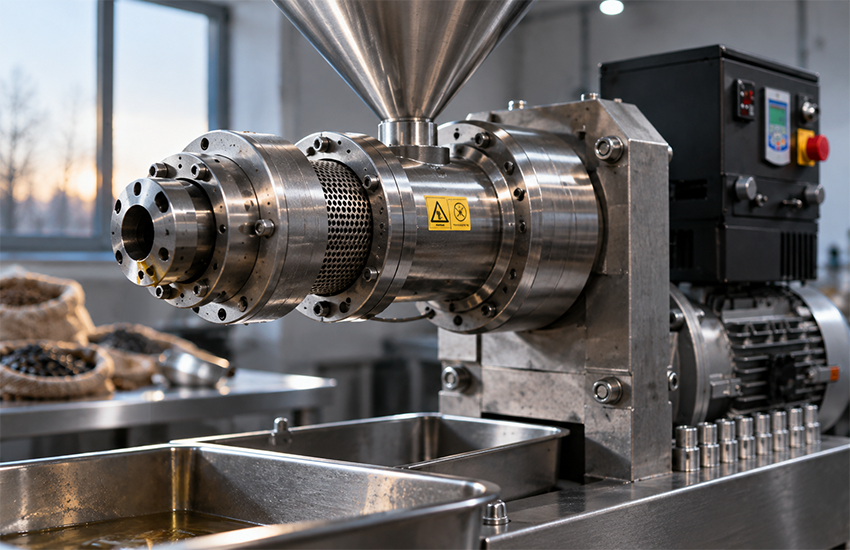
A screw press at rest sits at room temperature. If it stands in an unheated hall, a November morning might mean ten degrees, sometimes less. The entire mass of steel - body, head, screw, nozzle, strainer - acts as an enormous heat reservoir that has to be filled before the process starts behaving predictably.
The scale of this is easy to underestimate. Professional industrial units weigh anything from several dozen to several hundred kilograms, and a large share of that mass consists of parts in direct contact with the material being pressed. Warming that quantity of hardened steel by a few dozen degrees takes a considerable amount of energy and, more importantly, time. For as long as that process continues, every batch of seed entering the press gives up part of its heat to the structure instead of passing it into the oil.
The consequence is immediate and measurable. Oil leaving the machine in the first minutes of operation is cooler, thicker and behaves differently in flow. Not because the seed was poorer, but because the machine took heat away from it.
The first seed as sacrificial material
Experienced operators treat the first portion of raw material differently from the rest of the day. In many facilities there is an unwritten rule that the first kilogram or two serves a technical rather than a production purpose: pushing through the space between screw and cylinder, filling void volumes, evening out temperature and clearing any residue left after cleaning.
That portion yields oil which usually does not go into the same tank as the rest of the batch. It tends to be cloudier, carries more fine particles, and sometimes has a slightly different aromatic profile. It is not bad oil, but it is unrepresentative oil - pressed under conditions that will not repeat for the remainder of the day.
How you handle that portion is one of the simplest quality decisions available. It can be collected separately and put to technical use, added to a batch destined for longer settling, or returned to the press at the next start-up. What matters is that the decision be deliberate and repeatable rather than accidental.
Why a cold start is harder on the machine itself
A cold press offers greater resistance. Oil left in the gaps from the previous day is thicker, friction in the screw assembly rises, and the torque needed to push material through the nozzle can be markedly higher than in the steady state. An operator who sets the target speed and the narrowest nozzle straight away risks overloading, jamming or simply uneven flow.
Hence the practice of a gentle start-up: a slightly wider gap, a slightly lower speed, then a gradual approach to target parameters. This is not caution for its own sake. It reflects the fact that the rheology of the whole system in a cold machine is genuinely different.
The physics of reaching thermal equilibrium
Where the heat nobody switches on comes from
The most interesting thing about oil pressing is that most of the heat in the process does not come from the heater. It comes from the pressing itself. Seed forced through a narrowing space undergoes shear, rubs against itself and against the surface of the screw, and the mechanical energy supplied by the motor converts into thermal energy.
This phenomenon underpins the entire technology. In well-managed cold pressing the head heater mainly serves to make the process possible to start and to hold it stable, while process heat generates itself. That is precisely why the oil outlet temperature climbs during the first few dozen minutes of operation even though nobody is turning anything up.
How much heat is produced depends on several things at once: the hardness of the seed, its moisture content, nozzle diameter, screw speed and how fully the chamber is loaded. Changing any of these shifts the point at which the system settles. Pressing rapeseed and pressing walnut are, from the standpoint of the heat balance, two different processes carried out on the same machine.
Cold pressing and hot pressing - two different warm-up curves
The same mechanism operates in both modes, but its practical weight differs. In cold pressing almost all thermal energy comes from friction, so reaching the steady state takes longer and happens largely on its own. The head heater plays a supporting role here - it lets you begin the process and hold it steady, but it does not set the pace.
The consequences run in two directions. On one hand the transitional period is longer, so a greater share of oil is pressed under atypical conditions. On the other hand this is exactly where precision matters most, because the whole point of cold pressing is keeping the temperature below a defined threshold. A slow drift across the working day can cross that threshold unnoticed if nobody checks the outlet reading.
With hot pressing the picture reverses. Head heating contributes a much larger share of the energy, the machine reaches equilibrium sooner, and fluctuations in ambient temperature are compensated more easily. The transitional phase does not disappear, but it is shorter and more predictable, because part of the heat balance is under direct control through the setting.
In exchange, a different relationship appears, and it is easy to forget. Frictional heat adds to heater heat, so the actual material temperature in the chamber can run above the set value, particularly in the middle of a long shift when the whole structure is thoroughly warm. An operator who sets a value in the morning and does not revisit it may be working in an entirely different range by evening.
The practical conclusion for machines that run in both modes is simple. It is worth learning the warm-up curve separately for cold pressing and separately for hot pressing, because they are two different behaviours on the same equipment. Switching modes mid-day also opens a fresh transitional period, though a shorter one than a cold start.
Why the head and the screw heat at different rates
There is no single temperature inside a press. There are several, and each reaches its steady state at a different moment. The head with its nozzle, where pressure and friction peak, warms fastest. The screw, though it generates heat, simultaneously sheds it into the material and the body, so its temperature rises more slowly. The outer parts of the body and the base can stay cool long after the oil outlet has reached target values.
This stratification has practical consequences. A reading from one measurement point tells you only about that point. If the sensor sits at the oil outlet while the heater works on the head, the two values can diverge for a while. An operator learning a particular machine eventually knows by how much and for how long, and treats it as normal characteristic behaviour rather than a fault.
Construction matters too. A press with a heavy cantilevered stainless steel base behaves differently from a light bench unit. More mass means a longer approach to equilibrium, but also far greater resistance to momentary disturbance. A heavy machine warms slowly, yet once warm it is much harder to knock out of the steady state.
The equilibrium point - when the press stops changing
The steady state is the situation in which heat generated by friction and supplied by the heater equals heat carried away by the oil, the cake, the air and the housing. From that moment temperatures across the machine stop rising, and process parameters stabilise enough that each additional kilogram of seed produces a practically identical result.
In practice, getting there takes anywhere from fifteen minutes to over an hour. The shorter figure applies to smaller units running in a warm room on soft material. The longer one to large industrial presses started in a cold hall on hard seed. It is worth measuring this in your own facility, because it is one of the most useful numbers you can know about your equipment.
An interesting detail is that the equilibrium point is not a single point. Every combination of parameters - seed type, moisture, nozzle, speed - has its own steady state. Switching from one raw material to another opens a new transitional period, though usually shorter than a cold start because the machine is already warm.
What happens to the oil during warm-up
Viscosity changes everything
The viscosity of vegetable oil depends strongly on temperature. A difference of ten or fifteen degrees can alter flow resistance in a way that is immediately visible in how the machine behaves. Cooler oil passes through the strainer perforations less readily, drains more slowly into the tank, and holds on to fine solids for longer.
This is why the first litres of the day are more often cloudy. It is not only about residues left after cleaning; it is that thicker oil separates less efficiently from suspended matter at the very moment of discharge. The same raw material pressed three hours later gives a visibly clearer stream, because particles settle more easily in a less viscous medium.
Colour and aroma in the first litres
Process temperature affects how many pigments and aromatic compounds migrate from seed into oil. Cooler pressing generally yields lighter, milder oil; warmer pressing gives darker and more intense results. Because the first minutes run cooler than the rest of the day, start-up oil is often the lightest fraction of the entire batch.
For a producer building a recognisable product profile, this matters. If every bottle is to taste the same, you must either even out the pressing conditions, blend the whole batch before filling, or deliberately separate the transitional fraction. All three approaches are valid, but only one can be chosen by accident - and that one usually turns out worst.
The press cake as a thermometer
You do not need a sensor to tell where the press stands in its warm-up. Watching the cake is enough. During the cold start it typically emerges lighter in colour, damper to the touch, more crumbly and often irregular in shape. In the steady state it turns darker, denser, and leaves the machine in an even continuous stream with repeatable structure.
The change in cake appearance frequently precedes what the display will show. An operator who observes the same raw material across several seasons reads more from the cake than from any instrument. This is a skill that cannot be bought with the machine, but it develops faster if you pay it deliberate attention from day one.
Bear in mind, too, that extraction efficiency during the transitional phase is lower. Cooler, thicker oil leaves the material less readily, so more of it stays in the start-up cake. That is another reason to shorten the period rather than ignore it.
The rhythm of the day and the rhythm of the season
Morning, midday, evening
Even after reaching the steady state, a press does not operate in a vacuum. Ambient temperature shifts across the day, sometimes by ten degrees or more. In a hall that reads twelve degrees at dawn and twenty-two by mid-afternoon, the conditions for shedding heat are entirely different at nine o'clock and at three.
This drift is slow, which makes it easy to miss. It does not announce itself with a sudden change, only a gradual displacement: outlet temperature creeps up by a few degrees, the cake turns slightly darker, the oil grows a little more intense. If nobody corrects for it, the production day ends at a different point from where it began.
The remedy need not involve complex automation. Awareness and a notebook are enough: check parameters every two hours, make a small correction, record the reading. Process stabilisation systems that compensate for cooler production rooms do exactly the same thing, only without human involvement and without interruptions for other duties.
Stoppages - the most underrated enemy of consistency
Every shutdown begins a cooling process, and every restart means another, shorter transitional period. A fifteen-minute pause to refill the hopper or take a phone call will not cool the machine to ambient temperature, but it is enough to displace parameters for several minutes after resuming.
A facility that stops six times over the course of a day passes through six such micro-episodes. Each one adds a portion of oil pressed under off-normal conditions to the tank. The sum of those portions can be surprisingly large, and it is most often responsible for divergence between batches that nothing else seems to explain.
The conclusion is simple and has nothing to do with production scale: the fewer the stoppages, the more even the product. Preparing a stock of raw material before starting, organising oil and cake collection so it does not require halting the machine, and planning the order of materials within the day are organisational measures that translate directly into quality.
Changing raw material mid-day
Switching from one seed type to another without stopping production is a case of its own. The machine stays warm, so there is no cold start, yet a new transitional period still opens. Every raw material has different hardness, different oil content and different moisture, and therefore generates a different amount of heat at identical settings.
Moving from rapeseed to sunflower, from sunflower to pumpkin, from pumpkin to walnut - each shifts the equilibrium point somewhere new. Outlet temperature may rise although nothing was changed, or fall despite identical screw speed. This is not a fault, only the different heat balance of a new material.
The practical lesson concerns sequence. It pays to plan the day so that materials fall into a sensible order: from milder to more demanding, from lighter to darker, from less aromatic to more intense. Such an arrangement reduces the number of full cleandowns between batches and makes each transition a smaller step than it would be in a random order.
Winter and summer are two different processes
Seasonality affects more than raw material availability. In winter the machine starts from a lower baseline, takes longer to reach equilibrium and sheds heat to its surroundings more intensively throughout the day. In summer it warms faster and sometimes needs attention in the opposite direction, so as not to exceed the intended range.
Seed behaves differently too. Material stored in a cold warehouse and brought straight to the press carries considerably less energy into the process than the same material at room temperature. Holding seed for several hours in a heated room before pressing is one of the simplest ways to shorten the transitional phase in winter.
Keeping separate notes for different times of year is worthwhile. Settings that worked perfectly in July may need correcting in January, and that does not mean anything is wrong with the machine or the material.
Continuous operation as a route to stability
A machine that never cools is easier to manage
If the transitional phase is the source of variability, then the most effective way to limit it is to reduce the number of start-ups. A press running for many hours without stopping spends the overwhelming majority of that time in the steady state, so the share of oil produced under atypical conditions falls to a minimum.
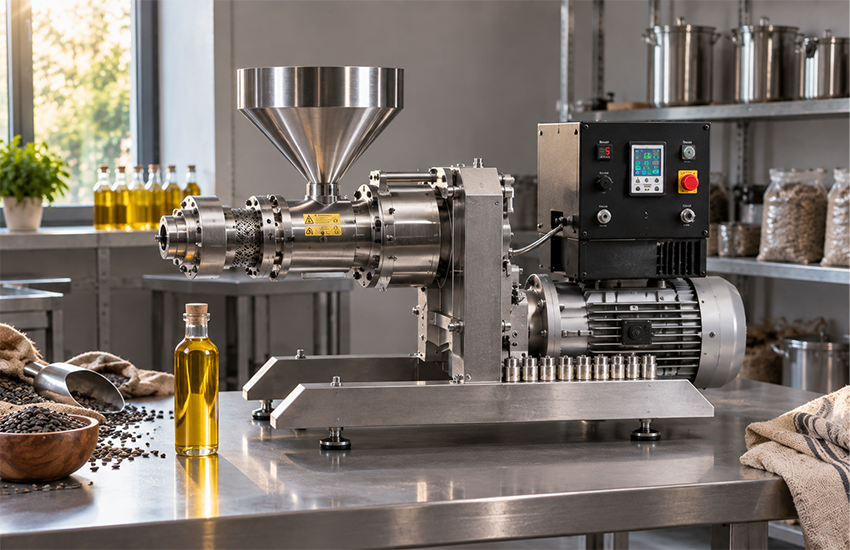
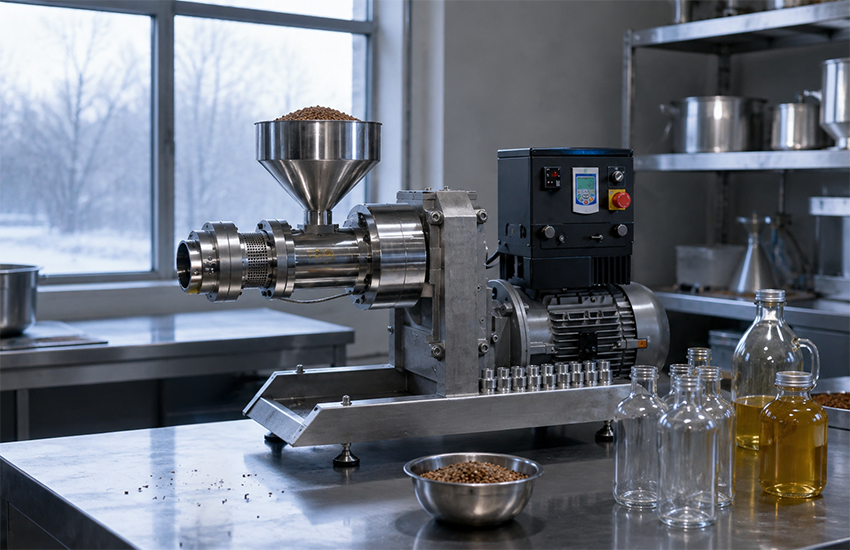
This is precisely why equipment designed for continuous production has an entirely different operating character from machines intended for occasional use. A professional hot and cold oil press with digital temperature control and silo connection is built around the assumption that once warm it will run for hours at a stretch. A direct drive with precision gearing, a hardened medical-grade stainless steel pressing assembly and the option of feeding from a silo mean that refilling does not force a shutdown and the machine can hold its steady state across a full shift.
From the standpoint of product consistency this is a qualitative change, not merely a quantitative one. What matters is not only how many kilograms pass through the press, but how large a share of that throughput was produced under identical conditions.
Temperature control and measurement where it counts
Managing the warm-up phase deliberately requires information. Integrated head heating lets you bring the most important assembly up to working temperature before the first seed is fed in, cutting the transitional period by several minutes or more. Digital measurement of oil outlet temperature, in turn, gives a reading from the point that best reflects what is actually happening to the product.
Add to that continuous speed adjustment and variable press gap regulation. These two elements let you tune the amount of heat generated by friction rather than leaving it to chance. A narrower nozzle and higher speed mean more energy converted into heat; a wider nozzle and slower running mean less. In the hands of an operator who understands the heat balance, these are the two most useful controls in the whole process.
Not every scale of production calls for the same machine. Smaller workshops and farms are often well served by a compact hot and cold oil press with integrated head heating rated at 14 kg per hour, which offers the same logic of temperature control at a lower throughput. The principle holds regardless of size: the better you govern heat, the less you depend on chance.
Managing start-up to shorten the transitional phase
Warming before the first seed
The simplest measure is not to begin pressing with a cold machine. Switching on head heating with adequate lead time means the most critical part of the assembly is already at working temperature when the first seed enters the chamber. Instead of surrendering heat to the structure, the material takes part in a normal process from the outset.
How much lead time depends on the machine and the room. A quarter of an hour may suffice in a warm hall; a cold one warrants more. This is a value each producer establishes once and then relies on for years.
The second element is the temperature of the raw material itself. Seed brought in from a cold store carries chill into the press that has to be compensated. A few hours in the production room before pressing costs nothing but planning, and can noticeably shorten the approach to equilibrium.
Start-up seed and separating the first fraction
Some producers run the start-up on a cheaper or less demanding material and only switch to the target seed once things have stabilised. This makes particular sense when pressing rare or difficult raw materials, where every portion processed under suboptimal conditions represents a real loss in quality.
If start-up takes place on the target material anyway, it is worth at least separating the first fraction of oil. A separate vessel under the outlet for the opening quarter of an hour is the simplest quality control tool in existence. That portion can later be added to a batch destined for longer settling, or used for purposes where uniformity carries no weight.
What matters is that the moment of switchover not be arbitrary. It should follow from a temperature reading, from the appearance of the cake, or from the clarity of the stream - from something observable and repeatable next time.
Your own warm-up curve
The most valuable tool in all of this is not a device but a notebook. Record the outlet temperature every five minutes from start-up for several days running, and a curve emerges describing one specific machine, in one specific room, on one specific material.
After a season such a notebook becomes a document that lets production run repeatably rather than intuitively. It supports planning the working day so the most demanding material enters the press during the window of greatest stability. It also lets a new operator be brought up to speed in a week instead of a season.
The end of the day - cooling and the last litres
What happens when the hopper empties
The shutdown phase mirrors the start-up, though it is discussed far less often. As the hopper empties, chamber loading falls, pressure at the nozzle drops, and with it the amount of heat generated by friction. The final portions of material pass through under conditions unlike the middle of the day - at lower resistance, in a machine that has begun shedding heat faster than it produces it.
Oil from this period tends to differ slightly in character, and the cake often changes structure - looser, less dense, sometimes visibly oilier. This is normal and indicates no fault, but it is better to know it than to hunt for a cause where none exists.
Cleaning a warm press
Cooling has one further practical dimension. Oil and material residues left inside the press thicken and harden as they cool, adhering to surfaces. Cleaning a machine while it is still warm is markedly easier than tackling it the following morning.
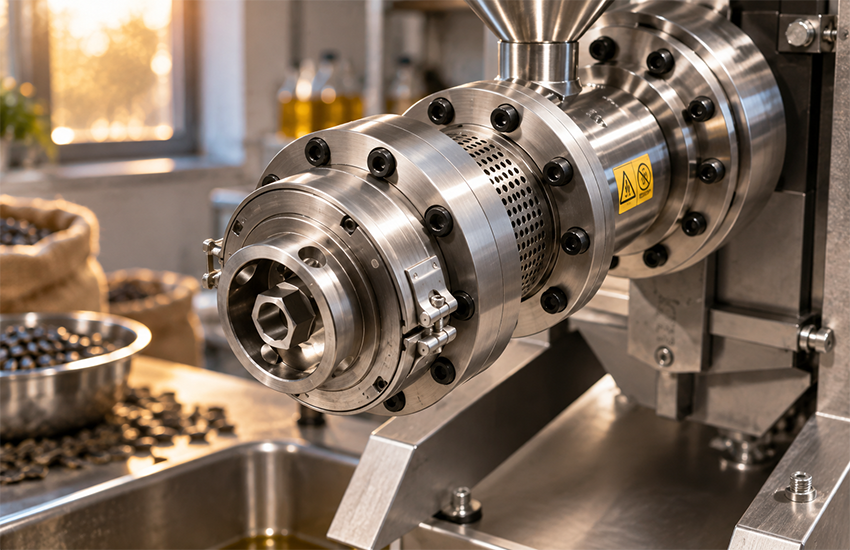
Designs built with hygiene in mind make this easier. A split press head gives quick access to the interior of the pressing assembly, and a cantilevered base opens up the space beneath the unit. Components rated as dishwasher safe reduce the whole procedure to a routine that can be performed daily without feeling as though it consumes half the evening.
Regular cleaning also connects back to the subject of this article. Residues in the strainer and in the gaps alter flow resistance, and therefore the heat balance at the next start-up. A clean press begins from a repeatable point; a neglected one from a point that differs every time.
What the warm-up curve teaches
The greatest value in watching what happens to a press during its first hour of work lies in the change of perspective. You stop thinking of pressing as a task you perform and start thinking of it as a process that unfolds over time. That shift has very concrete effects.
First, you stop looking for culprits where none exist. A batch that came out differently need not indicate poor raw material or a malfunction - it may simply contain a disproportionate quantity of oil from transitional phases. Second, you gain a planning tool: knowing when the machine is most stable, you can place the most demanding production inside that window. Third, you learn to read the machine from the cake, from the stream, from the reading, rather than relying solely on the setting.
There is also something here that goes beyond technique. Oil pressing belongs to those crafts in which the operator's senses still outperform automation at detecting subtle change. The warm-up curve is simply one of the languages in which a machine reports its condition. Learn it, and you lead the press rather than merely supervising it.
And finally, an observation that often surprises people beginning with their own production. The best oil of the day usually appears neither at the start nor at the end, but in that long, uneventful middle when nothing much is happening. The art of running a press comes down in large part to making that middle as long as possible.
Frequently Asked Questions
How long does an oil press need to reach a stable working temperature?
It depends on the mass of the machine, the temperature of the room and the type of seed being pressed. In practice the range runs from about fifteen minutes to over an hour. Smaller units in a heated room working soft material stabilise quickly; large industrial presses started in a cold hall need considerably longer. The best approach is to measure it yourself - record the oil outlet temperature every five minutes from start-up across the first hour.
Is oil from the first minutes of pressing fit for consumption?
Yes, provided the press was properly cleaned and the raw material is sound. This oil is no worse in terms of safety, but it tends to be less clear and may show a slightly different colour and aroma profile from the rest of the batch. For that reason many producers collect it separately and either give it longer settling or direct it to applications where full uniformity is not required.
Where does the heat in cold pressing come from if the seed is not heated?
It arises on its own, through friction and shear as material is forced through the narrowing space of the pressing chamber. Mechanical energy supplied by the motor converts partly into thermal energy. Cold pressing therefore does not mean a process without heat, but one in which temperature is held below a defined threshold in order to preserve nutritional value and the character of the raw material.
Do short breaks in operation really affect oil quality?
They do, though subtly. Every stop begins cooling, and every restart opens another brief transitional period in which parameters deviate from the steady state. A single pause will not change the character of a whole batch, but several pauses across a day add up to a noticeable quantity of oil pressed under atypical conditions. Limiting stoppages is one of the simpler ways to improve consistency.
How can you tell from the cake that the press has reached its steady state?
During warm-up the cake is usually lighter, damper, more crumbly and irregular in shape. Once stabilised it becomes darker, denser and leaves the machine in an even continuous stream with repeatable structure. This observation is often faster than a sensor reading, because the change in cake appearance tends to precede the settling of the displayed values.
Does pressing in winter require different settings from summer?
Usually yes. In winter the machine starts from a lower temperature, takes longer to reach equilibrium and sheds heat to its surroundings more intensively all day. Seed stored in a cold warehouse extends the process further. Holding raw material for several hours in a heated room before pressing helps, as does switching on head heating earlier. It is worth keeping separate notes on settings for different times of year.
Is preheating the press head before starting necessary?
Not strictly necessary, but clearly helpful. Bringing the head up to working temperature before the first portion of seed shortens the transitional period, reduces resistance at start-up and limits the quantity of oil produced under unsettled conditions. On machines equipped with integrated head heating and digital temperature control this is a routine step, performed some fifteen minutes before production begins.