
Table of Contents
- Flax - a plant that has been with us for millennia
- Two souls in one plant
- Growing flax - the calendar of a single season
- What is inside a flax seed
- Pressing linseed oil - the most demanding raw material in the mill
- Technology in practice - a press that gives control over the process
- Linseed oil beyond the bottle
- Sensory notes - how to recognise good linseed oil
- Flax is coming back, but not the way it left
- Frequently Asked Questions
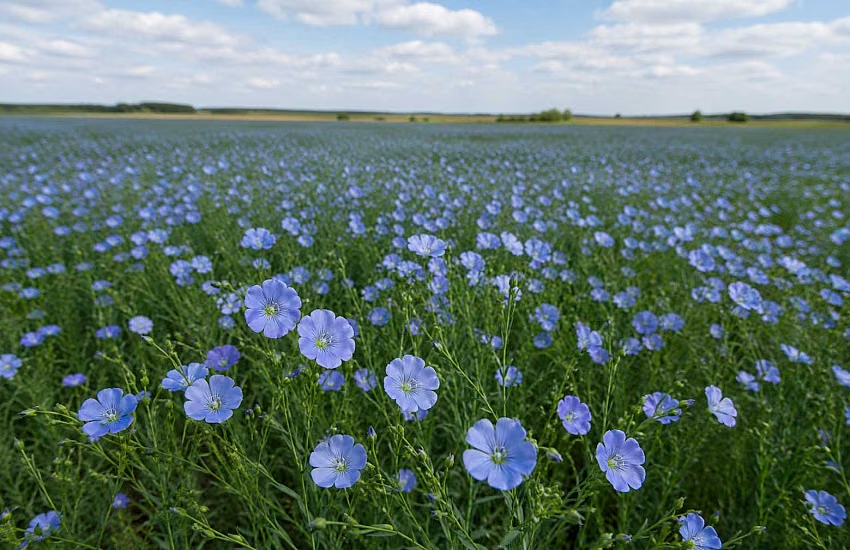
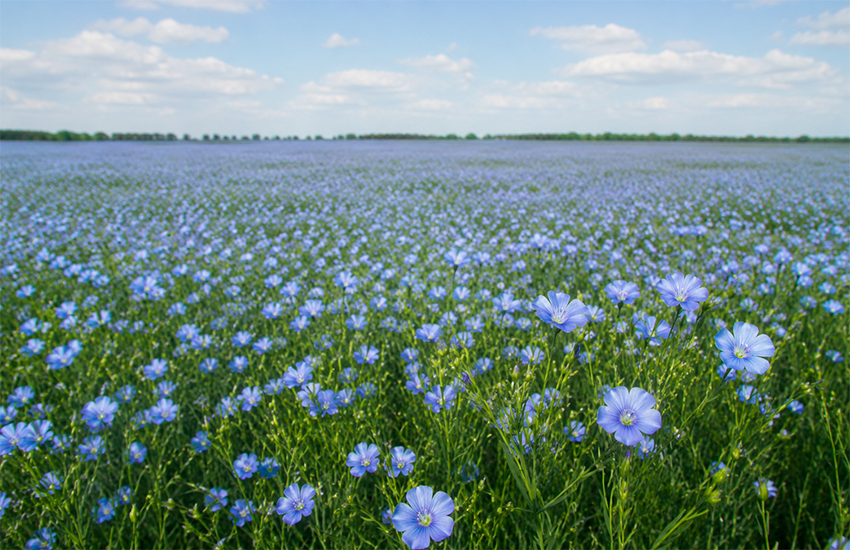
There is a sight in the Northern European countryside that lasts less time than rapeseed bloom and that almost nobody has watched from beginning to end. A field of flax in full flower has a colour that resists description - blue and faintly silver at once, shifting with the angle of the light, and gone by midday. Not because a cloud has passed over: flax flowers open at dawn and drop their petals within hours, so the following morning the same field turns blue all over again. For two or three weeks in June, it blooms daily and fades daily.
This brevity is more than a botanical curiosity. It is a preview of what flax will turn out to be later, in the store room, in the press and in the bottle. Linseed oil is the least stable oil you can press from any common temperate seed. It is also one of the oldest oils in European cooking, one of the most highly regarded nutritionally, and by some distance the most technically demanding. Flax seed gives up its oil easily, almost willingly - but the oil it gives demands a kind of care that neither rapeseed nor sunflower ever asks for.
This article covers flax as a whole: the plant that clothed and fed this part of Europe for thousands of years, what its cultivation actually looks like, and what happens to the seed the moment it enters a press.
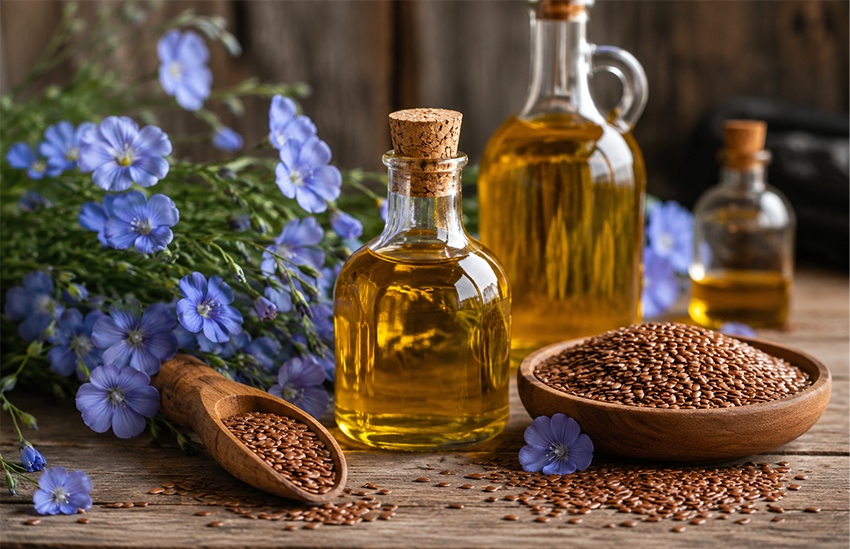
Flax - a plant that has been with us for millennia
Linum usitatissimum, the most useful flax
The botanical name of common flax is Linum usitatissimum, which translates roughly as "most useful". Eighteenth-century botanists did not hand out descriptions like that casually. It is hard to name another plant from which people have extracted so many different things at once: cloth, rope, edible oil, technical oil, animal feed, paper stock, filler for building compounds, and flooring.
Flax belongs to the Linaceae family. It is an annual with a single slender stem topped by a loose inflorescence, and its fruit is a capsule, commonly called a boll, holding up to ten flattened, glossy seeds. The seeds are small - thousand-seed weight usually falls between four and seven grams. That detail matters more than it sounds, because a small, slippery seed behaves differently inside a press screw than round rapeseed or a large, light-hulled sunflower kernel.
Oil content in flax seed typically runs from thirty-five to forty-five percent, depending on variety, weather and site. In that respect flax sits close to rapeseed. The composition of that fat, however, is entirely different - and that single difference governs everything that follows.
From prehistoric settlements to village looms
Traces of flax cultivation in Central and Northern Europe are older than most things we casually call traditional. Imprints of linen cloth and seeds in settlement layers from the Bronze Age onwards show the plant was present here continuously for thousands of years. Linen was, for most of that time, the basic clothing material - cotton only came into widespread use in the nineteenth century, and wool was expensive and heavier to work.
Growing flax for fibre required a whole chain of operations that now sound almost exotic. The crop was pulled up by the roots rather than cut, so as not to shorten the fibre. Then came retting: sheaves were spread on meadows or steeped in ponds so that micro-organisms could break down the substances binding the fibre to the stem. Scutching, breaking and hackling followed, and only at the very end came spinning. Across large parts of Poland, the Baltic region and Northern Europe, flax was the work around which autumn and winter in a village was organised.
The seed was a by-product in this arrangement, but a highly valued one. It went into the pot as a gruel or an infusion, into the medicine chest as a soothing remedy, and any surplus went under the press. Linseed oil was the fasting fat of rural kitchens, present above all in the months when animal fats were avoided. Dishes built directly around that flavour still survive - boiled potatoes with curd cheese and linseed oil is not a restaurant invention but a fragment of that everyday life.
By the middle of the twentieth century flax still occupied significant acreage across the region. The decades that followed brought retreat, as cheap synthetic fibres and cotton pushed it out of the textile market and cultivation shrank into a niche. Recent years have brought a rebound, but built on an entirely different foundation: flax returns to fields today mainly as an oilseed and as a seed eaten directly.
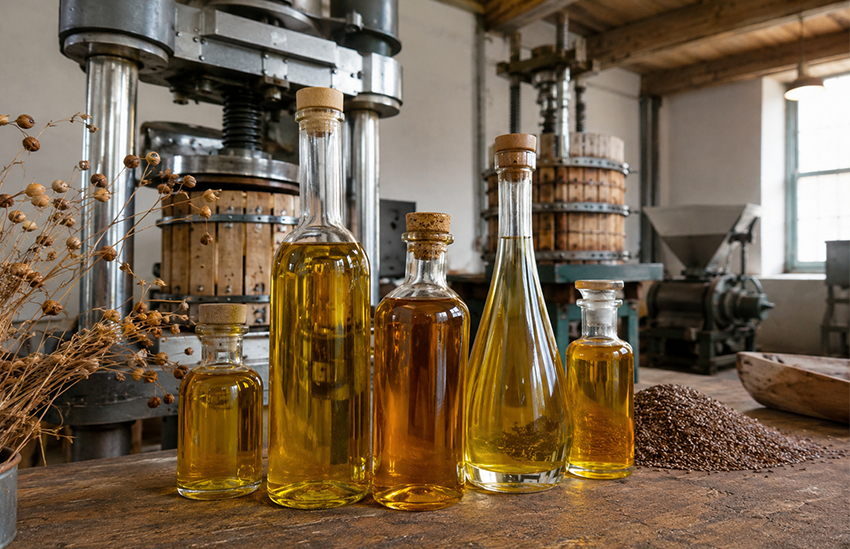
Two souls in one plant
Fibre flax and oil flax grow differently
Although we are talking about a single species, breeding has split it into two clearly distinct types, and the difference is visible in the field at a glance.
Fibre flax is tall, grown in a dense stand, with an almost unbranched stem reaching close to a metre. The dense sowing rate is deliberate - plants compete for light, draw themselves upwards and produce no side shoots, which gives long, uniform fibre. It yields little seed. Oil flax is shorter, more heavily branched, sets more capsules and is sown at a lower rate, with the whole physiology of the plant redirected towards seed and the stem reduced to a secondary concern. There is also an intermediate, dual-purpose type, which attempts to serve both ends but in practice is always a compromise.
For an oil producer, the choice extends beyond type to the specific variety. European registers include oil varieties differing in maturity date, resistance to lodging and oil content, and in Poland names such as Szafir, Oliwin and Bukoz have appeared among them. Choosing a variety is the first technological decision in the whole process - taken six months before anyone switches a press on.
Golden flax and brown flax - is the oil different?
This is one of the most frequently asked questions, and the answer disappoints anyone hoping for a clear winner. Seed coat colour reflects pigment content and is a varietal trait, not a measure of quality. Golden and brown flax have comparable oil content and comparable fatty acid profiles, with small differences that owe more to variety and growing conditions than to colour itself.
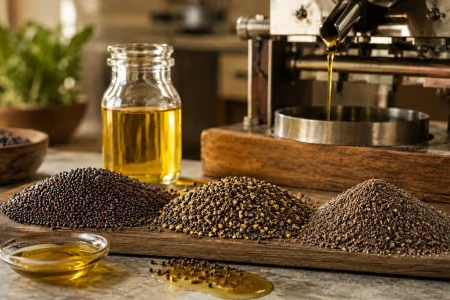
The differences you can actually perceive are sensory. Oil from golden flax tends to be milder, lighter in colour and more grassy-nutty. Oil from brown flax is usually darker and more assertive, with a clearer note of hay or walnut. For a small oil mill that is not a trivial distinction - it is a ready-made idea for two separate products from one botanical raw material, and the most reliable way to test it is to press a small batch of each at identical settings and taste them within the hour.
A separate category is made up of varieties bred for reduced alpha-linolenic acid content, aimed at thermal stability and industrial use. For a craft producer these are largely a curiosity, since the entire value of artisanal linseed oil rests on precisely what those varieties were designed to remove.
Growing flax - the calendar of a single season
Spring sowing and the right site
Oil flax is sown in early spring, usually from late March to mid-April, as soon as the soil allows machinery on and has warmed a few degrees. The plant tolerates cold nights well, and early sowing gives it an advantage over weeds, which this delicate crop competes with poorly.
It performs best on medium-textured, well-aerated soils with balanced pH and good structure, and dislikes compacted, crusting ground, because a small seed has no strength to break through a surface crust. Sowing is shallow, generally two to three centimetres. Flax reacts badly to excess nitrogen, which extends the stem, delays maturity and raises the risk of lodging - and a lodged crop is very difficult to harvest.
In the rotation, flax demands patience. Returning to the same field is generally advised no sooner than after several years, because the species is sensitive to soil fatigue and to diseases carried on crop residues. That is one reason flax is rarely the dominant crop on a farm and more often a carefully planned addition to it.
A June flowering that lasts one morning
Flowering usually begins in June and extends over two to three weeks. An individual flower lives a few hours - it opens early in the morning and has shed its petals before the afternoon. Because buds on a single plant open in sequence, the field appears to flower for many days, even though a different batch of buds opens each day.
Flax is predominantly self-pollinating, so insect activity does not determine yield. For an oil mill, the useful conclusion from this stage concerns weather: conditions during and just after flowering strongly influence oil accumulation in the seed. A cooler, moister run favours the deposition of polyunsaturated fatty acids, a hot and dry one reduces their share. Two batches of the same variety from two seasons can behave noticeably differently in a press, and that is not the machine's fault.
Ripening, harvest and the moisture level that decides everything
After flowering the capsules fill and the plant gradually yellows. Technical maturity is recognised by straw-coloured stems, brown bolls and the characteristic rattle of seed inside the capsules when the stand is shaken. Harvest usually falls in August, though in cooler regions it can slip into early September.
The greatest difficulty in harvesting flax is uneven ripening. The plant tends to produce late secondary shoots, especially after rain in late summer, leaving a stand where fully ripe capsules sit alongside green ones - and green seed means higher moisture, higher chlorophyll content and a much greater tendency to clog a press.
Moisture is the critical parameter with flax. Seed intended for pressing should be genuinely dry, in practice single-figure percentages, with many mills aiming around six or seven percent. The reason is specific to flax: the seed coat contains mucilage, which swells on contact with water and turns into a sticky layer. Damp seed stops being slippery and starts being adhesive, which completely changes how it behaves inside a press screw. Presses in this class are specified for seed up to eight percent residual moisture, but that figure is a ceiling to respect rather than a target to aim for.
Drying must be gentle. Flax responds badly to high drier temperatures, because its fat begins oxidising before it ever reaches the press, and once that process starts it cannot be reversed. Storage should be cool, dark and well ventilated, ideally in a layer shallow enough that the batch cannot heat from within.
What is inside a flax seed
Three double bonds that change everything
If only one technical fact from this article were to survive, it should be this one: roughly half, and often more, of the fatty acids in linseed oil consist of alpha-linolenic acid. This is an omega-3 fatty acid with eighteen carbon atoms and three double bonds. No other common vegetable oil comes close - rapeseed contains many times less, olive oil practically none.
Double bonds are the points at which a molecule is chemically active. Each one is a place where oxygen can act. Three of them in a single molecule means linseed oil oxidises incomparably faster than oils rich in monounsaturated fats. Everything we value nutritionally in linseed oil is simultaneously the source of its technical difficulty. These are not two separate traits but one trait seen from two sides.
The same fact produces another, more surprising property: linseed oil dries. It does not evaporate. It binds oxygen from the air and hardens, forming a flexible film. That is precisely why it was for centuries the basis of oil paints and of boiled linseed oil for timber, and why linoleum is made from its oxidised form - the name of that material comes straight from the Latin words for flax and oil. The same oil that makes a valuable addition to a meal turns into a hard protective layer on a plank.
Mucilage, lignans and what stays behind
The flax seed coat carries a layer of mucilage, or soluble polysaccharides. These are what make flax seed form its characteristic gel in water, and what lie behind the traditional use of a flax infusion as a soothing preparation. In pressing technology, however, mucilage is a factor to keep in view, because combined with moisture it can change how material flows through the press.
Flax seed is also among the richest known sources of lignans, polyphenolic compounds with antioxidant activity. Worth knowing: lignans are associated mainly with the seed coat fraction and after pressing they remain largely in the cake, not in the oil. That is a strong argument for treating flax press cake not as waste but as a second product of pressing with a value of its own.
There is also vitamin E in the form of tocopherols, naturally present in the oil and acting as its first line of defence against oxidation. That reserve is finite and is consumed over time - one more reason why freshness matters more with this oil than with any other temperate crop.
Pressing linseed oil - the most demanding raw material in the mill
A seed that gives up its oil easily
The paradox of flax is that in purely mechanical terms it is a generous raw material. The seeds are soft, thin-coated and oil-rich, so they require neither extreme pressure nor prior dehulling, and a screw press handles them without strain. The difficulty lies elsewhere - in controlling what happens to the oil at the moment it leaves the head. Flax forgives less than other seeds, because the temperature window in which an oil with a full profile is produced is unusually narrow.
The temperature beyond which the oil loses its character
In a screw press, heat does not come from the heater. It comes from friction. Material is compacted, forced through a narrowing space and expelled through a nozzle, and each of those stages converts part of the mechanical energy into heat. The head heater exists primarily to stabilise that process, not to drive it.
With rapeseed or sunflower, lifting the temperature by ten or fifteen degrees usually means higher yield and a deeper flavour. With flax the same move costs more than it returns. Polyunsaturated fatty acids react to heat faster, and oil overheated in the press also ages faster afterwards in the bottle, because oxidation, once initiated, behaves as a chain reaction. Mills working with flax therefore aim at the lower end of the range - cold pressing is conventionally understood as staying below forty degrees Celsius - monitor temperature at the oil outlet rather than only at the head, and accept a slightly lower yield in exchange for a complete profile. This is the point where the class of machine stops being a matter of convenience and becomes a matter of quality.
Mucilage, small seed and nozzle selection
The small flax seed calls for a different nozzle than rapeseed. Too wide an opening means part of the material passes through the head without full compression, and the cake comes out soft and greasy. Too narrow, and the press works at its limit, the temperature climbs, and the oil loses the very thing it was pressed for. With flax that margin is narrower than with most seeds, and the best way to find it is a short trial on a few kilograms before committing the whole batch. A well-pressed batch should leave cake with only a few percent of residual oil, which is a straightforward way to check whether the setting was right.
The mucilage adds its own thread to this. In dry seed it stays inactive; in seed at elevated moisture it starts working, material sticks to the screw, flow loses its evenness and the temperature begins to swing. This is why experienced mills check flax moisture before every batch, even when the seed comes from the same store as the week before.
Oxygen, light and time
Freshly pressed linseed oil is in the best condition it will ever be in. From that moment three factors work against it, and all three can be limited.
Oxygen enters the oil wherever liquid meets air - in open tanks, when decanting from a height, in a half-empty bottle. Light, particularly in the blue and ultraviolet range, initiates oxidation even in cool conditions, which is why linseed oil is bottled in dark glass and never in clear. Time acts independently of both, and its effect accelerates with storage temperature. The practical conclusion is uncompromising: flax is pressed in batches matched to the pace of sales, not in advance, with settling or filtration following quickly, bottling immediately after, and the finished product going into the cold. Linseed oil that has spent three months in an open tank in a warm room cannot be rescued by any packaging.
Technology in practice - a press that gives control over the process
Everything above reduces to one requirement of the machine: with flax, what counts is not raw force but precision and repeatability. A producer needs to set a temperature, read it where the oil actually leaves the press, and adjust working speed to each particular batch of seed.
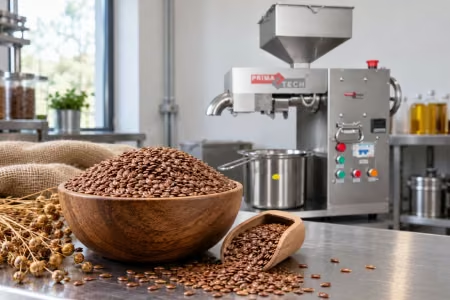
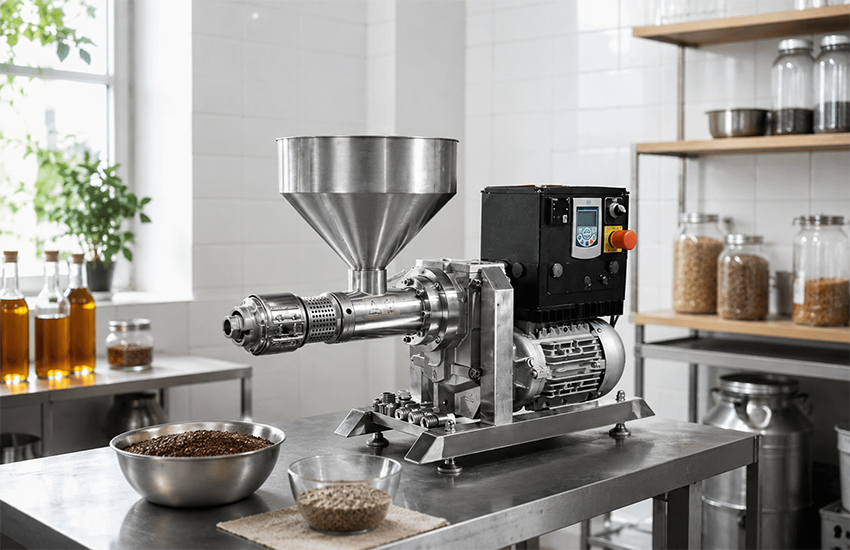
For this class of work, the compact hot and cold oil press with a throughput of up to 25 kg/h - model PTOW 500s - is a natural fit. A 1.5 kW direct drive on a standard 230 V supply removes any need for a three-phase installation, and at 68 kg with dimensions of 87 x 33 x 55 cm the unit can be moved and set up without dedicated infrastructure. Everything in contact with the seed is hardened medical-grade stainless steel, and the pressing assembly is dishwasher safe. That last point addresses a problem specific to flax: residues of an oil this rich in polyunsaturated fats turn rancid quickly, so ease of cleaning translates directly into the flavour of the next batch. A split press head reduces that job from a chore to a routine.
Three features carry the most weight for flax. The first is integrated head heating with digital temperature control, which allows the process to be run within a narrow, deliberately chosen range instead of trusting friction to settle in the right place by itself. The second is digital measurement of oil outlet temperature, the parameter that tells you more about flax than head temperature does, because it describes what is actually reaching the tank. The third is continuous speed adjustment combined with a variable press gap, which lets one machine move from rapeseed to flax and then to pumpkin seed within a single day. Six interchangeable nozzles come with the press, which with seeds of such different sizes is not a minor detail.
The press is also rated for seed with residual moisture up to eight percent and can be connected to a silo for longer runs. Producers working in unheated buildings, at markets or in humid conditions may prefer the stainless steel version of the same press with an inox control box, model PTOW 510s, which shares the identical pressing unit and specification but adds a stainless enclosure for the controls. With cold pressing carried out late in the autumn in an unheated room, stability of conditions is precisely what separates a repeatable batch from a lottery.
Linseed oil beyond the bottle
Why linseed oil is never used for frying
This question comes up constantly, and the answer follows directly from the chemistry described above. Linseed oil has one of the lowest smoke points among edible oils - it reacts to heat while other oils are still warming up. Heated, it loses its fatty acid profile and gains an acrid, unpleasant aroma.
Its place is in cold applications: dressings, sauces, curd cheese spreads, stirred into soup already on the plate, folded into grains after they come off the heat. That is a limitation, but also a ready-made story about the product. Linseed oil does not pretend to be a universal fat, and precisely because of that it has a clearly defined place in the kitchen.
Boiled oil, oil paint and linoleum
The second life of this raw material says more about linseed oil than most data tables. For centuries it was the binder of oil paints - pigment ground in linseed oil and laid on canvas bound oxygen and hardened into a durable paint layer. The same mechanism underlies boiled linseed oil, heat-treated and used to impregnate timber. Linoleum belongs to the same family: patented in the nineteenth century, it was made from oxidised linseed oil mixed with cork or wood flour and spread onto a jute backing. For a hundred years people walked on floors made from the same oil they had eaten with curd cheese for supper, which says everything about how extraordinary a substance alpha-linolenic acid is.
Flax press cake - the second product of pressing
What remains after pressing is the cake, holding residual fat, all the protein, fibre and the lignans mentioned earlier. In animal nutrition, flax cake is a valued component, traditionally associated with improved coat condition in horses and cattle, though it calls for sensible rationing and care in preparation, especially if served with water, because of the cyanogenic glycosides present in the seed. For a mill working in the food market it is also a raw material for milling into a high-fibre flour. Fresh, moist cake is not suited to long storage: because of the fat still in it, it needs to be processed or dried down promptly.
Sensory notes - how to recognise good linseed oil
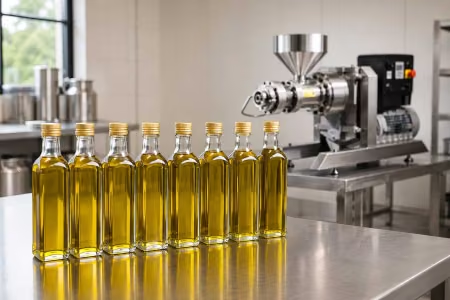
Fresh linseed oil ranges from pale yellow to golden brown depending on variety and pressing method. The aroma is grassy and faintly nutty, in some batches with a note of hay or freshly cut meadow. The flavour is pronounced, with a gentle bitterness underneath, but that bitterness should be short and clean.
The warning signal is an aftertaste described as fishy or oily - a distinctive, scratchy finish at the back of the throat. That is not a varietal trait or a fault of the seed but the result of oxidation, and oil that tastes this way has passed its moment. It is worth passing this on to customers, because many still take that aftertaste for a natural characteristic of linseed oil, when the opposite is true. Fresh, well-pressed and well-stored linseed oil has nothing to do with it, and that is the strongest argument a small mill has at its disposal.
Flax is coming back, but not the way it left
When flax disappeared from European fields, it disappeared as a fibre crop, losing to cotton and synthetic fibres in a calculation nobody was running in terms of flavour or nutritional value. It is returning today through an entirely different door: as a seed, as an oil, as an ingredient customers ask for by name.
For an oil producer that is both comfortable and demanding. Comfortable, because flax needs no explanation - its reputation is established. Demanding, because no other raw material exposes so mercilessly the difference between oil made carefully and oil made carelessly. With rapeseed, a technological error can be hidden in the flavour. With flax there is nowhere to hide it. A plant whose flower lasts a single morning asks for a mill working with comparable attention, and it repays that attention with a product nobody will mistake for anything else.
Frequently Asked Questions
When is oil flax sown?
Sowing falls in early spring, most often from late March to mid-April, as soon as soil conditions allow machinery onto the field. Flax tolerates cold nights, and an early date gives it an advantage over weeds, which this delicate plant competes with poorly. It is sown shallow, at two to three centimetres, into soil with good structure that does not form a surface crust.
How much oil can be obtained from a kilogram of flax seed?
Oil content in flax seed usually runs between thirty-five and forty-five percent, but cold pressing never extracts all of it - part of the fat deliberately stays in the cake. In practice, a kilogram of well-prepared dry seed yields somewhere around a third of a litre of oil, with the result depending on variety, seed moisture, press gap setting and working temperature.
Should flax be cold pressed or hot pressed?
Linseed oil intended for consumption is cold pressed, at the lowest practical temperature range, conventionally understood as below forty degrees Celsius. Alpha-linolenic acid reacts to heat faster than the fatty acids in rapeseed or sunflower, so raising the temperature to gain yield shows up in both the profile and the shelf life of the oil. Presses with adjustable head heating make it possible to run the process deliberately rather than leave it to frictional heat.
What seed moisture is right for pressing flax?
The seed should be distinctly dry - most mills work around six to eight percent moisture, and presses in this class are rated for residual moisture up to eight percent. With flax this matters twice over, because the mucilage in the seed coat swells on contact with water and changes how material behaves in the press screw, causing uneven flow and temperature swings. Drying must be gentle, since high drier temperatures initiate oxidation before pressing even begins.
What is the difference between golden and brown flax oil?
Oil content and fatty acid profile are comparable in both, and seed coat colour is a varietal trait rather than a measure of quality. The differences are primarily sensory: oil from golden flax tends to be milder and lighter, oil from brown flax usually darker and more assertive in flavour. For a small mill this is an opportunity to build two distinct products from one plant species.
How long can freshly pressed linseed oil be stored?
Considerably less time than other cold-pressed oils. The three double bonds in the alpha-linolenic acid molecule mean the oil reacts quickly with oxygen, so it is kept cold, in dark glass, ideally filled to the neck and opened only when it will be used within a few weeks. Producers press flax in batches matched to the pace of sales rather than building stock.
Can linseed oil be used for frying?
No. Linseed oil has one of the lowest smoke points among edible oils, and heat strips its fatty acid profile while adding a harsh, unpleasant aroma. Its place is in cold applications - dressings, sauces, spreads, and as a finishing addition to dishes that have already cooled slightly.