
Table of Contents
- Why the oilseed map has never stood still
- Crops coming back into the conversation
- Climate as the invisible press operator
- Dispersal instead of concentration
- Feedstocks already passing through screw presses
- Press technology as an answer to variable feedstock
- One press, many calendars
- What the history of pressing suggests about its future
- What to expect from the coming decade
- Frequently Asked Questions
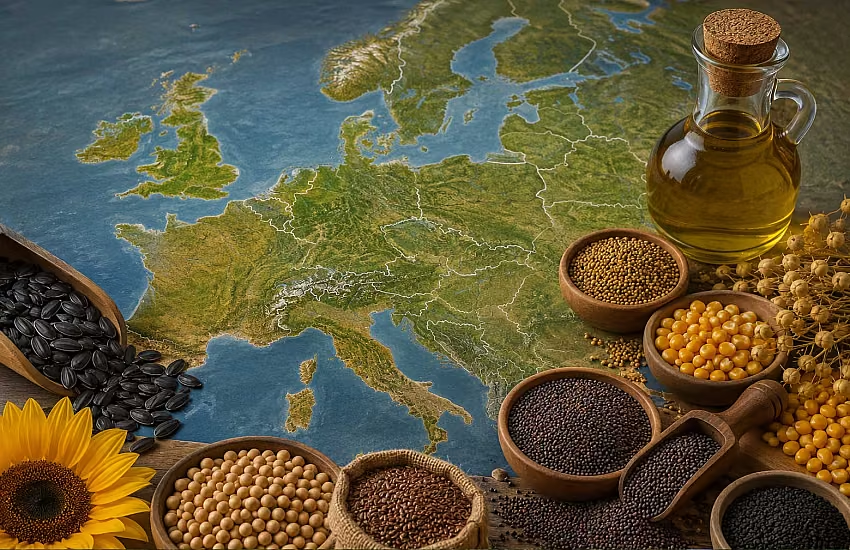
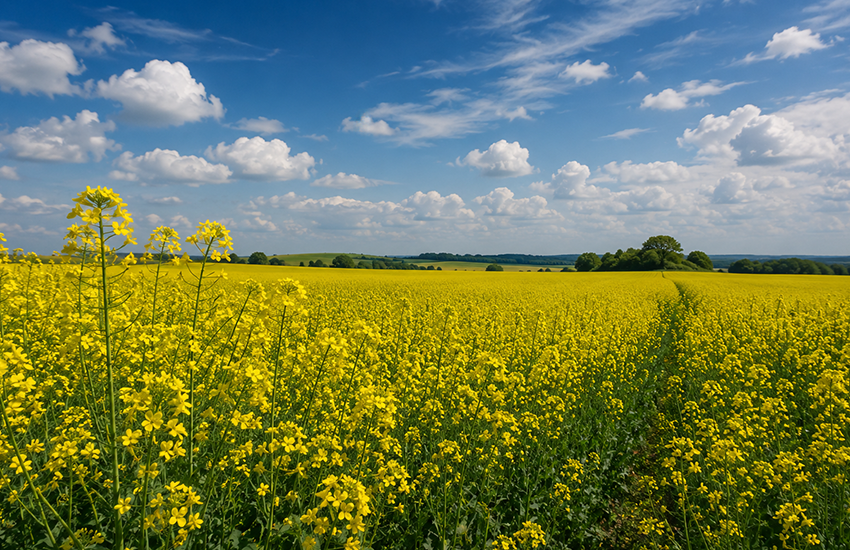
The map of oil crops in Europe looks nothing like it did a century ago, and it will almost certainly look different again in ten years. That sounds like a platitude until you look at the specific species and dates behind it. Rapeseed, today the most European of oil crops, only exists in an edible form because of breeding work carried out in the 1970s. Sunflower, associated with Ukraine and the warm south, now ripens in fields far further north than anyone would have planted it a generation ago. Camelina, which archaeologists pull out of Bronze Age settlement layers, is returning to seed catalogues after coming close to disappearing entirely.
Behind these shifts sit forces usually discussed in terms of climate, policy and supply chains. But their most interesting consequence is not visible in statistics. It shows up in the workshop, in what actually gets poured into the hopper and how the machine has to be set up before that material gives up its oil. Every change on the crop map ends in a very practical question: what temperature, what gap, what screw speed.
This article is not a market forecast. It is a guide to what is happening to oilseed raw material across Europe and what that means for anyone standing at a press. It gathers the stories of species arriving and departing, a few curiosities from the border between botany and pressing technology, and observations about how variable weather can turn one crop into two quite different feedstocks in consecutive seasons.
Why the oilseed map has never stood still
The idea that agriculture is a domain of continuity is comfortable but not especially accurate. Oil crops travel between continents faster than almost any other group of plants, because their value is concentrated in a small seed that is easy to move and store. The history of European oil pressing is a sequence of exactly such journeys.
Rapeseed had to be reinvented before anyone could eat it
Rapeseed was grown in Europe long before the industrial era, but not for food. Rapeseed oil burned in lamps and lubricated machinery, because it contained significant amounts of erucic acid and glucosinolates. Those compounds made it unattractive in the kitchen and made the cake difficult to feed to livestock.
The breakthrough came from Canada in the 1970s, when breeders produced varieties free of erucic acid and then varieties low in glucosinolates as well. The result was the double-low or "00" type, and the trade name canola, contracted from Canadian oil low acid. A plant that had been a technical raw material for centuries became one of the pillars of the European food industry within a single generation.
For pressing practice this meant something more than a change in chemistry. Modern rapeseed behaves differently in the press than the old types did. Seed size, hull thickness and susceptibility to mechanical damage during handling all shifted along with the fatty acid profile.
Sunflower's journey across three continents
The common sunflower originates in North America, where indigenous peoples cultivated it long before European contact. It reached Europe in the sixteenth century as an ornamental and spent two hundred years as a botanical curiosity in gardens.
It was the Russian Empire in the nineteenth century that turned it into an oil crop. A quirk of religious observance helped considerably. Sunflower was novel enough that it did not appear on the lists of fats restricted during Orthodox fasting periods. Sunflower oil therefore became a permitted fat at times when others were excluded, and that gap drove cultivation on an enormous scale. Selection by Russian breeders pushed the oil content of the seed from the low teens into the range familiar today.
Sunflower is now on the move again, this time northwards. Short-season varieties ripen reliably in conditions that would have been considered too cool twenty years ago. For northern European presses this means access to a feedstock that previously had to travel a long way.
Flax was everywhere, and then it wasn't
Oil flax was for centuries one of the most important crops of Northern and Central Europe. Linseed oil went into kitchens, but also into painters' studios and joiners' workshops, because it belongs to the drying oils. Exposed to oxygen it polymerises and forms a hard film. The same property that makes it valuable for wood finishing makes it demanding in food use, with a short shelf life and a genuine need for cold storage.
Flax retreated from the fields under pressure from cheaper, more stable oils and synthetic fibres. Its recent return is tied to interest in plant-derived omega-3 fatty acids, of which linseed is among the richest sources available.
Olives move north while soy moves into Central Europe
The boundary of viable olive cultivation has for centuries followed roughly the edge of the Mediterranean climate, and was treated as more or less fixed. Recent decades have unsettled that assumption. Trial plantings now run considerably further north than the historical limit, while in parts of southern Europe the constraint is no longer winters that are too cold but summers that are too hot and dry. The olive map is shifting upwards and coming under pressure at the same time, which is an unusual combination for any crop.
A comparable movement, for different reasons, applies to soy. A plant associated with South America and Asia now occupies growing acreages in Central Europe, including Austria, Hungary and southern Poland. Early-maturing varieties have shortened the required growing season enough to make cultivation possible in conditions that were recently prohibitive.
Soy is a distinctive feedstock from a pressing point of view. It carries relatively little fat compared with rapeseed or sunflower, and a great deal of protein. In practice this means the cake is often the more significant product, and the pressing process is frequently run with cake quality in mind rather than maximum oil yield.
Crops coming back into the conversation
The most interesting developments in European oil pressing are happening not in the mainstream but around its edges. Species that spent decades appearing only in ethnobotany textbooks are returning to variety registers and to press hoppers.
Camelina - three thousand years old, nearly lost in one century
Camelina sativa, known variously as gold-of-pleasure or false flax, is among the oldest oil plants of Europe. Its seeds turn up at archaeological sites from the Bronze and Iron Ages, including waterlogged settlements where anaerobic conditions preserved the plant material intact.
For most of the twentieth century camelina was practically absent from European fields. It came back because it turns out to be exceptionally well suited to the conditions now becoming normal: a short growing season, modest water requirements, tolerance of poorer soils and resistance to frost. It is sometimes sown as a catch crop, entering the field after another crop within the same season.
Camelina oil has a distinctive aroma with onion and mustard notes and a high alpha-linolenic acid content. In a screw press it behaves calmly. The seeds are small with a soft coat, and generally call for a narrower nozzle than most feedstocks.
Hemp, and an oil that is green for purely botanical reasons
Industrial hemp is returning to European agriculture after decades of absence driven by regulation. Fibre and oilseed varieties contain only trace amounts of psychoactive compounds and are grown from strictly defined approved variety lists.
Hemp oil stands out on the shelf by colour alone. It is distinctly green, and the green comes from chlorophyll present in the seed coat. Gentler pressing at lower temperatures can lighten it somewhat, but a greenish cast is an inherent characteristic of the feedstock, not a fault. An omega-6 to omega-3 ratio close to three to one makes it one of the more interesting oils in terms of fatty acid profile.
A practical note from the workshop: hemp seeds are relatively hard and tend to block the screen when the head runs too cool. This is a feedstock where precise control of head heating makes an immediately visible difference.
Poppy, safflower and milk thistle - niches that are ceasing to be niches
Poppyseed oil was a common product across Central Europe before cheaper alternatives displaced it. Like linseed it belongs to the drying oils, and it was prized by painters for centuries. Unlike linseed it does not yellow as noticeably with age, which made it the preferred medium for light passages in oil painting.
Safflower, sometimes called bastard saffron, was cultivated for millennia mainly for the dye extracted from its florets. Safflower petals have been recovered from Egyptian tombs, where they had been used to colour textiles. Oil was a by-product in that story. Today the proportions are reversed. Safflower is grown primarily for an oil very high in linoleic acid, and its drought tolerance makes it a candidate for increasingly warm and dry summers.
Milk thistle is a special case, because its most valuable fraction stays not in the oil but in the cake. Silymarin, the complex of compounds the plant is grown for, is poorly soluble in fats, so the press cake left after pressing milk thistle can be worth more than the oil itself. It is one of the few situations in which a press produces two primary products rather than a product and a residue.
Climate as the invisible press operator
Changes on the crop map are one thing. The second, far less obvious, is variation within the same species grown in the same field in consecutive years. For anyone pressing regularly, this is a more tangible phenomenon than any geographical shift.
Why the same rapeseed behaves differently every year
Oil content in seed is not a fixed characteristic. It depends on variety, but to a very large degree also on the weather during seed filling. Drought at that stage shortens the accumulation period and produces smaller seeds with lower fat content and a higher proportion of hull in the total mass. A wetter, cooler season does the opposite.
The consequence is immediately practical. Smaller, more hull-heavy seed needs a different gap setting than full, oil-rich seed. The same press configuration that gave clear oil and dry cake last season can produce cake that is too wet, or conversely scorched and over-heated, in the next.
Moisture, the parameter that decides everything
Seed moisture is the critical variable in cold pressing. Feedstock that is too wet fails to build sufficient pressure in the chamber. The mass slides rather than being compressed, the oil comes out cloudy and the cake emerges soft and sticky. Feedstock that is too dry generates excess friction, pushes the temperature above the intended level and can jam the screw outright.
For most oilseeds, predictable cold pressing happens within a narrow band of a few percentage points. Presses built for professional use are typically specified to handle residual moisture up to around eight percent, including unhulled seed. Seasons with delayed, rain-affected harvests force additional drying, and that in turn becomes one more variable shaping the sensory profile of the finished oil.
Every new species brings its own learning curve
Any feedstock entering a press for the first time requires several trial runs. There is no universal table converting seed species into a complete set of parameters, because batch, harvest year, storage history and degree of cleaning all enter the equation. In practice it is not the number of available species that determines what a pressing operation can do, but the range of adjustment the machine offers.
Dispersal instead of concentration
For most of the twentieth century European oil production moved in one direction: towards larger plants, longer logistics chains and stronger regional specialisation. Recent years have brought movement the other way, at every scale.
Shortening the road from field to bottle
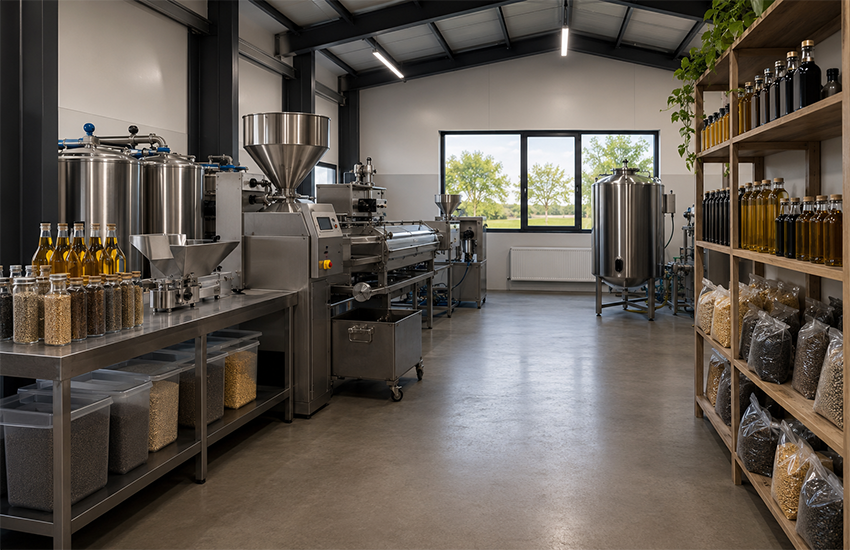
In the classic model, oilseed travelled hundreds or thousands of kilometres before reaching a press. The distributed model inverts that logic - the press moves closer to the field. The consequences are not only logistical but qualitative, because the shorter the interval between harvest and pressing, the less scope there is for processes that occur in stored seed.
Seed is not inert material. It contains enzymes, lipases among them, which begin breaking down fat at elevated moisture and temperature long before pressing starts. Oil pressed from freshly harvested seed and oil from the same seed after several months of imperfect storage are two different products, despite identical origin.
The press as part of a local material loop
Distributed pressing has a further aspect that gets less attention: the cake. Residue from cold pressing retains a substantial share of the protein along with residual fat, and is a valuable feed material. A well-adjusted press typically leaves around five percent oil in the cake, which is both a measure of extraction efficiency and a reason the cake remains nutritionally useful.
In a centralised model the cake circulates across the continent alongside the oil. In a distributed model it stays where it was made. That closes the loop locally: seed from the field goes into the press, the oil goes into a bottle, the cake returns to the farm as feed or as material for further processing. Increasingly the cake also finds uses beyond feed, as a functional flour, a baking ingredient or a cosmetic raw material.
Regional oils as a category still taking shape
Europe has an elaborate system of geographical indications for olive oil and a handful of regional oil specialities, Styrian pumpkin seed oil among the best known. Oils from rapeseed, flax or camelina have not yet developed a comparable map of regional identities. That is a space likely to fill over the coming decade, much as it filled earlier for cheese, cured meats and beer.
Feedstocks already passing through screw presses
The most surprising part of the change in oil pressing concerns not crops at all, but materials previously treated as the remains of some other process.
Seeds and stones from fruit and vegetable processing
Fruit processing generates enormous volumes of seeds and stones that were, for decades, simply waste. Grape seeds left after winemaking, apricot, cherry and plum kernels, seeds from tomato, pumpkin and raspberry processing - all contain oil, and some of them contain oil with a profile interesting enough to justify pressing in its own right.
Raspberry and strawberry seed oils carry natural phenolic compounds and tocopherols, which is why they are used mainly in cosmetics. Tomato seed oil, a by-product of the concentrate industry, contains lycopene that gives it a characteristic colour. Styrian pumpkin seed oil, pressed from a variety whose seeds lack a woody coat, is so intensely dark green that in a thin layer it flashes red - an optical effect regularly mistaken for adulteration.
Coffee, mango and other food-industry leftovers
Dried coffee grounds retain a small amount of oil with a pronounced aroma, used in cosmetics. Mango kernels yield a butter similar in consistency to shea. Citrus seeds left over from juice production are also pressed.
What these feedstocks share is that they arise in places where nobody planned to produce oil. Using them requires a press capable of handling material of unusual hardness, shape and fat content, which is a far broader specification than pressing a single well-understood crop.
Insect oils, which sound exotic and are already being tested
Lists of materials handled by contemporary screw presses now include entries that would have looked like typing errors a decade ago: black soldier fly larvae, weevil larvae, cricket. This is not a marketing curiosity but a reflection of genuine research into alternative sources of protein and fat.
Black soldier fly larvae are reared on organic residues, and their dry mass contains both protein and a substantial lipid fraction that can be separated mechanically. Pressing such material happens under different conditions than pressing seed, since it is more plastic and responds differently to pressure. It is a good illustration of how far the term "oil press" has expanded beyond its original meaning.
Press technology as an answer to variable feedstock
If the coming decade brings more species into pressing operations, with more variable parameters and less predictable harvest years, then the most important characteristic of a machine stops being maximum throughput and becomes range of adjustment.
Press gap and screw speed
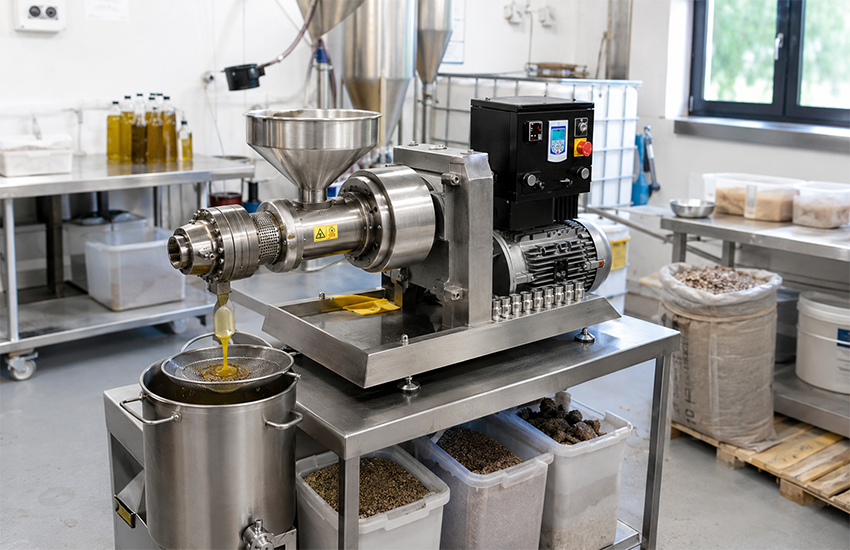
In a screw press, oil is released by a combination of pressure and friction. The screw transports material towards the head, the flow cross-section narrows, and the mass is compressed progressively harder. The width of the nozzle at the cake outlet determines how much resistance the material meets, and therefore how much pressure builds inside the chamber.
Small, soft seeds need a narrower nozzle; hard, large ones need a wider one. The same principle governs speed. Running the screw slower extends dwell time in the chamber and generally lowers outlet temperature, while running it faster raises throughput at the cost of more heating. On machines with infinitely variable speed adjustment and a variable press gap, such as this stainless steel hot and cold oil press with a 25 kg/h capacity, both parameters can be set independently for each feedstock instead of settling on a compromise. A set of six interchangeable nozzles covers the range from fine seed to hard kernels.
Temperature as the line between two technologies
The division between cold and hot pressing is not a division between two machines but between two operating regimes of the same machine. Cold pressing means the oil temperature stays below a conventional threshold - commonly taken as around 40 degrees Celsius for edible oils - and that no external heating is applied to the feedstock. Hot pressing raises the temperature deliberately, increasing yield and altering the aroma profile.
The complication is that chamber temperature is not set directly. It is the resultant of friction, speed, feedstock moisture and ambient conditions. A pressing room in an unheated building in November and the same room in July are two different process environments. The answer is integrated head heating with digital control and temperature measurement at the oil outlet, which allows repeatability regardless of season or location.
Material and hygiene in multi-feedstock work
Pressing a dozen different species over a season means frequent changeovers and cleaning. A split press head, components that can go through a dishwasher, and hardened medical-grade stainless steel throughout stop being conveniences and become preconditions for sensible work. Residue from a previous feedstock left in the chamber can dominate the aroma of the next batch, and with strongly flavoured oils the problem is detectable immediately.
One press, many calendars
The model in which a pressing operation runs for a few weeks a year on a single feedstock is giving way to one spread across the whole year. This is a change with direct implications for machine selection.
A pressing calendar instead of a pressing season
Rapeseed is harvested in summer, sunflower in autumn, camelina potentially twice in a season where grown as a catch crop, flax depending on sowing date, hemp in late autumn. Pumpkin seed arrives after the pumpkin harvest, grape seed after the vintage, fruit stones on the rhythm of processing. Nuts and imported materials such as sesame or almond have no local seasonality at all.
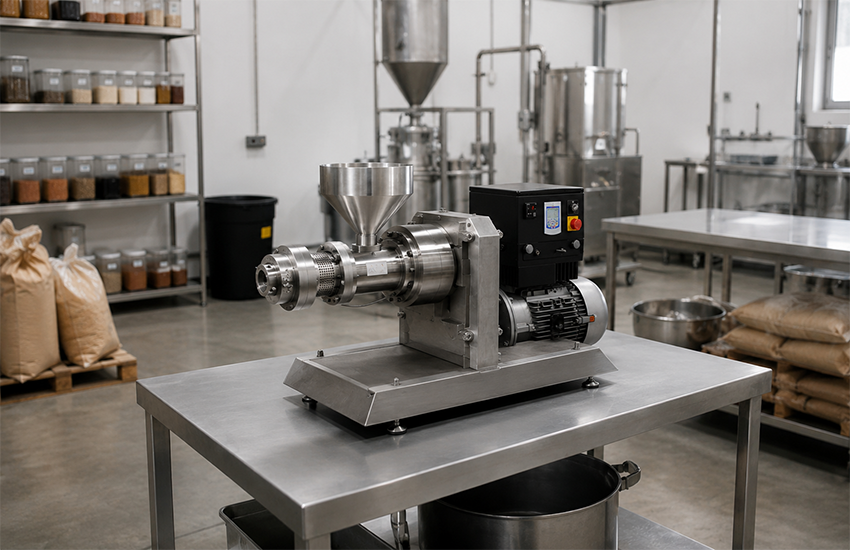
Laid side by side, these rhythms produce a calendar in which almost every month has its feedstock. The condition is a machine able to move between them without rebuilding - one that handles soft seed and hard seed, fine and coarse alike. Machines tested across more than a hundred seed varieties, built for continuous duty and capable of running from a silo feed, such as the professional PTOW 510s screw press with integrated head heating, are designed around exactly this pattern of use.
Continuous operation and practical footprint
Over longer pressing cycles, what matters is not only hourly throughput but the ability to run uninterrupted. A 1.5 kW motor on a standard 230 V supply with direct drive and precision gearing removes the belt from the equation, which lowers maintenance and improves reliability over long runs. The option of silo feeding changes the character of the process from a series of discrete batches into continuous production.
Footprint matters more than it might appear. At 68 kg and roughly 87 by 33 by 55 centimetres, a machine of this class fits in a room where a conventionally engineered industrial installation would not, and can be moved between locations without specialist handling equipment. For producers who press at their own premises and also at markets or fairs, that is a functional characteristic rather than a detail.
What the history of pressing suggests about its future
It is worth stepping back briefly, because historical perspective shows how little in this field is genuinely new and how much is a return to very old solutions in new form.
From stone and beam to screw
The oldest known oil installations relied on crushing the material with stone and then squeezing the mass under load. Beam presses, known around the Mediterranean since antiquity, used a long timber as a lever weighted with stones. Their efficiency was low and the process slow, but the principle was identical to today's: rupture the cells, release the fat, separate it from the solid residue.
Wedge presses, common in Northern Europe, worked by driving wedges into a box of material with a mallet. The screw press, converting rotation into pressure through a thread, was a breakthrough because it could hold steady pressure for extended periods without continuous effort from the operator.
The screw press in its modern form - the configuration that dominates small and medium operations today - introduced a qualitative change. The process stopped being cyclical and became continuous. Material is no longer loaded, squeezed and removed in batches; it moves without interruption through a chamber in which pressure rises along the path. That single design change is what made small-scale pressing practical.
Repeatability as a new element of the craft
For most of the history of oil pressing, process parameters were not measured. People pressed by watching the colour of the oil, the consistency of the cake and the smell rising from the chamber. Knowledge passed directly, in the workshop, and disappeared with the person who held it.
What has changed recently does not concern the physics of the process, which is identical. What changed is the ability to record the conditions under which the process ran. A reading of oil outlet temperature and a set head temperature are numbers that can be written next to a feedstock name and a date. The next person does not have to reconstruct that knowledge from nothing.
What to expect from the coming decade
A few directions are clearer than others. The first is a continuing widening of the species palette - not because rapeseed will lose importance, but because more complementary crops suited to shorter, drier seasons will appear alongside it.
The second is the growing role of feedstocks originating in other branches of processing. Seeds and stones that until now went to biogas plants or compost will increasingly go to presses, because pressing technology has become available at a scale that makes it sensible.
The third is precision. Oil pressing was for most of its history a craft built on experience and observation. Digital outlet temperature measurement and controlled head parameters do not replace experience, but they allow it to be recorded and repeated. A producer who knows the exact settings that yielded a particular profile can reproduce that result a year later, with a different batch of seed and different weather outside.
The fourth, and least measurable, is a change in how the oil itself is perceived. For decades it was an anonymous product defined solely by the plant it came from. Increasingly it is defined by origin, variety, harvest year and pressing method - the way wine, coffee and honey have long been defined. Europe's oilseed map is ceasing to be a map of crops and becoming a map of producers.
Frequently Asked Questions
Does climate change really affect oil quality, or is that just theory?
The effect is measurable and noticeable in practice. Weather during seed filling determines fat content, seed size and the proportion of hull in the total mass. Drought produces smaller, oil-poorer seed; a wet season does the reverse. This translates directly into pressing yield and into the need to adjust press settings between harvest years of the same crop.
Which newer oil crops have the best prospects in northern and central Europe?
Species with short growing seasons and low water demand look strongest. Camelina stands out for its tolerance of poor soils and its suitability as a catch crop. Safflower handles drought well. Early sunflower varieties now ripen considerably further north than they once did. Industrial hemp is returning as a multi-purpose crop yielding both seed and fibre.
Can one press really handle such different feedstocks?
Yes, provided it offers sufficient adjustment range. Three elements matter: a variable press gap, infinitely adjustable screw speed and head temperature control. A set of nozzles in different diameters allows resistance to be matched to the specific seed. Machines tested across more than a hundred species work on exactly this principle - not a hundred separate modes, but a wide band of continuously adjustable parameters.
Why does oil from the same seed taste different between batches?
Several factors combine. Variable feedstock moisture changes friction in the chamber and therefore process temperature. Differences between a cold machine at the start of a run and a warmed one later also affect aroma. On top of that sits variation in the seed itself: harvest year, variety and storage conditions. Repeatability comes from temperature control and consistent process management, not from assuming the raw material is always the same.
What is the practical difference between cold and hot pressing?
Cold pressing means no external heating of the feedstock and oil temperature held below a conventional threshold, usually around 40 degrees Celsius. It preserves delicate aroma compounds and the natural nutritional profile, but yields less. Hot pressing, using head heating or pre-roasted seed, increases extraction and deepens aroma - the oil becomes darker and more pronounced. The same press can run in both modes if it has controllable heating.
What can be done with press cake without livestock on site?
Cake does not have to end up as feed. Milled, it becomes a functional flour used in baking, bars and breakfast mixes. Milk thistle cake is valued for its silymarin content, hemp and flax cake for protein and fibre. Some producers use cake as a cosmetic raw material in scrubs and masks. The condition is proper drying and storage, since the residual fat in cake is prone to rancidity.
How should a press be set up for a feedstock never run before?
Start with a small trial batch and the most conservative settings - a wider nozzle, slower speed and moderate head temperature. Watch the cake consistency: too wet means insufficient pressure, crumbling and scorched means too much. Then narrow the nozzle gradually and correct the speed, noting every change. After a few trials you have a settings record to return to. It is also worth checking seed moisture before the first attempt, since that is the most common cause of a disappointing first run.