
Table of Contents
- The Revival of Home Oil Production - Where Does the Trend Come From?
- What Is Seed Roasting and Why Does It Matter So Much?
- What Happens Inside the Seed During Roasting?
- How Does Roasting Improve Pressing Efficiency?
- Aroma, Flavour and Colour - The Sensory Dimension of Roasted Oil
- Roasting Different Seeds - Rapeseed, Sunflower, Pumpkin, Flax and More
- Roasting, Hygiene and Raw Material Safety
- The Electric Grain Roaster 40-50 kg/h - The Heart of a Small Oil Mill
- How to Roast Seeds for the Best Oil? Practical Tips
- Common Mistakes When Roasting Seeds - and How to Avoid Them
- Roasting as the Daily Rhythm of Your Own Oil Mill
- Frequently Asked Questions (FAQ)
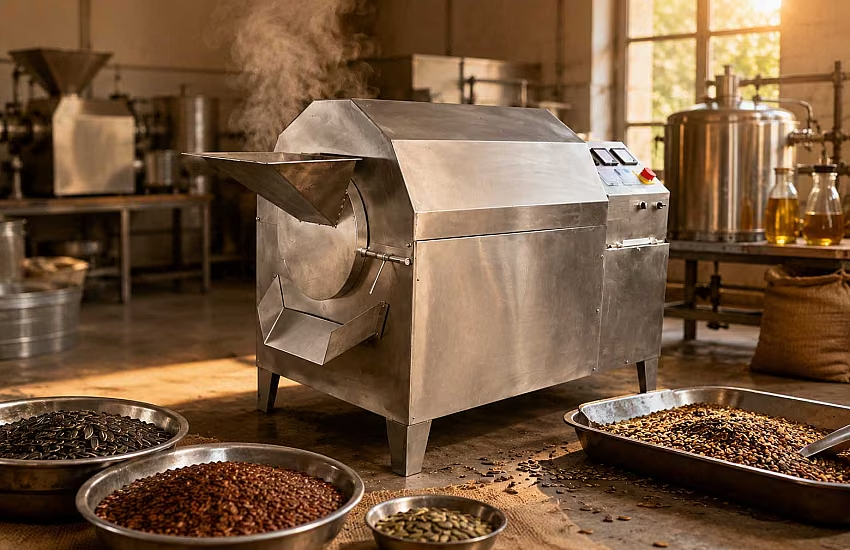
More and more people are discovering that oil does not have to be an anonymous product pulled off a supermarket shelf. It can be something made in your own kitchen, on a farm, or in a small manufactory - from seeds whose origin you know, and according to rules you set yourself. The trend of producing your own oil grows from season to season, and with it returns a question that at first glance seems purely technical, yet in reality decides everything: whether to roast seeds before pressing, and how to do it well. Roasting is the step that is easiest to skip and hardest to master - and at the same time it is the one that most often separates a flat, characterless oil from one with depth, aroma, and personality. In this article we look closely at what happens to a seed under the influence of heat, why roasting is the heart of a good oil mill, and how to control it deliberately.
The Revival of Home Oil Production - Where Does the Trend Come From?
Home and small-scale oil pressing has stopped being a niche for enthusiasts. Year by year, more households, cooks, smallholders, and lovers of healthy eating want to know exactly what ends up in the bottle they put on the table. Oil pressed cold or warm in your own setup offers what mass production cannot - freshness measured in days rather than months, full control over the raw material, and a flavour that has not been standardised for the sake of a long shelf life.
There is more behind this movement than fashion. It is a return to craft, in which a person once again understands the whole process - from seed to finished product. In an era when we buy so many things without knowing how they were made, your own oil mill restores a sense of agency. Add to that a growing awareness of nutrition and a desire to reach for fresh, unprocessed products with a known composition. Oil pressed a few days ago from seeds you chose yourself belongs to an entirely different category than a product of unknown history that has sat on a shelf for months. And since we are talking about full control over the process, it is impossible to ignore the step that many beginners treat as a curiosity, even though it largely determines the quality of the final oil.
From Consumer to Producer
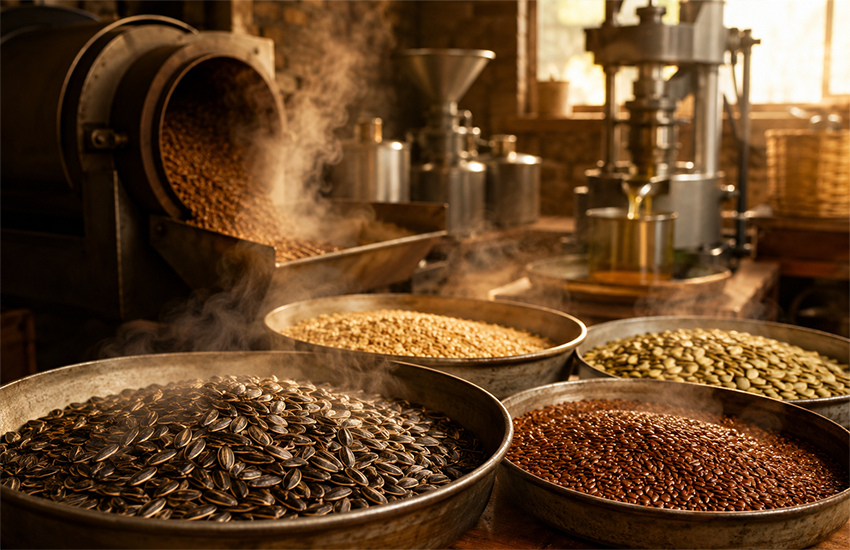
Moving from the role of consumer to that of producer changes your perspective. Suddenly, vague phrases like "healthy oil" or "natural oil" are no longer enough - specific decisions begin to matter. Which seeds to choose, how to store them, whether to grind them, and above all whether and how to roast them. These are questions professional oil mills have been asking for generations, and today they are reaching ordinary kitchens too. The deeper you go, the clearer it becomes that pressing is not a single action but a sequence of deliberate choices, and the heat treatment of seeds is one of the most important among them.
A Raw Material You Fully Control
The greatest value of producing your own oil is that every stage stays in your hands. You know which field the seeds came from, how long they sat in storage, what condition they are in. You can also decide what profile the finished oil should have - mild and delicate, or intense, nutty, with a clear note of roasting. This is exactly where roasting becomes a creative tool. It is not an add-on to the process but an instrument with which you shape the final product as deliberately as a baker chooses the temperature of an oven and a coffee roaster designs a roasting profile.
What Is Seed Roasting and Why Does It Matter So Much?
Roasting is a process of heat treatment in which seeds are heated to a high temperature without the involvement of water. The raw material is surrounded by hot air that penetrates the seed evenly - in a professional machine this takes place inside a rotating drum heated by electric heaters, so that every seed receives a comparable dose of heat. It sounds simple, and yet this seemingly uncomplicated operation triggers a cascade of physical and chemical changes in the seeds that translate directly into the quantity, flavour, and shelf life of the oil obtained.
The importance of roasting is hard to overstate, because it works on several levels at once. First, it changes the internal structure of the seed, making it easier for oil to flow out during pressing. Second, it triggers the reactions responsible for the development of aroma and colour. Third, it serves a hygienic function, eliminating some unwanted microorganisms. For the producer, this means that a single, well-controlled treatment simultaneously influences yield, sensory character, and the safety of the raw material.
Roasting Versus Other Methods of Preparing Seeds
Seeds can be prepared for pressing in various ways - cleaned, ground, conditioned for moisture. Roasting differs from these in that it deliberately uses dry, intense heat to rebuild the seed from the inside. Unlike steaming or soaking, it does not add water but removes it, which is crucial for how the oil and the press cake behave later. As a result, roasting is not merely a preparatory step but a genuine transformation of the raw material, the effects of which can be felt in every drop.
The Three Levels of Roasting Intensity
In practice, roasting is usually carried out in one of three temperature ranges, and the choice depends on the type of seed and the desired effect. Mild roasting, up to around 140 degrees Celsius, gently dries and activates the seed while preserving a subtle flavour profile. Medium roasting, in the 150 to 200 degree range, brings out a fuller aroma and more clearly increases oil flow. High-intensity roasting, reaching up to 300 degrees, produces a deep, strongly nutty character typical of oils with a bold taste. Temperature is therefore not a fixed setting but a deliberate choice that leads to different results from the same raw material.
What Happens Inside the Seed During Roasting?
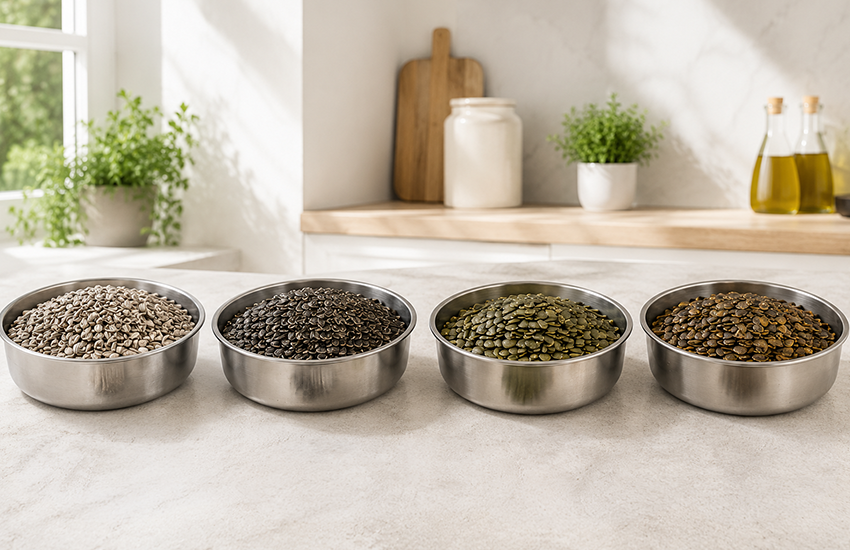
To understand why roasting has such a strong effect on oil, it is worth looking inside the seed. An oilseed is a microscopic store of fat enclosed within cellular structures. The oil does not float freely inside it - it is trapped in tiny vesicles, surrounded by cell walls and bound to other components of the seed. Pressing raw, unprepared seed is like trying to squeeze juice from a fruit with a thick, tough skin. Part of the oil then stays in the mass of the raw material and ends up in the press cake instead of flowing into the bottle. Roasting changes this situation radically, rebuilding the seed so that it gives up far more of what it holds inside.
Breaking Down the Cell Structure and Releasing the Oil
Under the influence of heat, the cell walls of the seed become brittle and partly rupture. The oil, until then locked in vesicles, gains a path of escape and during pressing moves more easily toward the outer part of the material. In addition, heat lowers the viscosity of the oil - warmed fat is thinner, more fluid, and therefore flows out faster and more efficiently under the pressure of the press screw. It is precisely this combination of two phenomena, the weakening of the seed structure and the reduced viscosity of the oil, that makes it possible to press more from roasted material than from raw.
The Maillard Reaction and the Birth of Aroma
The most fascinating dimension of roasting is the chemistry of flavour. As the temperature rises, Maillard reactions take place in the seed - the same ones responsible for the smell of fresh bread, the taste of grilled meat, and the aroma of roasted coffee. The sugars and proteins present in the seed react with one another, creating hundreds of new aromatic compounds. It is thanks to them that oil from roasted seeds smells nutty, toasty, sometimes almost caramel-like, while oil from raw seed remains neutral and bland. Roasting therefore not only releases oil from the seed but actually creates its flavour personality, one that did not exist before.
The Role of Water and Moisture
The water contained in seeds plays a subtle but important role in this process. Fresh or moist seed contains more water, which evaporates in the first phase of roasting. Properly drying the raw material is important, because excess moisture hampers pressing and adversely affects the shelf life of the oil and the press cake. On the other hand, drying that is too aggressive and too fast can lead to uneven roasting and scorching of the surface while the inside remains raw. This is why control matters so much - even, gradual heating in a rotating drum gives a far better result than sudden heating in a frying pan.
How Does Roasting Improve Pressing Efficiency?
One of the most frequently cited reasons to roast seeds is the greater amount of oil obtained during pressing. This is not a marketing slogan but a consequence of the changes in the seeds described above. Raw seed resists the press - its hard, intact structure holds a significant part of the fat inside. Roasted seed is more yielding, its cells are partly opened, and the oil is thinner, so the press squeezes it out more fully and efficiently.
The Mechanics of Oil Flow in the Press
In a screw press, seeds are pushed and crushed in the pressing chamber, and the oil leaks out through gaps while the solid part of the material forms into press cake. The more easily the oil separates from the solid material, the better the pressing result. Roasting supports this separation in two ways. First, it releases the oil from the cellular structures, so it does not remain trapped in the mass. Second, the reduced viscosity of warmed oil allows it to flow more quickly through the gaps of the press before the material has a chance to compact excessively. The result is a smoother, more efficient process.
Cold Pressing and Roasting - Are They Mutually Exclusive?
This question often causes confusion. Contrary to appearances, roasting and cold pressing are not at odds. The term "cold pressing" refers to the fact that during pressing itself the seeds are not heated from the outside, and the oil does not exceed a temperature that would destroy its valuable components. Roasting happens earlier, as a separate stage of preparing the raw material. Many producers combine both approaches - first gently roasting the seeds to bring out aroma and improve oil flow, then letting them cool and only afterward pressing them cold. This yields an aromatic oil that has nonetheless been pressed under gentle conditions. The conscious handling of these stages is one of the skills that distinguishes a mature producer from a beginner. It is worth remembering that the producer decides where in the process and with what intensity to apply heat - and it is precisely this decision-making that lies at the heart of a craft approach to oil.
Aroma, Flavour and Colour - The Sensory Dimension of Roasted Oil
Oil is not just fat - it is a sensory experience that begins with smell and ends with the aftertaste lingering on the palate. Roasting is the most powerful tool for shaping that experience. The same batch of seeds, treated with different temperatures, can give a delicate, almost neutral oil or an intense, deep, expressive one. For the producer this means enormous creative freedom, and for the recipient a richness of flavour they will not find in uniform mass-market products.
How Temperature Shapes the Flavour Profile
The higher the temperature and the longer the roasting, the more intense the aroma. Mild roasting preserves the fresh, slightly grassy or grainy character of the raw material, emphasising its nature without masking it with roasted notes. Medium roasting brings out nutty and toasty notes that for many oils are practically a signature. Strong roasting leads to deep, roasted, almost caramel tones, ideal for oils with a bold, culinary purpose. The key here is to match the intensity to the type of seed and the intended effect, because what works wonderfully with one raw material may dominate the delicate flavour of another.
Colour, Clarity and Shelf Life
Roasting also affects how the oil looks. Higher temperatures usually deepen the colour, giving oils a warmer, more golden or amber hue. Properly dried raw material also tends to yield a clearer oil, with less water and fewer residues that could accelerate spoilage. It is important, however, to keep a sense of proportion - overheating the raw material can worsen quality and introduce unpleasant, bitter notes. This is why the art of roasting lies in finding the balance between drawing out aroma and preserving the nobility of the oil, and that balance is easiest to achieve with precise temperature control.
Roasting Different Seeds - Rapeseed, Sunflower, Pumpkin, Flax and More
There is no single universal method of roasting, because every type of seed has its own structure, fat content, and sensitivity to heat. A good producer treats roasting as a dialogue with the raw material - adjusting temperature and time to what is in front of them. Below are a few general principles worth knowing as you begin your adventure with the heat treatment of oilseeds.
Classic Oilseeds
Rapeseed and sunflower are raw materials that respond very well to roasting. Light to medium roasting clearly improves oil flow and gives it a pleasant, nutty aroma. This is a popular choice among those starting their own production, because these seeds are widely available, high in fat, and forgiving of small mistakes. In their case, roasting produces an oil with a distinct character and at the same time a relatively high pressing yield.
Seeds With a Delicate Structure
Flax and hemp seeds call for greater caution. They contain sensitive fatty acids that more easily undergo unfavourable changes under high temperatures. For these, mild roasting is often used, or intense heating is avoided altogether, in order to preserve the fresh, raw profile and the delicate qualities of the oil. If we do roast them, we do so with restraint, treating temperature as a subtle tool rather than a means of extracting maximum aroma.
Seeds That Need Higher Temperatures
Sesame, pumpkin seeds, and some nuts can develop their flavour beautifully only with more pronounced roasting. It is from strongly roasted sesame that oils with a deep, characteristic aroma are made, indispensable in Asian cuisine. Likewise, oil from roasted pumpkin seeds gains an intense, dark colour and an expressive taste owed precisely to heat treatment. Here roasting is not an add-on but practically a condition for creating a product with the expected character, which is why temperature control is decisive.
Roasting, Hygiene and Raw Material Safety
Roasting has one more dimension that is easy to forget when focusing on flavour and yield - it is a natural method of improving the safety of the raw material. High temperature not only rebuilds the seed but also limits the presence of unwanted microorganisms on its surface. For a producer who cares about the quality and shelf life of their oil, this is an important reason to treat heat treatment as a permanent part of the process.
Natural Elimination of Microorganisms
During roasting, hot air acts on the surface of the seeds, reducing the fungi and microorganisms that may have settled on the grain during harvest and storage. This is a kind of natural sanitation of the raw material, requiring no chemicals, only a suitably chosen temperature. Cleaner raw material means a cleaner, more durable oil and better-protected press cake that retains its properties longer after pressing.
Roasting in Feed Preparation
It is worth mentioning that roasting has long played an important role in preparing animal feed as well. Heat treatment of grain eliminates some anti-nutritional factors, increases protein digestibility, and improves the usability of the raw material. An interesting fact is that roasted barley is valued for its disinfecting properties, helpful in preventing digestive ailments in young animals. For a farm that presses oil and at the same time uses press cake and grain as feed, a roaster thus becomes a device with double practical value.
The Electric Grain Roaster 40-50 kg/h - The Heart of a Small Oil Mill
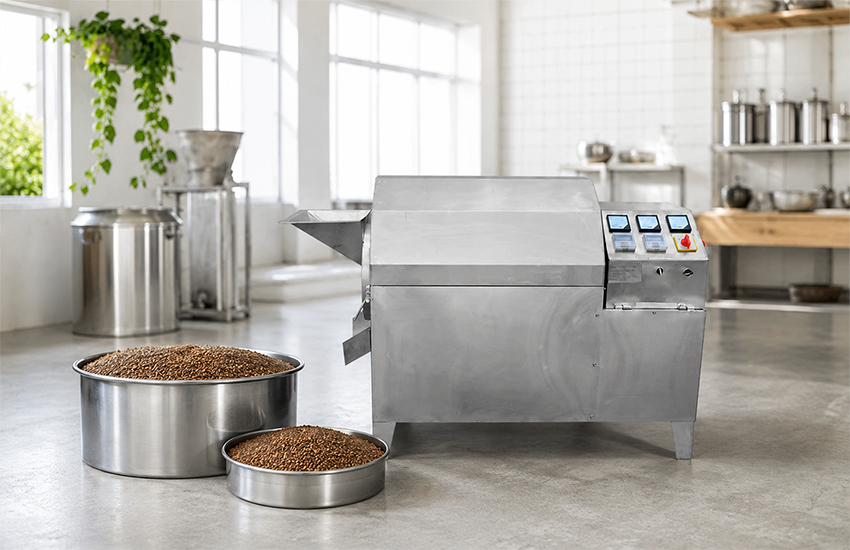
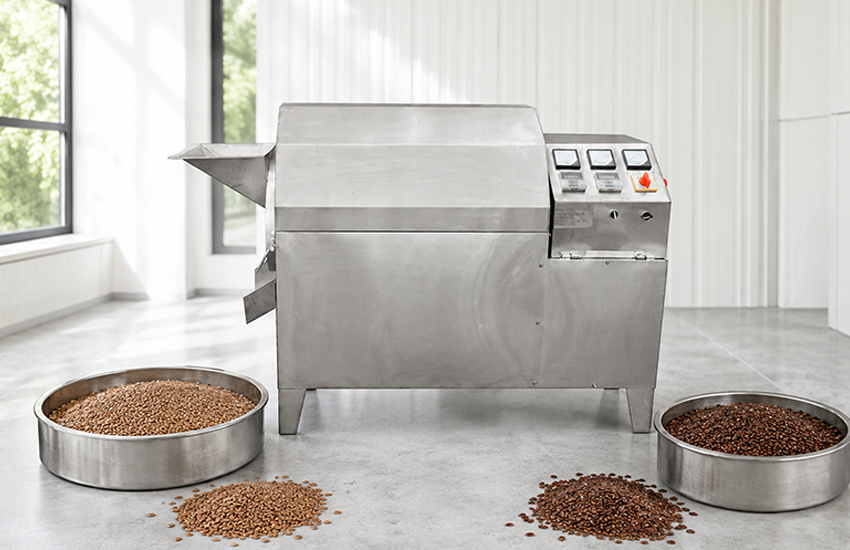
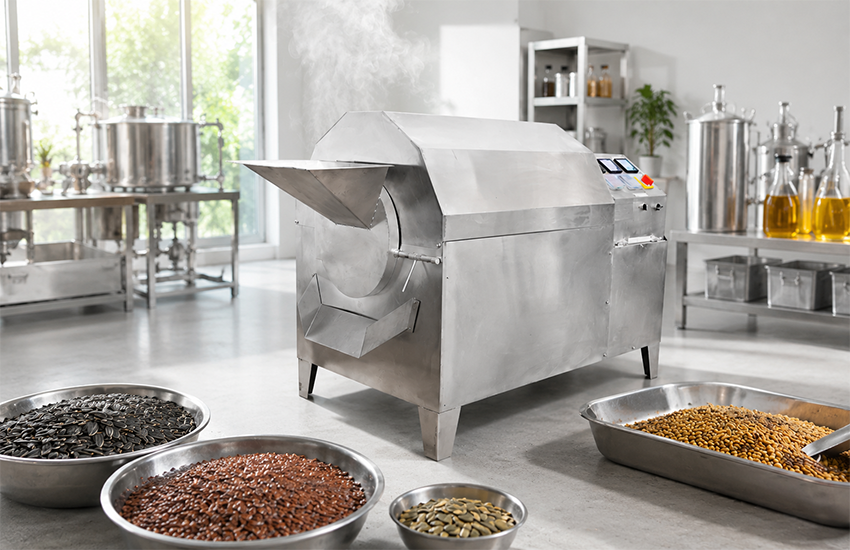
Since roasting plays such an important role, the quality of its results depends largely on the device you use to carry it out. Improvising on a frying pan or in a home oven may be enough at the very beginning, but it quickly reveals its limitations - uneven heating, no temperature control, scorched fragments next to raw ones. A professional approach calls for a tool built for the task, and one such solution for a growing operation is the Electric Grain Roaster - 40-50 kg/h.
This machine is designed with small production facilities and home oil mills in mind, for those who want to raise their production to a higher level. It roasts seed in a rotating drum heated by electric heaters, so the raw material is heated evenly, without cold or overheated zones. A capacity of 40 to 50 kg per hour and a single batch load of 20 to 25 kg make it suitable for regular, repeatable work rather than only occasional trials.
Precise Temperature Control and Even Roasting
The heart of good roasting is control, and this is provided by a precise digital thermostat that lets you set and hold the desired temperature. This is a crucial function when you remember how much the final result depends on a few degrees of difference. The maximum roasting temperature reaches 300 degrees Celsius, giving full freedom - from gently drying delicate seeds to strong, intense roasting of raw materials that develop their flavour only at high heat. The rotating drum ensures that every seed receives a comparable dose of heat, which translates into repeatable and predictable results.
Stainless Steel, Hygiene and Ease of Use
The components of the machine are made of stainless steel grades 304 and 201, which greatly simplifies keeping it clean - a matter not to be underestimated in food production. Smooth, resistant surfaces do not absorb odours or fat and are easy to clean, which has a direct impact on the quality of subsequent batches. The design provides convenient loading and collection of the raw material thanks to a feed hopper and a lockable discharge chute, so operation remains intuitive even for those just starting out with a professional roaster, and roasted seeds are collected in a dedicated container included with the machine.
Who Is This Machine For?
A roaster with a capacity of 40 to 50 kg per hour is a proposition for those who take their own oil production seriously - for small oil mills, farms transforming into manufactories, and enthusiasts who have already passed the stage of first experiments and want to obtain repeatable, high-quality oil. With a weight of around 200 kg, dimensions of 163 by 77 by 100 cm, a power of 9.75 kW, and a 400 V supply, this is stationary equipment intended for regular work in a designated place. For someone building production with steady, good results in mind, the roaster marked with the code HDF-150 becomes the central point of the entire process, around which the rest of the oil mill's work is organised.
How to Roast Seeds for the Best Oil? Practical Tips
Knowing why roasting is important is only half the journey. The other half is practice - the deliberate handling of temperature, time, and observation of the raw material. Below are a few principles that help beginners reach good results faster and avoid the most common mistakes.
Match the Temperature to the Seed Type
The first and most important rule is this: there is no single temperature for everything. Delicate seeds such as flax or hemp are roasted mildly or not at all, so as not to destroy their sensitive components. Classic oilseeds such as rapeseed and sunflower tolerate light to medium roasting well, which brings out aroma and improves oil flow. Raw materials such as sesame or pumpkin seeds develop their full flavour only with stronger roasting. Before setting the temperature, then, consider what oil you want to obtain and what you are pressing it from.
Watch the Time and the Changes in the Seed
Roasting is a process worth following closely, especially at the start. The changing smell, colour, and sound of the seed are valuable signals. Over time you develop a feel that lets you recognise the moment of optimal roasting before the raw material crosses the line and begins to scorch. A good practice is to keep your own notes - recording the temperature, time, and result for a given type of seed. This makes successive batches increasingly repeatable, and the producer moves from guessing to deliberate control of the process.
Let the Seeds Rest Before Pressing
After roasting, it is worth letting the seeds cool a little before they go into the press, especially if you care about pressing under gentle conditions. A short rest allows the temperature to even out across the whole mass of raw material and stabilises its structure. This is a simple step that is sometimes skipped in haste, yet it can noticeably improve the quality and predictability of pressing. Patience at this stage often pays off with a better, cleaner oil.
Common Mistakes When Roasting Seeds - and How to Avoid Them
The road to well-roasted seed usually passes through a few typical missteps. Knowing these pitfalls lets you avoid them rather than learning the hard way on wasted batches of raw material. Most mistakes stem not from ill will but from haste and from attempts to speed up a process that runs at its own pace.
Too High a Temperature and Too Much Haste
The most common mistake among beginners is the urge to speed up roasting by turning up the temperature. The effect is often the opposite of what was intended - the surface of the seed scorches while the inside remains raw and underroasted. Such raw material gives an oil with a bitter, burnt aftertaste that is hard to fix at later stages. It is better to run the process a little more slowly, letting the heat penetrate the seed evenly. Patience and gradual heating almost always give a better result than aggressive, sudden roasting aimed solely at saving time.
Uneven Roasting and Lack of Control
The second common problem is uneven roasting of the raw material, typical of improvised methods such as a frying pan or an ordinary oven. When the seed is not constantly moved, some fragments receive too much heat and others too little, which translates into inconsistent flavour and lower predictability of pressing. The solution is a device with a rotating drum, in which the raw material is continuously mixed, together with a thermostat that keeps the temperature in check. Control is the key word - without it, roasting becomes a lottery, and with it a repeatable, deliberate process.
Roasting Moist or Poorly Stored Raw Material
The third mistake is disregarding the condition of the raw material itself. Moist, improperly stored seeds roast unevenly and can yield an oil with poorer shelf life. Before the grain goes into the roaster, it is worth making sure it was stored correctly, in a dry and airy place, away from moisture and foreign odours. The quality of the finished oil begins long before pressing - already at the stage of storage and preparation of the raw material - and roasting works best when it has clean, dry seed in good condition to work with.
Roasting as the Daily Rhythm of Your Own Oil Mill
When roasting becomes a permanent part of the process, the way you look at oil production changes. It stops being a one-off squeeze of seeds in a press and becomes a sequence of connected stages, each of which matters. Selecting and storing the raw material, roasting, the optional rest of the seed, pressing, filtration, and bottling - all of this adds up to a rhythm that in time gets into your blood. In this rhythm the roaster plays a special role, because it is there that decisions are made which shape the character of the entire batch.
Producing your own oil is an adventure in which you grow together with the process. The more you understand, the better your results, and roasting is one of those areas where knowledge and intuition translate into flavour in an immediate, tangible way. It is the step that turns ordinary pressing into a genuine craft - and for many producers this very awareness is the most beautiful part of the whole journey from seed to bottle. It is worth devoting attention to it, experimenting with temperature and time for different seeds, keeping notes, and gradually building your own style. With a good roaster, a little patience, and growing knowledge, anyone can produce oils whose flavour and aroma surpass what mass production offers - and the satisfaction of having made them yourself is a value that cannot be bought.
Frequently Asked Questions (FAQ)
Is roasting necessary for pressing oil?
Roasting is not strictly necessary - oil can also be pressed from raw seeds, and for some delicate raw materials such as flax it is often deliberately avoided in order to preserve their sensitive components. It is, however, a step that significantly increases oil flow, enriches aroma, and improves the safety of the raw material. For those who want an expressive, characterful oil and a higher pressing yield, roasting is one of the most important tools, which is why in practice many producers treat it as a standard part of the process.
What temperature should I roast oilseeds at?
It all depends on the type of seed and the desired effect. Mild roasting is usually carried out up to around 140 degrees Celsius, medium roasting in the 150 to 200 degree range, and high-intensity roasting up to 300 degrees. Delicate seeds are roasted at lower temperatures or not at all, classic oilseeds tolerate the light to medium range well, and raw materials such as sesame or pumpkin seeds develop their flavour at higher heat. It is best to start with milder settings and gradually adjust the temperature to the specific raw material, noting the results.
Does roasting reduce the nutritional value of the oil?
Roasting carried out with restraint and under control need not worsen the quality of the oil, and may even improve its shelf life thanks to better drying of the raw material. The problem appears only with excessive, too aggressive heating, which can adversely affect sensitive components, especially in seeds rich in delicate fatty acids. This is why precise temperature control matters so much - skilful roasting lets you draw out aroma and increase oil flow while preserving the noble character of the oil.
How long should I roast seeds before pressing?
There is no single universal time, because it depends on the type of seed, its moisture, the set temperature, and the expected effect. Rather than following a rigid clock, it is worth observing the seed itself - its smell, colour, and structure. A changing aroma and a deepening colour are signals that the process is progressing. Over time the producer develops a feel and recognises the optimal moment. It helps to keep notes of the temperature and time for a given raw material, which makes successive batches increasingly repeatable.
Can all seeds be roasted?
Most oilseeds can be roasted, but not all react to heat in the same way. Classic raw materials such as rapeseed, sunflower, sesame, and pumpkin seeds tolerate heat treatment very well, and often only develop their full flavour thanks to it. Seeds containing sensitive fatty acids, such as flax or hemp, on the other hand, require far greater caution and are often roasted very mildly or not at all. The key is to match the roasting intensity to the specific raw material rather than applying a single scheme to everything.
How is a roaster different from an oven or a frying pan?
A frying pan or a home oven may be enough for first experiments, but they provide neither even heating nor precise temperature control. The result is often unevenly roasted seed - some scorched, some still raw. A professional roaster roasts the raw material in a rotating drum, in which hot air evenly surrounds every seed, while a digital thermostat lets you precisely set and hold the temperature. This makes the results repeatable and gives the producer full control over the process, which is decisive in regular oil production.
How much grain can the 40-50 kg/h roaster handle?
The electric grain roaster with a capacity of 40 to 50 kg per hour allows a single batch load of 20 to 25 kg of raw material, and over an hour of work it handles the stated 40 to 50 kg of grain. These parameters are intended for regular, repeatable production in small oil mills and farms, not merely for occasional trials. Thanks to this capacity, the machine keeps pace with the work of the press and lets you run the whole process smoothly - from roasting successive batches to pressing them - without bottlenecks slowing down production.