
Table of Contents
- Why Supermarket Oil Has No Face - and Why That Is a Huge Opportunity
- What a Taste Signature Actually Is
- Anatomy of a Recognisable Oil - The Variables the Producer Controls
- The Press as an Instrument - The Machine's Role in Building a Signature
- From a Single Oil to a Signature Blend
- A Sensory Vocabulary - How to Talk to Customers About Your Oil
- How a Signature Translates Into a Brand
- Own Production as the Prerequisite for Having a Signature
- A Practical Step-by-Step Plan for Developing Your Own Signature
- Frequently Asked Questions (FAQ)
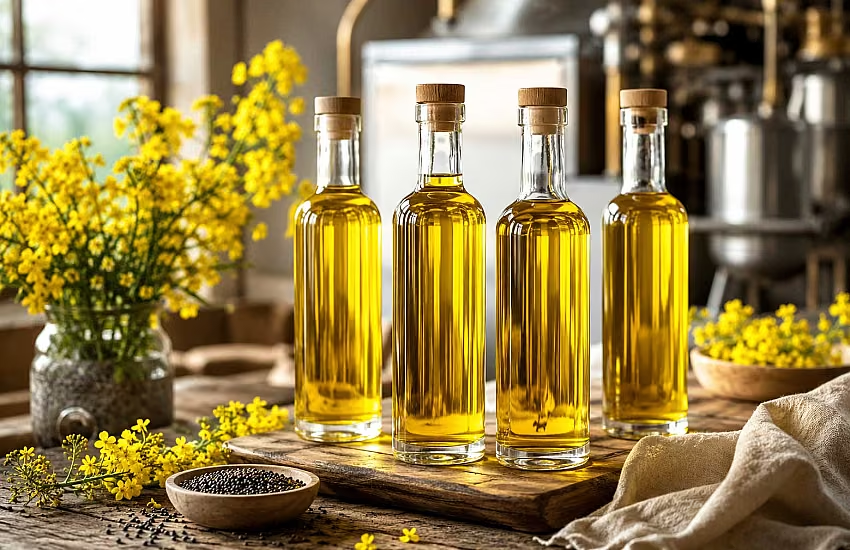
Picture a blind tasting. A dozen unlabelled bottles stand on the table, and among them is the oil from your press. Someone dips a spoon, lifts it to their lips, pauses for a moment and says: "This is the one made by that farm near the woods." They never saw a logo. They never read a name. And yet they recognised it. That is the precise moment a product stops being an anonymous commodity and becomes a brand. Something you can identify with your eyes closed carries a value no clever slogan or beautifully designed label will ever build.
In a world where shelves sag under oils that look almost identical, the hardest thing to copy is not the packaging or the description on a website. The hardest thing to imitate is taste - a specific, repeatable, characterful profile that customers learn to associate with one maker and one maker only. That profile can be called a signature. Just as a winemaker has a style, a coffee roaster a character, and a baker a recognisable loaf, an oil producer can develop their own unmistakable signature in a bottle. This article is about building exactly that - from the seed, through the oil press, all the way to the customer's awareness.
More and more farms, manufactories and enthusiasts are discovering that pressing your own oil is not only a way to put a healthy product on your own table. It is also the foundation of a brand built around a specific person, place and way of working. The taste signature sits at the very heart of that foundation.
Why Supermarket Oil Has No Face - and Why That Is a Huge Opportunity
The average oil from a chain store is a perfectly anonymous product. It is made from raw material drawn from many sources, standardised so that batch after batch tastes exactly the same - which is to say, of almost nothing at all. For decades the food industry has worked to make oil neutral, predictable and stripped of any feature that might surprise anyone. That makes sense at industrial scale, but it has one side effect: such oil has no face. Nobody asks who made it, because the answer is - nobody in particular.
This is exactly where space opens up for the small producer. Where large scale forces uniformity, a small oil mill can stake everything on the opposite value - character. Cold-pressed oil from one specific field, from seeds harvested in a particular season, processed by one person according to their own method, carries qualities a factory will never reproduce. And that is not a flaw or an imperfection. It is precisely the kind of distinctiveness that today's consumer, tired of the anonymity of the supermarket shelf, has been craving.
It is worth noting how the way we buy food is changing. People want to know where what they eat comes from, who stands behind it, and how a given product differs from dozens of others. In this context, a vivid, recognisable taste becomes the strongest argument of all - far more powerful than any claim on a label. Because a claim can be written about any product. A signature cannot be written. It has to be developed at your own press, spoon by spoon, batch by batch.
Small-scale production, then, does not compete with industry on industry's terms. It plays an entirely different game - a game of singularity, in which the anonymity of the competition is its greatest asset.
What a Taste Signature Actually Is
A taste signature is a consistent, recognisable and repeatable sensory profile that a customer can attribute to a specific producer. It is woven from a whole tangle of impressions - the intensity of the aroma, a nutty or grassy note, the presence or absence of bitterness, the body on the palate, the length of the finish, even the colour of the oil in the glass. It is not a single trait but a harmony of many, always arranged in the same characteristic way.
The best analogy remains the world of wine and coffee. Two winemakers from neighbouring vineyards, working with the same grape variety, will produce two entirely different wines - because each makes different decisions at every stage. Likewise, a coffee roaster builds its character through a roasting profile that becomes its hallmark. Exactly the same mechanism operates in oil. The same rapeseed, sunflower or flax seeds, run through a press by two different people, will yield two different oils. The difference lies in the hundreds of small choices that add up to the maker's style.
A Style That Cannot Be Copied
A signature is so valuable precisely because it is practically impossible to replicate. A competitor can study your label, copy your product description, even use a similar bottle. But they cannot reproduce your taste, because it arises from a unique combination of raw material, equipment, working parameters and personal intuition. It is the sum of decisions only you make - decisions that not even your closest competitor fully knows.
The longer you work on your oil, the deeper and more settled that style becomes. After a while the signature grows so distinctive that a customer reaching for another brand's oil immediately senses the difference. That is the moment you stop competing on price or availability and begin competing on identity. And nobody can buy identity wholesale.
Repeatability as the Heart of a Signature
A vivid taste is only half the battle. The second, far harder half is repeatability. A signature does not exist if every bottle tastes different. A customer who once fell in love with your oil and came back for another bottle expects exactly the same experience. If they get it, you build trust and loyalty. If they do not, you lose the most precious thing of all - the predictability of the brand.
This is where pressing oil "by feel" ends and conscious craft begins. Repeatability demands control over every important parameter of the process and the keeping of your own notes - the type of raw material, its moisture, the pressing temperature, the press settings. It is a little like keeping a recipe book you return to with every batch. Without that discipline the taste will drift and the signature will never stabilise. With it, repeatability stops being a matter of luck and becomes craft you can fully control.
A separate challenge is the natural variability of the raw material between seasons. Seeds from different harvests are never identical - different weather, different moisture, a different growing season mean that the same species can vary in character from year to year. An experienced producer learns to compensate for this, gently adjusting the pressing parameters so that, despite the changing raw material, the final profile stays faithful to the signature. This is the higher school of the craft, the one that separates the accidental maker from the conscious brand builder - and another reason why full control over the process and a precise, predictable machine matter so much.
Anatomy of a Recognisable Oil - The Variables the Producer Controls
A signature does not come from nowhere. It is built from concrete, deliberate decisions taken at successive stages of production. Each of those stages is a dial the producer can turn, shaping the final character of the oil. The better you understand how each variable works, the more precisely you can compose your own style.
Seed Selection and Origin
Everything begins with the raw material. The plant variety, the region of cultivation, the type of soil, the course of the weather in a given season - all of it leaves a trace in the oil. Flax from one field will have a different profile from flax grown on another, even though both are the same species. A producer building a signature treats the choice of seed as the first decision about flavour, not merely a logistical one. A steady relationship with a specific supplier, or working from your own crops, delivers the repeatability without which there can be no consistent style.
Quality and preparation of the raw material matter too. Seeds of the right low moisture and good cleanliness press differently from contaminated or damp ones. For many oils the optimal raw material is seed with an oil content above fifteen per cent and moisture below ten per cent. A deliberate choice and consistency at this stage form the foundation on which the rest of the signature is built.
Roasting Profile and Hot Pressing
Temperature is one of the most powerful tools for shaping flavour. Roasting the seeds before pressing, or hot pressing itself, in which the seeds work at high temperature, completely changes the character of the oil. Deep, nutty, sometimes almost caramel and toasted notes appear, and the aroma becomes more intense and expressive. This is precisely the difference between a delicate, fresh oil and an oil with a strong, roasted character.
A roasting profile can become a brand's recognisable signature. One producer will opt for a light, subtle toast, another for stronger, almost espresso-like notes. Hot pressing also makes it possible to extract oil from more difficult raw materials, such as hulled sunflower or coconut flakes, and to obtain a higher yield. Deliberately working this parameter - always to the same proven scheme - is one of the fastest routes to building a distinctive style.
Cold Pressing and Temperature Control
At the opposite pole sits cold pressing - the most natural and healthiest method of obtaining oil. The oil then never exceeds around forty degrees Celsius, which preserves the full range of nutrients, the natural aroma, the colour and the fresh taste of the raw material. It is the method for producers who want their signature to be precisely that purity and fidelity to the seed - delicacy, freshness, a light grassy note and the clear character of one specific seed.
Cold-pressed oil is rich in unsaturated omega-3 and omega-6 fatty acids, which makes it not only a flavour but also a health distinction for the brand. The key here is temperature control - its stability batch after batch decides whether the profile stays repeatable. A producer who can hold the same conditions every time gets the same recognisable oil every time. It seems a minor detail, yet in practice it is the very essence of a repeatable signature.
Filtration and Clarity
The final stage of shaping a signature is how you treat the freshly pressed oil. Some producers favour a naturally cloudy, unfiltered oil with a light sediment that underlines its artisanal, raw character. Others prefer oil that is clear, transparent and gleaming in the glass. Both paths are entirely valid - what matters is choosing one and sticking to it consistently, because the appearance of the oil in the bottle is also part of its signature.
Clarity affects not only taste and visual impression but also shelf life. The decision whether and how to filter, how long to let the oil settle naturally, at what temperature to store it - all of it adds up to the final, recognisable effect. Consistency at this stage closes the whole process of building character.
The Press as an Instrument - The Machine's Role in Building a Signature
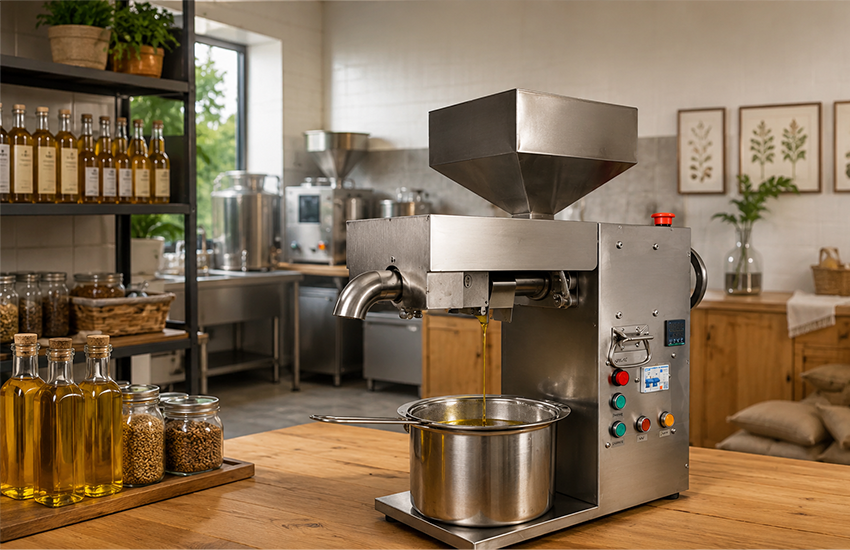
You can have the best idea for a flavour and the best raw material, but without the right tool no signature will ever be reproduced. An oil press is to a producer what an instrument is to a musician - it turns intention into a concrete, repeatable result. That is why choosing the machine is not merely a technical decision but a cornerstone of the whole brand identity. The instrument has to be precise and versatile enough to let you develop your own style, and stable enough to reproduce that style time after time.
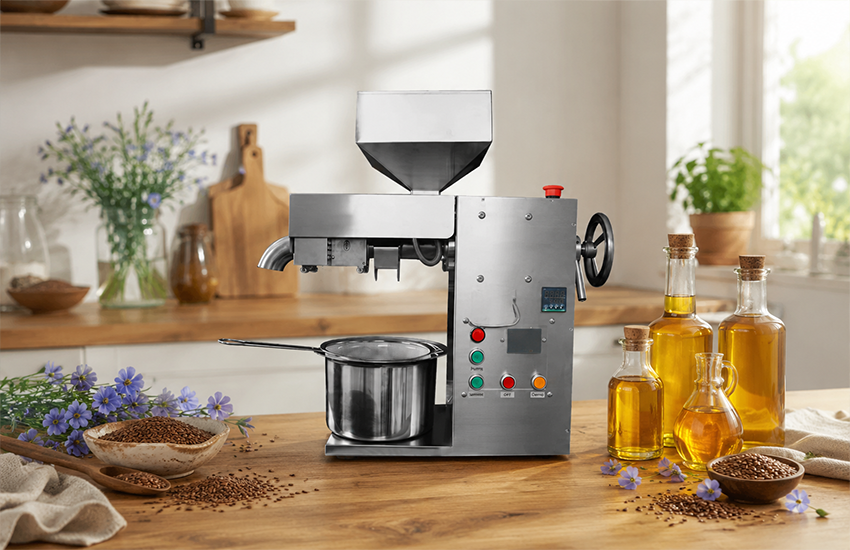
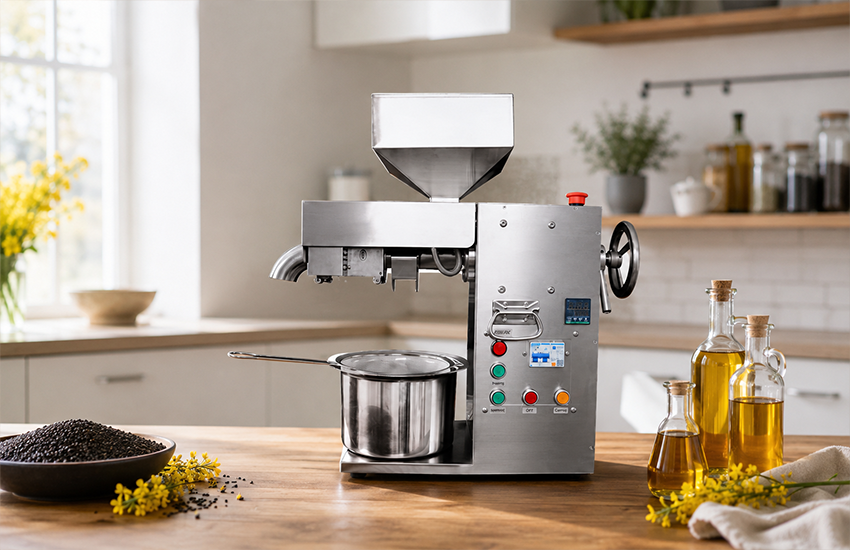
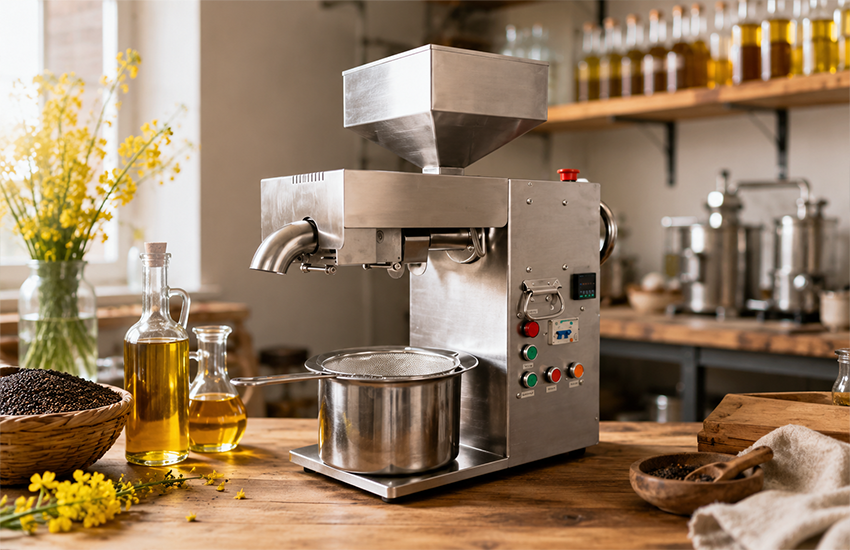
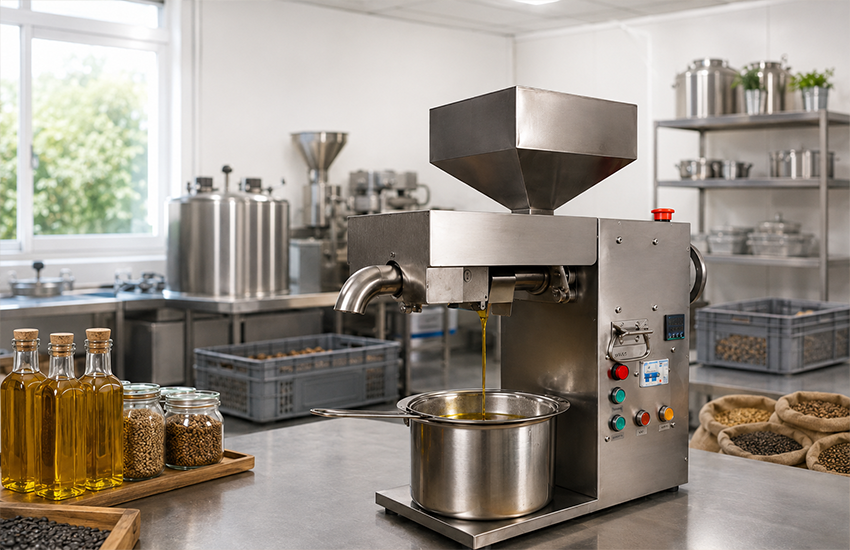
A perfect example of such an instrument is the semi-industrial oil press with a capacity of 15-20 kg/h. This machine combines a compact footprint with output that will comfortably serve both home production and a small professional oil mill or an agritourism farm building its own brand. Most importantly, though, it gives the producer a remarkable degree of control over the signature.
The press handles both cold and hot pressing, with a temperature reaching up to 250 degrees Celsius. That means complete freedom in shaping the profile - from a delicate, fresh cold-pressed oil to the strong, nutty character of hot pressing. The set includes two interchangeable screws, which let you match the machine's work to different raw materials and fine-tune the result with even greater precision. It is exactly this versatility that turns a single device into a palette of possibilities on which the producer composes their signature.
The build matters too. The surface of the machine is made of stainless steel compliant with food hygiene standards, while the components in contact with the raw material are made of grade 304 and 420 stainless steel. For a brand that builds its value around the quality and purity of the product, that carries enormous weight - hygiene and durability are, after all, part of the promise made to the customer. At 53 kilograms and with compact dimensions of 70 by 30 by 74 centimetres, the machine fits even a small workshop, and a power supply from the domestic 230 V mains means production can be set up almost anywhere.
For the sake of clarity it is worth gathering the most important parameters, because these are what translate into the real ability to shape a signature.
| Specification | Value |
|---|---|
| Capacity | 15-20 kg/h |
| Oil residue in press cake | up to 5% |
| Max. pressing temperature | up to 250°C |
| Motor | 1.5 kW |
| Heater | 500 W |
| Hopper capacity | 4-5 kg |
| Power supply | 230 V 50 Hz |
| Weight | 53 kg |
| Dimensions | 70 x 30 x 74 cm |
What makes this machine especially valuable for brand building is repeatability. Stable settings, predictable screw operation and temperature control mean that a profile, once developed, can be reproduced indefinitely. And that, after all, is the precondition for any signature to exist - without repeatability, only chance remains.
From a Single Oil to a Signature Blend
Once a producer has mastered pressing individual oils and developed a stable style, a further level of brand building opens up - signature blends. Just as a perfumer combines fragrance notes and a winemaker creates a cuvée from several varieties, an oil maker can compose their own blends that cannot be found anywhere else. This is the highest school of the signature, because such a composition is by definition unrepeatable.
The possibilities are vast. You can combine a mild rapeseed oil with an expressive flaxseed oil, add a note of oil from roasted seeds for depth, balance the bitterness with a sweeter component. Every such recipe becomes a unique product and, at the same time, an element that defines the brand. The customer is no longer simply buying "flaxseed oil" - they are buying a specific composition signed with the producer's name, one they cannot get from anyone else.
A versatile oil press is the essential condition here, because composing requires freely obtaining many different base oils from different raw materials and at different parameters. The ability to press both cold and hot, to work with a broad range of seeds and nuts, and the interchangeable screws, give the producer a full palette of ingredients for creating their own recipes. It is at this stage that the brand stops being an oil maker and becomes the author of products that simply cannot be imitated.
A Sensory Vocabulary - How to Talk to Customers About Your Oil
A developed signature needs words that help the customer notice and name it. Most people do not have a rich vocabulary for the taste of oil and often cannot put into words what they are experiencing. The producer's role is to hand them that language - to gently guide their attention, to suggest what to look out for and how to describe the impression. This is one of the most underrated elements of brand building, and at the same time one of the most effective.
It is worth describing your oil in a concrete, vivid way. Instead of a vague "tasty," it is better to say the oil has a distinct hazelnut note, a light grassy freshness, or a delicate, pleasant bitterness in the finish. Such descriptions not only help the customer recognise the character of the product but also build an aura of refinement and intention around it. A customer given words to describe what they feel on the palate remembers the experience far better and shares it with others more readily.
A consistent sensory vocabulary gradually becomes part of the brand's identity. If you consistently describe your oil with the same characteristic terms, those terms begin to fuse with the product in the minds of your audience. A coherent whole then emerges - a recognisable taste described in a recognisable language. You can go a step further and suggest specific culinary uses that best showcase a given profile: which dishes it suits, what to pair it with, how to serve it. In this way the producer is no longer selling merely a bottle of oil, but a whole flavour experience of which they are the author and the guide.
How a Signature Translates Into a Brand
Developing a recognisable taste is not art for art's sake. It is a real brand-building tool that translates into concrete effects - understood here not as calculations but as a lasting relationship with the customer and the power of recognition. A signature works on several levels at once, and each of them strengthens the producer's position.
Recognition and the Customer's Sensory Memory
Taste lodges in the memory differently from an image or a word. Impressions of flavour and aroma are linked in the human brain to emotions and memories more strongly than any other stimulus. A customer who has once experienced a vivid, characterful oil remembers it on a deeper level than a logo or a name. When they encounter that taste again, they recognise it instantly - and recall the feelings that accompanied it.
That sensory memory is the foundation of loyalty. It is thanks to it that a customer comes back, recommends the oil to friends and distinguishes it from the competition without looking at the label. A brand that has built a strong signature holds a place in the customer's mind that cannot easily be taken. It is the most durable kind of advantage a small producer can build.
A Story That Sells Without Words
A taste signature is a natural starting point for the story of a brand. Every decision that makes up the oil's profile - the choice of specific seeds, the way they are roasted, the pressing method - is ready material for a story you can share with the customer. The producer stops selling the product itself and starts sharing the story of how it came to be, their philosophy, and the choices that made this oil exceptional.
Crucially, that story is credible, because it is backed by taste. The customer does not just read it - they taste it. This is an entirely different kind of communication from empty marketing claims. The story of the producer, their press and their way of working gains its power precisely when it finds confirmation in the bottle. Signature and narrative feed off each other, creating a coherent, persuasive image of a brand built around a specific person.
Press Cake and Companion Products as Part of the Signature
A signature does not end with the oil. The pressing process also yields press cake - a valuable by-product that can become an extension of the brand and its character. Press cake works wonderfully as animal feed and as an addition to baking, salads and spreads, and once ground it turns into an aromatic flour that carries the character of the raw material and the pressing method.
A producer building a signature can treat press cake not as waste but as another element of a coherent offering. A flour from press cake with a distinctive profile, bars, crackers or culinary additions signed with the same brand broaden its presence and reinforce the image of a maker working in the spirit of zero waste. In this way a single batch of seeds gives rise to a whole family of products united by one recognisable character - and the brand gains a depth and consistency that the anonymous industry simply cannot offer.
Own Production as the Prerequisite for Having a Signature
It has to be said plainly - you cannot have a signature by buying ready-made oil and merely labelling it. The character described here is born only when the producer controls the entire process: from the choice of seed, through the pressing parameters, all the way to filtration and bottling. Only your own production gives you authority over every dial that shapes the flavour. Handing any of those stages over to someone else means losing control over the most precious thing of all.
This is why the trend of pressing your own oil is gaining such significance today. More and more farms, manufactories and enthusiasts are recognising that an oil press of your own is not only a way to a healthy, fresh product but, above all, the foundation of an independent, recognisable brand. With a press, the producer stops depending on suppliers of ready-made oil and gains the freedom to create a product exactly as they want it to be - from the first drop to the last.
Own production also means full transparency, which is what the modern customer expects. The producer can say, with a clear conscience, where the raw material comes from, how the pressing proceeds and exactly what goes into the bottle. In a world where trust in food can be fragile, such openness is a powerful argument. And all of it begins with a single decision - choosing the press that will become the instrument of brand building. Compact, versatile and efficient, the semi-industrial oil press is, for many beginning and growing producers, a natural first step on that road.
A Practical Step-by-Step Plan for Developing Your Own Signature
Building a recognisable style does not have to be chaotic. It is best treated as a deliberate process carried out methodically, stage by stage. The first step is exploration - at the outset it is worth pressing several different raw materials, cold and hot, at varying settings, and tasting each result attentively. This period of free experimentation lets you discover which flavour direction appeals to you most and what you want to become your signature.
Once you find a profile that feels like your own, it is time to lock it in. This is where meticulous note-taking begins - the type and origin of the raw material, its moisture, the method and temperature of pressing, the press settings and the filtration approach. These notes are your recipe book, the one you will return to with every batch. Without them repeatability remains a matter of luck; with them it becomes a craft you can fully control.
The next stage is verifying repeatability. Press the same recipe several times on different days and check whether the result is consistent. If differences appear, look for their source - it usually hides in the raw material or in parameters that were not reproduced precisely. Only when you can consciously and reliably reproduce the same profile can you consider the signature ready to build a brand around. The final step is telling customers about it - giving it a name, a story and a place in the brand's communication, so that taste and narrative form one coherent whole.
It is a process that takes time and patience, but that is exactly why it is so hard to copy. A signature is the sum of weeks and months of conscious work at your own press - and that is what makes it so valuable.
Frequently Asked Questions (FAQ)
What is a taste signature in oil and how do you build one?
A taste signature is a consistent, recognisable and repeatable sensory profile that a customer can attribute to a specific producer. You build it through deliberate decisions at every stage of production - from the selection and origin of the seed, through the method and temperature of pressing and the roasting profile, all the way to the approach to filtration. The key is repeatability, the ability to reproduce the same profile in every batch. That requires keeping notes of your parameters and working on a machine that lets you stably recreate the same conditions.
Is a single press enough to develop your own oil style?
Yes, provided it is a sufficiently versatile machine. A press that handles both cold and hot pressing, works with a broad range of raw materials and comes with interchangeable screws gives you a full palette for shaping flavour. A semi-industrial oil press with a capacity of 15-20 kg/h, two screws in the set and a temperature range up to 250 degrees Celsius makes it possible to create both delicate cold-pressed oils and strong, nutty hot-pressed oils, and even to compose signature blends.
What matters more for the character of an oil - the raw material or the pressing method?
Both factors are crucial and work together. The raw material sets the starting point - the variety, the region of cultivation, the soil and the season all leave their trace in the oil. The pressing method then decides how that potential is drawn out and shaped. Cold pressing emphasises freshness and fidelity to the raw material, while hot pressing and roasting add depth and nutty, toasted notes. A signature is born only from the combination of a deliberate choice of raw material with a consistently applied pressing method.
Why is repeatability so important in building an oil brand?
Because a brand rests on trust and predictability. A customer who fell in love with your oil and comes back for another bottle expects exactly the same experience. If they get it, loyalty and recognition are built. If every batch tastes different, the signature never stabilises and the customer has nothing to recognise. Repeatability is therefore the precondition for a signature to exist at all - without it, only an accidental, inconsistent product remains.
What is cold and hot pressing, and how do they affect the taste?
Cold pressing is a method in which the oil never exceeds around forty degrees Celsius, so it preserves the full range of nutrients, the natural aroma, the colour and the fresh taste of the raw material. It yields delicate, light oils faithful to the seed. Hot pressing takes place at high temperature and makes it possible to obtain a higher yield and to press more difficult raw materials, but above all it gives the oil an intense, nutty, sometimes toasted character. The choice between these methods - or a deliberate combination of both - is one of the most important decisions shaping a signature.
What can you do with the press cake produced during pressing?
Press cake is a valuable by-product, not waste. It works wonderfully as animal feed and as an addition to baking, salads and spreads. Once ground, it turns into an aromatic flour that takes on the character of the raw material and the pressing method. For a producer building a brand, press cake is an opportunity to broaden the offering with products signed under the same brand and working in the spirit of zero waste - from flour, through bars, to culinary additions that form a coherent family of products.
Is pressing your own oil necessary to build a recognisable brand?
In practice, yes. A signature - a recognisable and repeatable character of the oil - cannot be achieved by buying a ready-made product and merely labelling it. That character is born only when the producer controls the entire process, from the choice of seed, through the pressing parameters, all the way to bottling. Only an oil press of your own gives that control, and with it the independence and full transparency that the modern customer expects. That is why pressing your own oil is today the foundation of a strong, inimitable brand.
A taste signature is the most durable capital a small oil producer can build. It cannot be bought, copied or replaced with clever marketing - it arises only at your own press, from the union of good raw material, deliberate decisions and patience. In a world of anonymous oils on the shelf, it is precisely a recognisable, repeatable taste that turns a farm into a brand and a producer into an author. And all of it begins with a single decision: to press in your own way and leave your own signature in the bottle.