
Table of Contents
- The Invisible World Hidden Inside a Metal Cylinder
- The Anatomy of a Single Seed - What Happens Step by Step
- The Screw - A Brilliant Mechanism We Rarely Think About
- A Brief History of Oil Pressing - From Stone to Steel
- Physics and Chemistry in a Single Machine - Why Oil "Knows" How to Flow
- Every Seed Has Its Own Character - How Different Raw Materials Behave in the Press
- Multi-Stage Pressing - Why More Means Better
- When a Curiosity Becomes a Working Tool
- Press Cake - The Second Life of a Seed
- Oil Pressing as a Meeting of Science and Tradition
- Frequently Asked Questions
Watching a thin stream of golden oil trickle from a press, it is easy to assume that pressing is a wonderfully simple affair - you pour in the seeds, wait a moment, and collect the oil. Yet inside the metal cylinder, hidden from view, a genuine physical drama unfolds. A hard, dry seed is crushed in a fraction of a second with enormous force, its microscopic cells burst one after another, and the fat trapped within them - accumulated by the plant over an entire summer - is pushed out into the open. This is a story that links an ancient mathematician, a medieval printer, and a modern machine builder. And it is precisely this invisible world inside the press that this article is devoted to.
If you have ever wondered why oil can be squeezed from a handful of seeds, why some seeds give it up willingly while others resist, and where the idea of pressing fat with a rotating screw came from in the first place, this text will take the whole process apart piece by piece. No economics, no profitability tables. Pure curiosity and the physics of oil pressing in their most distilled form.
The Invisible World Hidden Inside a Metal Cylinder
Most people who see a working oil press for the first time fix their eyes on two things: the stream of oil and the press cake crumbling out the other side. What happens between those two points remains a mystery sealed inside a steel chamber. And yet that is exactly where the most interesting part of the whole story takes place.
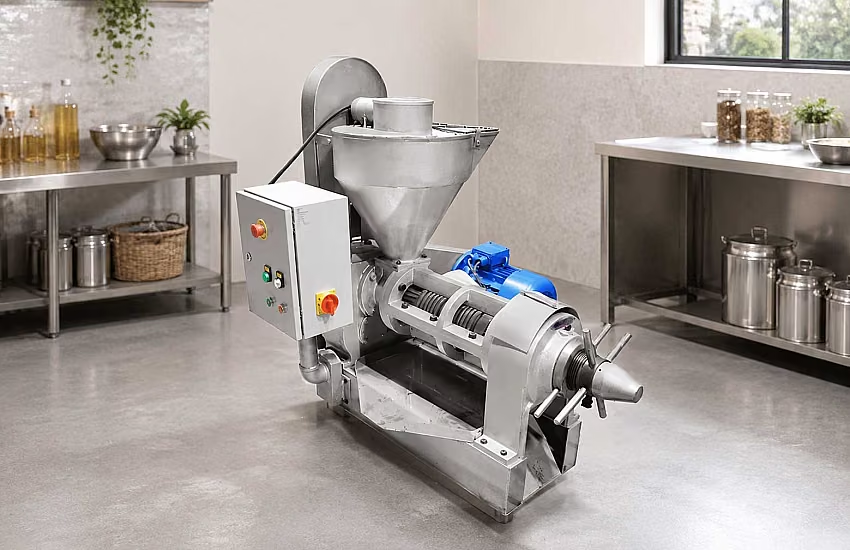
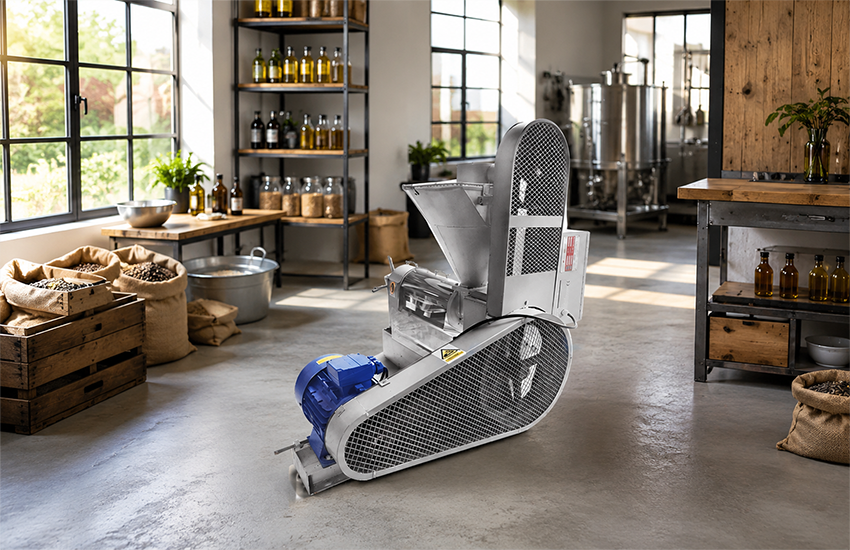
Inside a screw oil press sits a long, rotating shaft wound with a spiral - this is the screw itself, sometimes called the auger or worm. Surrounding it is a perforated chamber that resembles a metal cage with narrow slots. When seeds drop into the feeding hopper, the screw grabs them and begins moving them forward. With every centimeter, the space around the seeds shrinks. The spiral is designed so that the further the material travels, the less room it has. A seed that a moment ago rested freely in the hopper is suddenly compressed with a force measured in tons per square centimeter.
At this point something fascinating happens. The oil, which was trapped inside microscopic cellular structures, no longer has anywhere to escape - except in one direction. It flows out through the slots of the perforated chamber, while the solid part of the raw material, stripped of most of its fat, is pushed onward and leaves the machine as a compacted cake. This separation of two phases, liquid and solid, takes place without any chemicals, solvents, or additives. Purely through mechanical force and the clever geometry of the screw.
It is worth pausing on the scale of the forces at work here. Although the whole process looks calm - just a rotating shaft and oil flowing out - extreme conditions reign inside the chamber. The raw material is subjected to pressure measured in hundreds of atmospheres, and all of this happens within the space enclosed in a small cylinder. A single seed completes its journey from the feeding hopper to the cake outlet in just a few seconds, during which it transforms from a hard, dry kernel into a compressed cake stripped of most of its fat. This combination of immense pressure and a brief window of time is what makes pressing so effective. If the forces were weaker or the raw material lingered in the press too long, the result would be worse. The engineering of a screw oil press therefore comes down to finding the perfect balance between the intensity of the pressure and the speed at which the material moves through.
The Anatomy of a Single Seed - What Happens Step by Step
To truly understand pressing, it is worth shrinking down for a moment to the size of a rapeseed grain and travelling with it all the way through the inside of the press. It is a journey that lasts only a few seconds, but it includes several distinct stages, each governed by its own laws of physics.
Stage One - Bursting the Cell Walls
Oil inside seeds does not float around freely. It is stored in tiny structures called oil bodies, or oleosomes, which the plant builds inside its cells as an energy reserve for the future germinating seedling. Each such cell is surrounded by a wall - and that wall is the first barrier that has to be overcome.
As the screw begins to compress the raw material, the cell walls cannot withstand the pressure and rupture. Picture millions of microscopic bubbles bursting all at once under the strain - that is exactly what happens at the start of the process. Only the tearing of this structure opens the way for the trapped fat. For this reason, a raw material with an intact, natural structure presses differently than ground or weathered grain. The natural shell that surrounds many oilseeds plays a role here that we will return to later - it turns out to be surprisingly helpful.
Stage Two - The Pressure That Releases the Oil
Once the cells have been ruptured, the oil is already outside their structure, but it is still mixed into a dense mass of crushed raw material. Now the second force comes into play - rising pressure. As the screw moves the material toward an increasingly narrow part of the chamber, the mass is compressed to the limit. The pressure squeezes the oil out of the dense paste like water wrung from a sponge.
The geometry of the whole arrangement is crucial here. At the end of the chamber there is a restriction that resists the material being pushed through. Thanks to this, the mass does not fly out freely but has to force its way through a narrow throat, which raises the pressure throughout the entire chamber even further. It is precisely this deliberately introduced resistance that makes pressing effective. Without it, a large part of the oil would remain in the raw material.
Stage Three - Friction, Heat, and the Last Drops
The third, often underappreciated element is heat. When hard material rubs against the screw and the chamber walls under enormous pressure, part of the mechanical energy turns into thermal energy. Pressing, even the kind called cold pressing, always involves some rise in temperature caused by friction. This phenomenon has profound consequences for the quality of the oil.
Oil becomes thinner as it warms, and thinner oil flows out through the slots more easily. On the other hand, too high a temperature could destroy the delicate compounds responsible for aroma, color, and nutritional value. That is why a well-designed oil press balances on a fine line - enough pressure and friction for the oil to flow out efficiently, but not so much that it overheats the raw material. This is exactly where the world of mass production parts ways with the world of premium oils mechanically pressed while preserving their natural properties.
The Screw - A Brilliant Mechanism We Rarely Think About
At the heart of every screw oil press is, as the name suggests, the screw. This seemingly simple component - a rotating shaft with a spiral thread - conceals a solution that humanity worked on for more than two thousand years. It is worth devoting a moment to it, because it is one of the most elegant mechanisms in the entire history of technology.
From Archimedes to the Oil Press
A spiral mechanism enclosed in a cylinder is not a modern invention. Its roots reach back to antiquity, specifically to a construction known as the Archimedes screw. As early as the third century BC, a rotating spiral inside a tube was used to lift water from a lower level to a higher one - for irrigating fields, for example, or for draining ships. The principle was brilliant in its simplicity: turning the spiral moved the material along its axis.
The very same fundamental principle, after centuries of refinement, works today inside an oil press. The difference is that the screw in an oil press does not merely move the material - it compresses it at the same time. This combination of two functions, transport and compression, makes it the ideal tool for continuous pressing. Raw material enters on one side, and on the other it emerges already separated into oil and press cake, without any interruption to the work. It is hard to find a more beautiful example of how an ancient idea lives on in a modern machine.
Why the Screw Was a Breakthrough
Before continuous screw presses came along, pressing oil was a laborious batch process. The raw material was loaded into the press, squeezed, left to sit, the oil collected, the chamber emptied, and the whole thing started over. Each batch required a separate cycle. The invention of the continuous screw press changed everything, because it allowed an uninterrupted flow of raw material through the machine.
The screw solved three problems at once. First, it provided a constant supply of raw material, eliminating the need for manual loading and emptying. Second, thanks to the variable geometry of the spiral, it made possible a gradual, controlled build-up of pressure instead of one sudden squeeze. Third, it allowed work to continue almost without pause, which for any oil mill geared toward regular production is a value impossible to overstate. This is exactly why modern industrial machines, such as the Screw Oil Press 3 t/24h, are built on this proven principle - the simplicity of the mechanism goes hand in hand with its reliability.
A Brief History of Oil Pressing - From Stone to Steel
Oil pressing is one of the oldest processing technologies that humanity ever devised. Long before the first machines existed, people discovered that valuable fat could be extracted from seeds and fruits if they were pressed hard enough. The road from primitive crushing to the precise screw press took thousands of years and was paved with ingenious solutions.
The First Presses - Mortars, Wedges, and Levers
The oldest methods of obtaining oil were as simple as they were laborious. Seeds or fruits were crushed in stone mortars or ground between two stones, and the resulting mass was pressed out by hand or weighted down with rocks. Over time, more thoughtful designs appeared. In the ancient Mediterranean world, where olive oil was the main product, lever presses, also called beam presses, gained enormous popularity.
They worked on the principle of a huge wooden beam, one end fixed in place and the other weighted with stones or tensioned with ropes. The beam pressed down on bags filled with crushed raw material, and the oil that flowed out drained into vessels placed beneath. Although the solution seems archaic today, it worked effectively and for centuries formed the backbone of oil production across the Mediterranean basin. Alongside lever presses, wedge presses were also used, in which oil was squeezed out by driving wooden or metal wedges into a specially built frame.
Screw Presses and the Printing Revolution
The real breakthrough came with the use of the screw. The screw press, in which a turning screw pressed a plate against the raw material, gave far greater control over the pressing force and was more compact than the sprawling lever presses. The screw mechanism allowed the pressure to be increased gradually through rotation alone, which made the process more reliable and more efficient.
Here lies one of the best curiosities in the entire history of technology. The same screw press that served to press oil and wine became the inspiration for an invention that changed the course of civilization. When the first printing machine with movable type was being built in the middle of the fifteenth century, its makers reached for the proven mechanism of the screw press familiar from vineyards and oil mills. One could say, then, that oil-pressing technology indirectly contributed to the spread of books and knowledge. The mechanism that squeezed fat from seeds also pressed paper against type coated with ink.
The Birth of the Continuous Screw Press
Screw presses and lever presses shared one common flaw - they worked in batches. It was only the turn of the nineteenth and twentieth centuries that brought the solution which to this day forms the foundation of industrial pressing. It was then that the continuous screw press was constructed, in which the raw material was no longer loaded in portions but flowed uninterrupted through the machine, compressed by the rotating screw.
This solution revolutionized the extraction of oil. The machine could run for hours without stopping, and operating it came down mainly to feeding it raw material and collecting the products. Modern screw presses are direct descendants of those pioneering designs - refined, fitted with durable motors and stainless steel components, but built on the same fundamental idea. When you look at a modern oil press running in continuous mode, you are in essence looking at the culmination of more than two thousand years of human ingenuity.
Physics and Chemistry in a Single Machine - Why Oil "Knows" How to Flow
Pressing oil looks like a purely mechanical process, but in reality it is a subtle interplay of physics and chemistry. How much oil can be recovered and of what quality depends on several variables that at first glance seem secondary. In fact, it is precisely these that determine the success or failure of the whole endeavor.
The Role of Moisture and Temperature
The moisture of the raw material is one of the most underrated factors. Grain that is too wet behaves completely differently in the press than dry grain. Excess water causes the oil to begin emulsifying, that is, mixing with water in the form of tiny droplets, which makes it hard to separate and impedes the flow through the slots. The mass turns mushy and sticks to the components of the machine. Conversely, overdried raw material tends to be brittle and dusty, and pressing loses its efficiency.
There is an optimal moisture range in which the raw material gives up its oil most willingly. For many oilseeds this means a moisture content below ten percent. Within this range the mass keeps the right consistency - plastic enough to be compressed, yet compact enough for the oil to drain cleanly away from the solid part. Temperature works hand in hand with moisture, since heat affects both the viscosity of the oil and the behavior of the water in the raw material. Experienced oil makers know that preparing the grain for pressing can be just as important as the pressing itself. Sometimes it is the proper drying or conditioning of the raw material before it goes into the press that decides whether the oil flows abundantly or the process causes trouble. A small change in moisture can noticeably alter the behavior of the same batch of seeds, which is why controlling this parameter is one of the foundations of successful pressing.
Why the Husk Matters
The natural shell mentioned earlier is another supporting hero whose role is far greater than it might seem. The husk and the fibrous part of the raw material act in the press as something of a natural scaffold and filter at the same time. They create microscopic channels through which the oil can drain and separate from the rest of the mass.
If the raw material consisted of soft pulp alone, with no fibrous structure whatsoever, the compressed mass would turn into a uniform, impermeable paste from which oil would struggle to find its way out. The fibers ensure permeability and let the liquid flow through the compressed material. This is why the best pressing results are obtained from raw material with a natural, intact shell - it retains a built-in system for draining oil away. Nature, in designing seeds, happened to equip them with an ideal structure for pressing, though that was certainly not its original intention.
Every Seed Has Its Own Character - How Different Raw Materials Behave in the Press
One of the most surprising things for people who are just starting to press oil is the discovery that individual seeds behave completely differently in the press. The machine stays the same, the operating principle of the screw does not change, and yet every raw material has its own temperament. Some give up their oil eagerly, others resist, and still others demand particular care so as not to ruin their delicate properties. It is a little as if each grain had a character that reveals itself only under pressure.
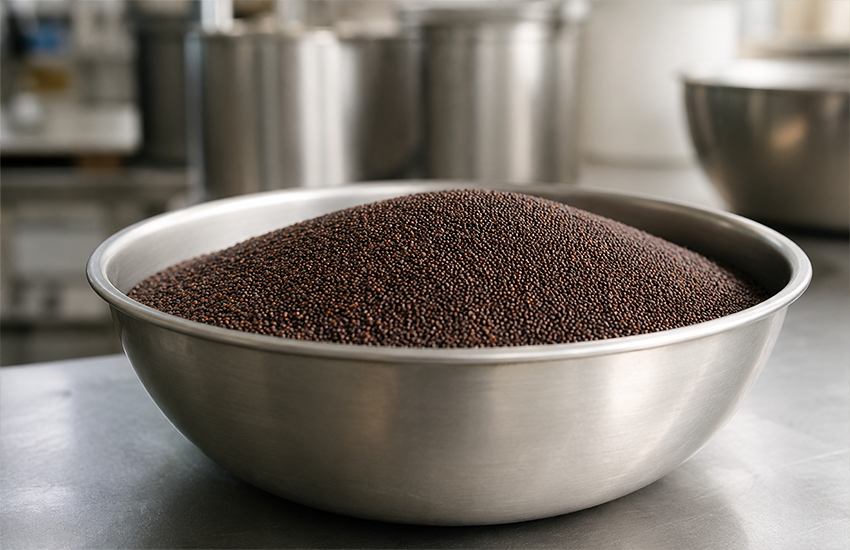
Rapeseed, the classic oil-mill raw material in our climate zone, is a small, hard grain with a high fat content. It presses well and efficiently, yielding an oil with a characteristic color. Sunflower, on the other hand, is an example of a raw material in which the husk matters enormously - it is the husk that decides how cleanly the oil separates from the rest of the mass and how smoothly the whole process runs. Flax, that is linseed, provides an exceptionally valuable oil, but also an exceptionally sensitive one. Its oil reacts quickly to heat and contact with air, which is why pressing flax requires special attention to temperature in order to preserve its delicate nature.
Pumpkin seeds behave differently again, yielding a thick, dark green oil with an intense character, as does sesame, prized for centuries in kitchens around the world. Hemp, nuts, and many other oil-rich raw materials add further chapters to this story, each with its own particulars regarding hardness, oil content, moisture, and sensitivity to heat. For anyone involved in pressing, this means that getting to know your own press is an ongoing process - every new raw material is a new lesson and a new opportunity to better understand how the physics of pressing harmonizes with the nature of a specific grain. It is precisely this variety that makes work in an oil mill never dull, and the versatile design of a good screw oil press makes it possible to experiment with a whole palette of oilseeds.
Multi-Stage Pressing - Why More Means Better
One of the most interesting solutions used in modern industrial presses is multi-stage pressing. Instead of trying to extract all the oil in a single violent act of compression, the raw material passes through several successive zones of rising pressure. Each stage squeezes out another portion of oil, and the effect accumulates as the material advances through the chamber.
Why does this work better than a single pressing? The reason lies in the nature of the process itself. Oil does not leave the raw material instantly - it needs time to migrate through the compressed mass and find its way to the drainage slots. Gradually increasing the pressure across several stages gives the liquid a chance to flow out at each phase instead of becoming trapped in material that was compressed too quickly. The result is a lower content of residual oil in the press cake and a fuller use of the raw material.
In practice, this means that a well-designed three-stage press leaves far less fat in the cake than a simple single-stage construction. A residual oil content of just a few percent is a result that a hundred years ago would have been difficult to achieve without the use of chemical solvents. Today, a modern screw oil press can manage it through mechanical force alone, thanks to thoughtful geometry and multi-stage compression. It is exactly this kind of engineering finesse that sets professional machines apart from simple hobbyist presses.
When a Curiosity Becomes a Working Tool
All this knowledge about physics, history, and the geometry of the screw takes on a practical dimension the moment someone decides to press oil in earnest. That is when abstract principles turn into concrete machine parameters, and theoretical musings about pressure and friction become real liters of oil flowing into a tank.
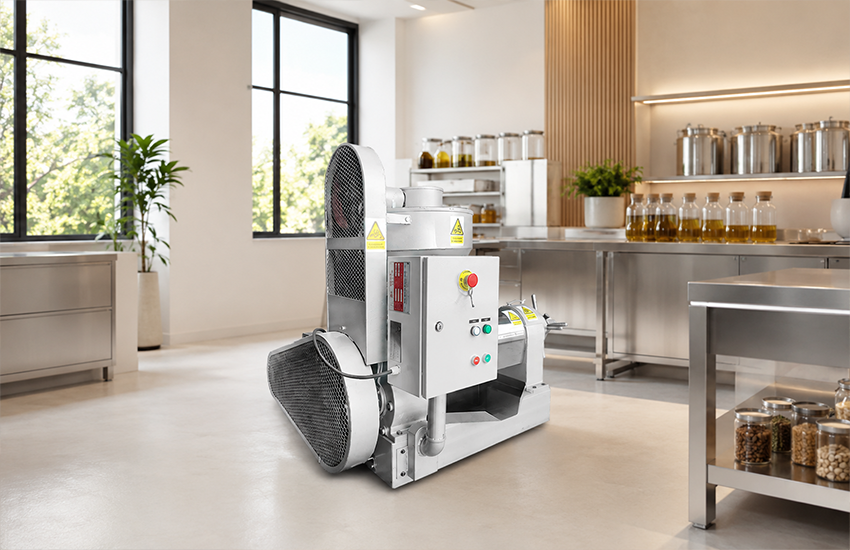
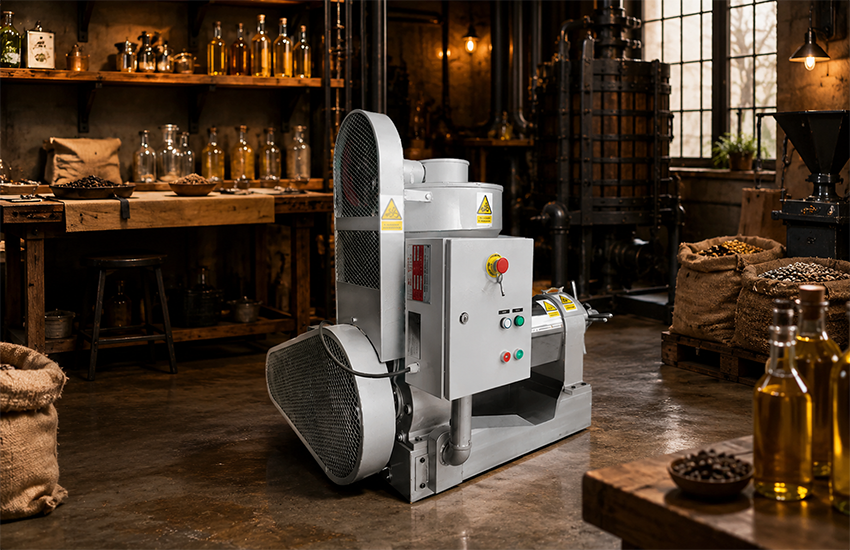
A good example of a machine in which all the principles described above work in harmony is the Screw Oil Press 3 t/24h, designated YZYX90-2. It is a construction designed with continuous, efficient operation in mind, in which the screw performs exactly that dual function discussed earlier - it moves and at the same time compresses the raw material. Pressing takes place in a natural, purely mechanical way, without the involvement of any chemical substances.
The machine operates as a three-stage system, which translates into very good use of the raw material - the residual oil in the press cake drops to around eight percent. It is driven by a five-and-a-half kilowatt motor suited to continuous operation, and the components that come into contact with the raw material, such as the drip tray and the chamber cover, are made of stainless steel. A capacity ranging from two-point-six to three tonnes per twenty-four hours places this machine in a segment that lets you move beyond hobby scale without requiring an elaborate industrial infrastructure.
Importantly from the perspective of someone who wants to press regularly, the machine carries a CE certificate confirming compliance with European safety standards, and its solid, industrial construction is prepared for intensive use. It works equally well as a standalone unit or as part of a larger production line. In other words, more than two thousand years of development in pressing technology have been enclosed here in a single, ready-to-work machine.
Press Cake - The Second Life of a Seed
The story of pressing would be incomplete if it focused solely on the oil. After all, one more product emerges from the press, one that for many people is equally fascinating - the press cake. It is everything left of the seed after most of its fat has been taken away: a compressed, warm cake rich in protein, fiber, and the remaining nutrients.
The most interesting thing is that press cake is not waste at all. Quite the opposite - it is a fully valuable raw material with a wide range of uses. Traditionally it is used as a nutritious animal feed, since it concentrates the protein and the components that the plant had gathered in the seeds. Cattle, pigs, poultry, and fish readily accept this kind of dietary supplement. Over time, however, it was discovered that the potential of press cake reaches much further.
Selected types of cake now find use in the kitchen as high-protein flours and baking additions, fitting neatly into the trend of functional food and the zero-waste philosophy. Press cake can also be processed further into pellets or blended into custom recipes. What is fascinating is the very fact that a single pressing produces two distinct products, and the raw material is used almost in its entirety - with no waste, in keeping with the logic that nature has always followed. It is an elegant bracket that closes the whole process: nothing is wasted, everything finds its place.
Oil Pressing as a Meeting of Science and Tradition
When you add it all up, it turns out that the seemingly simple act of expressing oil is in fact a meeting of several worlds. There is the physics of pressure and friction, the chemistry of fats and moisture, the biology of plant cells storing energy, and the history of human ingenuity reaching back to ancient mathematicians and medieval craftsmen. All of it comes together in a single rotating spiral enclosed in a steel chamber.
The next time you see a stream of freshly pressed oil, it is worth remembering how many invisible processes go into that one moment. A hard grain that only a moment earlier looked unyielding surrenders its most precious treasure thanks to a force that humanity learned to harness over thousands of years of trial and error. Oil pressing is not only production - it is tangible proof of how deep knowledge can hide behind the simplest of acts. And it is precisely this depth that keeps the subject of oil pressing so endlessly interesting.
There is one more reason this story is so striking. A technology that for centuries required vast installations, many pairs of hands, and entire buildings dedicated solely to pressing now fits into a single, compact machine that can be set up in a modest room and started almost at once. What was once the domain of specialized oil mills and demanded knowledge passed down from generation to generation has become accessible to farms, small manufactories, and enthusiasts wanting to press oil on their own terms. All that knowledge about pressure, friction, moisture, and the geometry of the screw, accumulated over the ages, has been enclosed in a machine ready to work. In a sense, every modern screw oil press is therefore a small monument to human ingenuity - a quiet witness to thousands of years spent perfecting one of the oldest technologies in the world.
Frequently Asked Questions
Does the oil really stay cold during cold pressing?
Not entirely. The term "cold pressing" means that no additional heat is supplied to the raw material from outside, for example through prior roasting or heating. The process of compression itself, however, always generates a certain amount of heat caused by the friction of the raw material against the screw and the chamber walls. The temperature rises slightly, but stays low enough to preserve the delicate compounds responsible for aroma, color, and nutritional value. This is the fundamental difference compared with methods in which the raw material is deliberately heated strongly before pressing.
Why is more oil obtained from some seeds than from others?
This is determined above all by the natural fat content of a given raw material. Oilseeds differ considerably in this respect - some store fat as their main energy reserve, others to a lesser degree. Effective pressing usually calls for a raw material with an oil content exceeding fifteen percent or so. The structure of the seed, its moisture, and the presence of a husk that helps drain the oil also matter. All these factors together decide how generously a grain will give up its fat.
What exactly does multi-stage pressing mean?
Multi-stage pressing is a process in which the raw material passes through several successive zones of rising pressure instead of being compressed all at once. Each stage squeezes out another portion of oil, giving the liquid time to flow out of the compressed mass. The result is a fuller use of the raw material and a lower content of residual fat in the press cake. In practice, a three-stage construction leaves much less oil in the cake than a simple single-stage press, which makes the whole process more efficient without the need to resort to chemical methods.
Where does the screw mechanism used in presses come from?
The principle of a rotating spiral enclosed in a cylinder has its roots in antiquity, in a construction known as the Archimedes screw, already used more than two thousand years ago to lift water. The modern screw in an oil press uses the same fundamental idea, adding to it the function of compressing the raw material as it is moved along. Continuous screw presses in their present form developed at the turn of the nineteenth and twentieth centuries and have served as the foundation of industrial oil pressing ever since.
Can the press cake left after pressing be put to any use?
Absolutely, and in many ways. Press cake, the residue left after the oil has been taken away, is rich in protein and fiber. Traditionally it is used as a valuable feed for farm animals. Selected types of cake are also suitable for food applications, for example as high-protein flours or baking additions. Press cake can be processed further as well, for instance into pellets. As a result, a single pressing yields two useful products, and the raw material is used almost in its entirety.
Why is the moisture of the raw material so important for pressing?
Moisture directly affects how the raw material behaves in the press. Grain that is too wet causes the oil to start emulsifying and mixing with water, which makes it harder to separate, and the mass turns mushy and sticks to the machine's components. Overdried raw material, in turn, tends to be brittle and dusty, and pressing loses its efficiency. There is an optimal moisture range, usually below ten percent for oilseeds, in which the raw material keeps a consistency that allows smooth compression and a clean separation of oil from the solid part.
Can a screw oil press operate continuously for an extended period?
Yes, and that is precisely its greatest advantage compared with older batch presses. A continuous screw press accepts raw material without interruption and presses oil continuously for as long as it is fed grain. Machines intended for industrial work, such as the Screw Oil Press 3 t/24h, are fitted with motors and components suited to intensive, long-term use. This makes regular, larger-scale production possible without having to stop work after each portion of raw material, which was the inconvenience of the old methods of pressing.