
Table of Contents
- Colour as the first message an oil sends
- Where colour in fat actually comes from
- Dichromatism, or the oil that changes colour with layer thickness
- Why the same batch of seeds can yield oil of different shades
- Cold versus hot - two routes to two different palettes
- Cloudiness is not the same thing as colour
- How colour changes over time and what that says about freshness
- Light - the greatest enemy of both colour and quality
- Practice: steering colour deliberately in your own mill
- Colour in culture, or why every oil has its own gold
- A simple home method for assessing colour
- Colour as the producer's signature
- Frequently Asked Questions
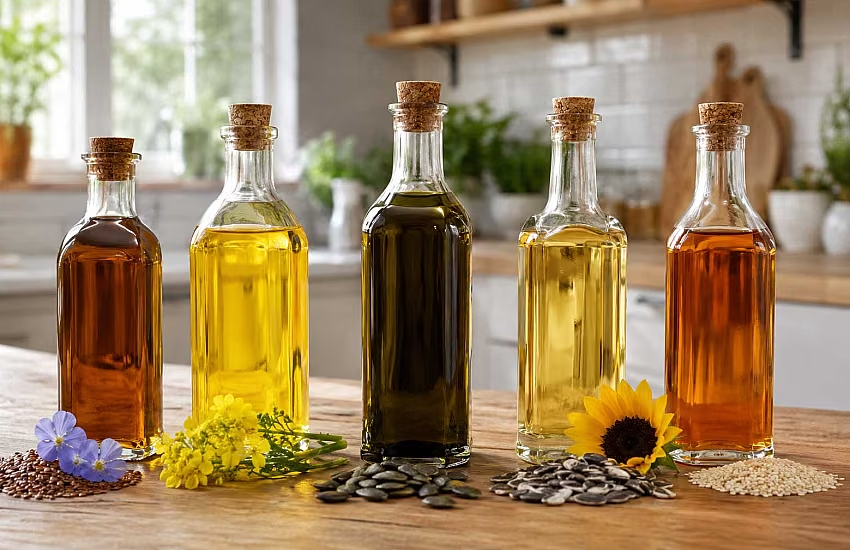
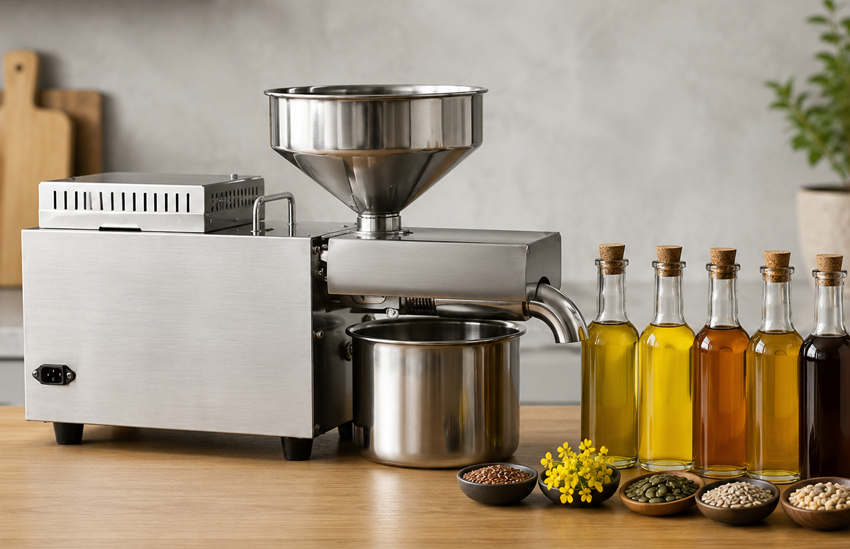
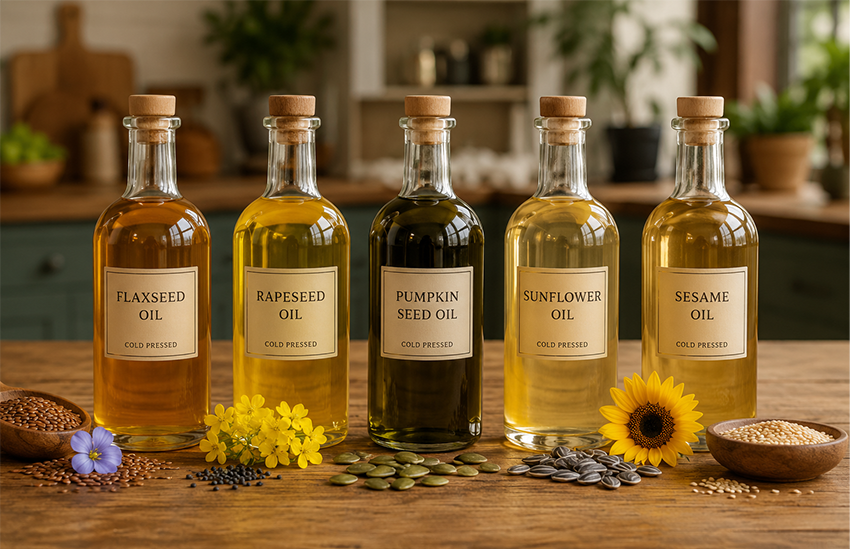
Line up six bottles of oil pressed on the same day, on the same machine, by the same person. The flaxseed oil will look like liquid amber. The rapeseed oil will show a deep, warm yellow with a green undertone. Hemp oil will surprise you with an intense green, as though someone had dissolved a leaf in it. Sunflower oil will turn out pale and almost transparent. Pumpkin seed oil will appear emerald in a thin layer and dark red in a thick one. Sesame oil from roasted seeds will take on the colour of strong tea.
Six different colours from one press. The colour of oil is neither an accident nor a decoration - it is a record of everything that happened to the seed from the moment it began ripening in the field to the moment the stream of fat left the pressing chamber. For an oil producer, colour is a free, instant and surprisingly accurate diagnostic indicator. You just need to know how to read it.
This article is about where colour in vegetable fat comes from, why the same raw material can yield oil of a completely different shade, what colour reveals about freshness and shelf life, and how to steer colour deliberately when pressing in your own kitchen or small oil mill.
Colour as the first message an oil sends
Before anyone unscrews the bottle and smells the contents, before they take a spoonful, they see the colour. The human visual system processes colour information in a fraction of a second and immediately links it to a taste expectation. Green oil promises grassy notes, freshness, perhaps a hint of bitterness. Deep yellow suggests nuttiness and body. A very pale, almost colourless liquid reads as neutral, even characterless.
This is not purely psychology. Those associations have a real chemical basis, because the compounds responsible for colour and the compounds responsible for aroma often arise in the same processes or originate from the same structures within the seed. When we see green, we usually see chlorophyll - and chlorophyll in oil means the raw material contained photosynthetic tissue, or the seeds had not reached full maturity. Either condition translates directly into a sensory profile.
It is also worth noticing what the industry has trained us to expect. Refined supermarket oils are pale and uniform because one stage of refining is bleaching - removing pigments with bleaching earths. The industry does this deliberately: a pale oil is visually predictable, more stable during long storage and never surprises the customer with variation between batches. The price of that predictability is concrete, though. Alongside the pigments go accompanying compounds that help build flavour and nutritional value.
Cold-pressed oil from a small mill goes in precisely the opposite direction. Its colour is variable, seasonal, sometimes counter-intuitive - and that is exactly why it carries information.
Where colour in fat actually comes from
Fat itself is colourless. Triacylglycerols, the main component of every vegetable oil, do not absorb visible light in any way that would produce a shade. A pure, laboratory-purified fat fraction is as transparent as water.
All the colour therefore comes from accompanying substances - compounds extracted from the seed along with the fat during pressing, which dissolve in it because they are themselves lipophilic. They usually account for a fraction of a percent of the oil's mass, but their tinting strength is enormous. A few milligrams of chlorophyll per kilogram of oil are enough to turn an entire bottle a distinct green.
Chlorophylls - the green trace of a leaf inside a seed
Chlorophylls a and b are photosynthetic pigments whose job in the plant is to capture light. They have characteristic absorption bands in the blue and red regions and transmit green light - hence the green of leaves, and hence the green of any oil that contains them.
Chlorophyll ends up in seeds for two reasons. First, ripening seeds are green for a period and carry out photosynthesis themselves. As they mature, chlorophyll breaks down and the seed turns brown, black or grey depending on the species. If harvest comes too early, or if a batch contains a high proportion of immature seeds, chlorophyll will find its way into the oil. In rapeseed this matters enough that the share of green seeds in a batch is a standard raw-material quality parameter.
Second, chlorophyll can come from residual covering tissue - thin membranes, hull fragments, plant debris that entered the hopper alongside the seed. Hulless pumpkin seed oil owes its green to exactly that: the thin greenish membrane surrounding the kernel.
Chlorophyll has a second face, though, which I will return to later in this article: it is a photosensitiser. In the presence of light it can actively accelerate the spoilage of oil.
Carotenoids - yellow, orange and red
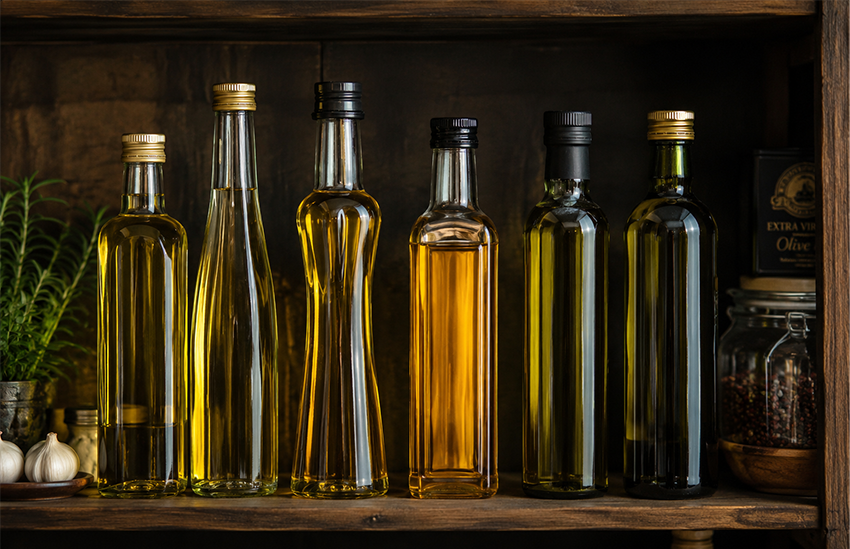
The second great pigment family is the carotenoids: beta-carotene, lutein, zeaxanthin, lycopene and several dozen related compounds. They account for the entire range from pale straw through saturated yellow and orange to red. They colour carrots, maize, peppers and tomatoes, and they colour most vegetable oils.
In the seed, carotenoids serve a protective function - they quench excess light energy and neutralise reactive oxygen species. That same property continues working later, in the bottle. Carotenoids are natural quenchers of singlet oxygen, the aggressive form of oxygen generated partly by chlorophyll under light. In other words, the yellow pigment partially protects the oil against what the green one does.
Carotenoid content depends heavily on species and variety. Hulled sunflower yields a very pale oil because it contains few carotenoids. Oils from pumpkin seed, hemp and maize germ are considerably richer.
The less obvious pigments
Beyond the two main families, several other groups influence the final shade.
Pheophytins are chlorophylls that have lost their central magnesium ion. This transformation happens easily in mildly acidic conditions and under elevated temperature. Pheophytin is olive-brown rather than clean green, which is why oil that has been heated strongly in the pressing chamber often loses its emerald tone in favour of something closer to khaki.
Maillard and caramelisation products appear when seeds have been roasted before pressing, or when chamber temperature was high. Melanoidins - brown polymers formed from reducing sugars reacting with amino acids - are insoluble in water, but their smaller fractions migrate into the fat phase and tint the oil anywhere from golden brown to nearly chocolate. Classic roasted sesame oil is the clearest example.
Phenolic compounds and flavonoids do not usually contribute strong colour, but they affect how oil ages chromatically, since some of them darken on oxidation.
It is worth stating what colour does not show. Tocopherols, meaning vitamin E, are practically colourless. So are phytosterols. The omega-3 and omega-6 fatty acids that lead many producers to buy a press in the first place have no colour of their own whatsoever. A pale oil is therefore not automatically nutritionally poorer, and a dark one is not automatically richer. Colour reports on one group of substances, not on the whole composition.
Dichromatism, or the oil that changes colour with layer thickness
If there is one phenomenon in the world of vegetable oils that looks like a conjuring trick the first time you see it, it is the dichromatism of pumpkin seed oil.
Pour it in a thin layer onto a white plate and you will see a saturated, dark green. Pour the very same oil into a tall glass and look through it against the light, and you will see red, as if through a glass of red wine. Nothing about the oil has changed. Only the path the light has to travel through the liquid has changed.
The explanation lies in the Beer-Lambert law and in the shape of chlorophyll's absorption spectrum. Chlorophyll absorbs blue light very strongly, and red light around 660 nanometres equally strongly, leaving a narrow transmission window in the green region. In a thin layer, mainly that window gets through - we see green. In a thick layer, even that narrow band is extinguished, because absorption grows exponentially with optical path length. What survives is the long-wavelength tail above roughly 700 nanometres, where chlorophyll absorbs only weakly. The light reaching the eye is therefore predominantly deep red.
The effect is distinctive enough that in Styria, where pumpkin seed oil holds protected geographical indication status, it serves as an informal authenticity test. Oil diluted with a cheaper, pale oil loses the effect, because too low a chlorophyll concentration cannot extinguish the green window even in a thick layer.
For a producer, the practical conclusion is clear. When assessing the colour of your own oil, always do it under identical conditions: the same layer thickness, the same vessel, the same background and the same light. Otherwise comparisons between batches are worthless.
Why the same batch of seeds can yield oil of different shades
Sooner or later, everyone who presses regularly asks this question. The same sack of seed, the same machine, yet Monday's oil differs visibly from Wednesday's. There are several causes and all of them are controllable.
Temperature in the pressing chamber
This is the variable with the greatest influence. Raising temperature does three things to colour simultaneously.
First, it increases pigment solubility in the fat and makes extraction from seed tissue easier. Higher temperature therefore generally means more intense colour from the same raw material. Second, it triggers the conversion of chlorophyll into pheophytin, shifting clean green towards olive-brown. Third, above a certain threshold, non-enzymatic browning reactions begin and lay a layer of warm brown tones over everything.
This is why the same flaxseed pressed below forty degrees Celsius gives a bright, clear amber, while the same flaxseed in a chamber heated to well over a hundred degrees yields an oil that is darker, warmer in tone and noticeably more roasted in aroma.
Crucially, chamber temperature depends not only on the heater setting but also on friction. The compressing auger generates heat by itself, and the longer the machine runs without a break, the higher the equilibrium temperature inside the chamber becomes. Oil from the first few minutes of a run is often paler than oil from the fortieth minute of the same session. If repeatable colour matters to you, it is worth collecting that initial warm-up portion separately.
Seed maturity and origin
The same species, the same variety, but a different field and a different harvest date - and the pigment profile is different. The proportion of immature seeds translates directly into chlorophyll content. Weather during ripening affects carotenoid synthesis. Sunlight hours, night temperatures, water availability - all of it leaves a trace in the spectrum.
This is a nuisance for an industrial producer who wants every bottle to look identical. For a small mill it is closer to an asset, because it is tangible evidence that the product comes from a specific harvest rather than from an averaged, high-tonnage blend.
Hulls, particle size and suspended solids
Hull and seed-coat fragments contain different pigments from the endosperm. Pressing hulled and unhulled seed therefore yields oils of different shades even when everything else is identical. Degree of comminution works the same way - finer particles have more contact surface and release more accompanying substances.
On top of that comes the question of particles suspended in fresh oil. Straight after pressing, oil carries microscopic tissue fragments that scatter light and make the colour look cloudier, paler and less saturated than it really is. After sedimentation, the same oil often turns out to be considerably deeper in tone.
Cold versus hot - two routes to two different palettes
In the practice of a small oil mill, the choice between cold and hot pressing is a choice between two colour palettes, two aroma profiles and two yield levels.
Cold pressing, where the oil never exceeds roughly forty degrees Celsius, preserves pigments in a state closest to how they existed in the seed. Greens stay clean, yellows stay bright, and the whole has a raw, fresh character. Heat-sensitive compounds are preserved too, including unsaturated fatty acids in undamaged form.
Hot pressing, where the seed passes through a chamber heated to between roughly one hundred and twenty and two hundred degrees Celsius, gives warmer, deeper and more complex colours. Notes of brown, gold and sometimes copper appear. At the same time yield rises - higher temperature lowers fat viscosity and weakens cell structures, so more oil flows from the same mass of seed. This route also makes it possible to work with difficult raw materials that lack a hard shell, such as hulled sunflower kernels or coconut flakes.
The problem with most home presses is that they offer a binary choice: heater on or heater off. That deprives the producer of precise process control, and with it, control over colour.
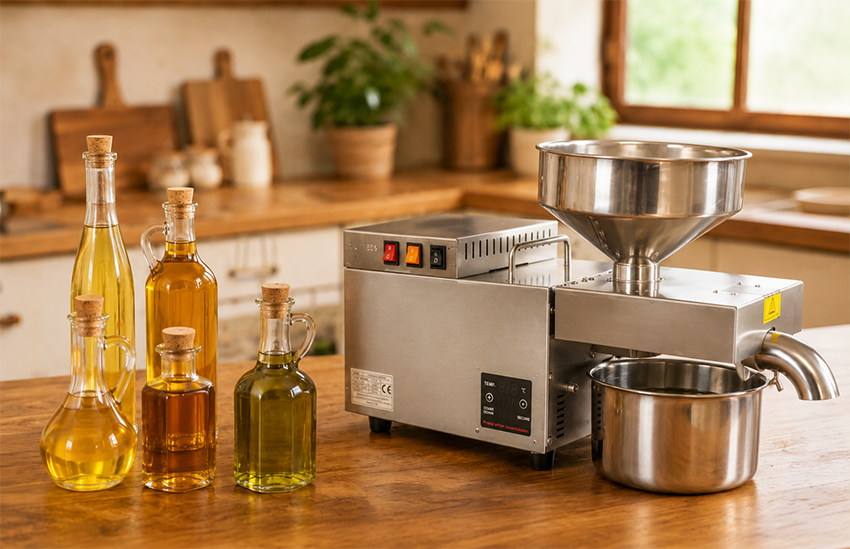
One exception is the home oil press for hot and cold pressing with a capacity of 9-12 kg/h, which is among the very few designs intended for domestic use that offer adjustable heater temperature across a range reaching two hundred degrees Celsius. That changes the nature of working with a press. Instead of two modes you get a dial, and with it the ability to find each raw material's own equilibrium point between yield, aroma and colour. Rapeseed can be run at low temperature to keep its greenish tone and fresh, faintly brassica-like profile, while nuts can be taken higher to draw out caramel depth. The LY-011 model works at nine to twelve and a half kilograms per hour, with a four-hundred-watt motor and an eight-hundred-watt heater, and residual oil in the cake stays at three to five percent.
The machine also comes with two interchangeable augers - one for coarse seed, one for fine. Auger choice affects the degree of compression and the quantity of fine particles passing into the oil, and therefore indirectly affects clarity and colour depth as well.
Cloudiness is not the same thing as colour
This distinction is worth fixing permanently, because its absence is the source of a great many mistaken assessments.
Colour arises from selective light absorption by dissolved pigments. Cloudiness arises from light scattering on particles suspended in the liquid. These are two independent optical phenomena, even though the eye perceives them together.
Freshly pressed oil is always cloudy. It carries phospholipids, protein fragments, tissue particles and traces of water. That suspension scatters light in all directions, making the oil look brighter, more matte and less saturated than it actually is. After a few days of sedimentation, once the particles have settled, the same oil reveals its true colour - usually deeper and more transparent.
The practical conclusion is simple. Never judge an oil's final colour immediately after pressing. Wait until it has cleared, and only then record the result.
There is one further kind of cloudiness that has nothing to do with colour and is frequently misread: cold haze. Oils rich in saturated fatty acids form crystals at low temperature, which appear whitish and flocculent. This phenomenon is entirely reversible. Once warmed to room temperature, the oil returns to clarity. It indicates neither spoilage nor adulteration.
How colour changes over time and what that says about freshness
The colour of oil is not fixed. It evolves throughout storage, and that evolution is a legible record of what is happening inside the bottle.
The first tendency is fading. Chlorophylls and carotenoids are sensitive to light and oxygen. Over time they break down and the oil gradually loses saturation. Green rapeseed oil becomes progressively more yellow; intensely yellow sunflower oil pales towards straw. Fading alone does not yet mean the oil has spoiled, but it does mean part of the antioxidant protection carotenoids provided has disappeared.
The second tendency, considerably more worrying, is darkening combined with the appearance of a greyish, muddy tone. That signals advanced oxidation. Secondary products of peroxide breakdown form coloured compounds while the oil simultaneously develops a characteristically rancid smell. If an oil is darker after a few months than it was on pressing day and has also lost its fresh aroma, colour is confirming what the nose already reports.
The third thing is a change in clarity. New sediment appearing after many weeks of quiet storage, particularly flocculent sediment that does not settle, can indicate microbiological activity arising from residual water in the oil. This is one reason raw-material moisture should stay below ten percent.
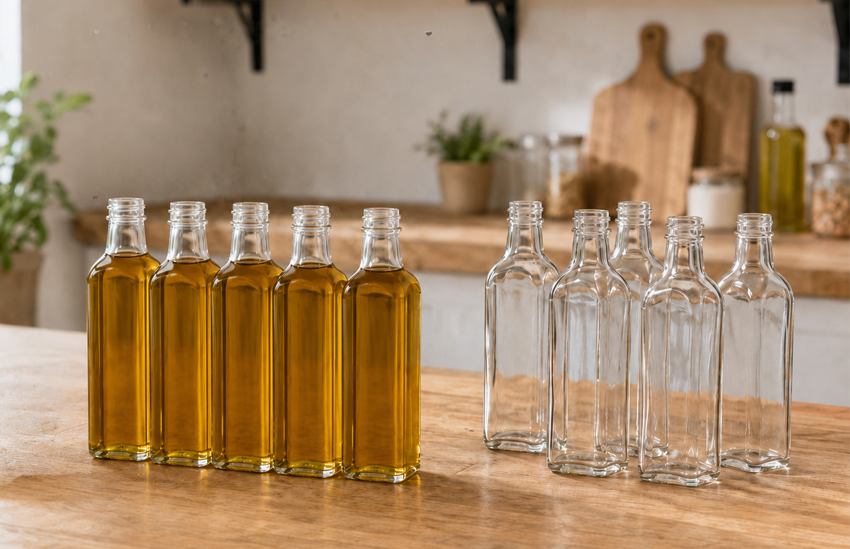
A good practice is keeping a simple colour archive. From each batch, set aside a small sample in a sealed transparent vial, label it with date, species and pressing temperature, and store it in darkness. After a dozen or so samples you have your own reference chart, allowing you to judge instantly whether a new batch falls within normal range.
Light - the greatest enemy of both colour and quality
Here we return to chlorophyll and its second face.
Chlorophyll is a photosensitiser. It absorbs light energy and transfers it to oxygen molecules, converting ordinary oxygen into singlet oxygen - a far more reactive form that attacks the double bonds in unsaturated fatty acids. This mechanism, called photo-oxidation, is orders of magnitude faster than the ordinary autoxidation that proceeds in darkness.
The practical consequence is paradoxical. The most visually striking oils - the deep green, high-chlorophyll ones - are simultaneously the most light-sensitive. A bottle of such oil standing on a windowsill spoils many times faster than an identical bottle in a closed cupboard.
This is the origin of the whole tradition of dark glass in cold-pressed oil packaging. A bottle of dark green or amber glass blocks a substantial portion of the radiation in the range where chlorophyll absorbs most effectively. Storage in genuine darkness works better still - in a carton, a cupboard, a pantry.
Carotenoids, as noted earlier, work in the opposite direction: they quench singlet oxygen and partly neutralise the damage. An oil with a balanced pigment profile, containing both chlorophyll and carotenoids, is therefore more stable in this respect than one dominated by chlorophyll alone.
Practice: steering colour deliberately in your own mill
Theory becomes useful only when it translates into concrete decisions at the machine. Here is what working on colour looks like day to day.
Start by establishing one fixed assessment protocol. The same vial, the same layer thickness, the same white background, the same lighting - ideally diffuse daylight at a consistent time of day. Without this, every comparison is illusory, because dichromatism and lighting differences can shift perceived colour more drastically than any real change in composition.
Next, run a temperature series. Take one raw material and press it three times: once cold, once at an intermediate setting, once with the heater high. Leave all three samples to clear for the same number of days, then compare them side by side. You will see not only three colours but three aromas and three yields. This exercise teaches you more about your own machine than any instruction manual.
Keep notes. Date, species, raw-material origin, moisture, auger used, temperature setting, continuous running time, description of colour after clearing. After a season, such a notebook becomes a map that lets you reproduce any successful result deliberately.
Remember the effect of running time. Because the chamber heats up through friction regardless of the heater, a longer session means a higher final temperature. If you are pressing a large batch and want uniformity, consider blending the whole production run in a single collecting vessel before bottling.
Pay attention to raw-material preparation. Cleaning seed of plant debris, removing stem and leaf fragments, sieving out immature seeds - all of it directly affects the pigment profile. A few minutes of sorting can change the colour of the finished product more than an hour of experimenting with the heater.
If you are still building your workshop, the LY-011 screw oil press for cold and hot pressing gives you convenient scope for exactly this kind of experimentation. Its stainless steel housing, which meets food-hygiene standards, makes it easy to keep clean between trials - and when working on colour that matters, since residue from a previous raw material in the chamber can distort the result of the next batch. The unit measures sixty-five by thirty-eight by twenty centimetres, weighs twenty kilograms and fits in a standard kitchen cabinet, while its 230 V supply lets it work in any room with a socket. The set includes a second auger, an oil container with strainer, a heat-resistant glove and a cleaning brush.
Colour in culture, or why every oil has its own gold
People have described oils by colour for thousands of years, and they have almost always reached for the metaphor of precious metal.
Styrian pumpkin seed oil is called green gold. First-pressing olive oil across the Mediterranean is liquid gold. Moroccan argan oil is described as gold of the desert. West African palm oil, intensely orange thanks to an exceptionally high carotene content, served for centuries as both a ceremonial and a dyeing material.
This vocabulary is no accident. In cultures where oil was produced locally and seasonally, colour was the only available quality indicator - there were no laboratories, no peroxide value measurements. Colour was the certificate. A producer who could consistently deliver oil of a recognisable, deep hue built a reputation.
Interestingly, the mechanism is returning. A customer buying oil from a small mill increasingly looks not at the ingredient list but at what they can see through the glass. Colour variation between seasons, which industry treats as a production defect, becomes proof of authenticity in a craft context. A bottle that looks exactly the same every single time cannot, by definition, come from one particular field and one particular harvest.
A simple home method for assessing colour
Finally, a practical tool. You do not need a spectrophotometer or industrial colour standards to run a sensible, repeatable colour assessment of your own product.
Prepare a set of identical transparent vials with flat walls. Always fill them to the same level. Assess at a window in daylight, under overcast sky or in shade - avoid direct sun, which introduces a strong yellow component. Use the same white background every time, for instance a sheet of clean paper.
Record three independent parameters. Hue, meaning the direction of colour: green, yellow, orange, brown. Saturation, meaning intensity: from pale to deep. Clarity, meaning the presence of suspended matter: from milky to fully transparent.
A phone photograph can help, but only if you disable automatic white balance or include a fixed reference point in the frame - the same white card, for example. Camera automation can "correct" colour so effectively that two genuinely different oils come out identical in the photograph.
And most importantly: always assess after clearing, never straight from the machine.
Colour as the producer's signature
Colour is the only quality parameter a customer evaluates independently, instantly and without any tools. It is also one of the few over which a producer holds real, ongoing control - through choice of raw material, its preparation and above all through process temperature.
Understanding that green comes from chlorophyll, yellow from carotenoids and brown from thermal reactions changes how you work at the press. Colour stops being a by-product and becomes a parameter you design. A press with adjustable temperature becomes a tool in that work rather than a machine performing a single fixed operation.
Freshly pressed oil emerging from the chamber in a particular colour is telling the story of a field, a season, a harvest and the decisions made at the machine. It is worth learning to read that story - and worth learning to write it deliberately.
Frequently Asked Questions
Is darker oil always healthier than pale oil?
No. Colour primarily reports on chlorophyll, carotenoid and thermal-reaction product content. Tocopherols, phytosterols and the omega-3 and omega-6 unsaturated fatty acids are all practically colourless. A very pale oil from hulled sunflower may have an excellent fatty acid profile, while an intensely dark oil from roasted seed may contain fewer heat-sensitive compounds. Colour describes one group of substances, not the full nutritional composition.
Why is my rapeseed oil green when supermarket rapeseed oil is yellow?
The green tone comes from chlorophyll present in seeds that did not reach full maturity, or from plant tissue fragments in the batch. Supermarket oils undergo refining, one stage of which is bleaching with bleaching earths to remove pigments. Green in cold-pressed oil is therefore natural and typical. It is worth remembering, though, that chlorophyll-rich oils are more light-sensitive and need storing in darkness.
Why does pumpkin seed oil look red in a glass and green on a plate?
This is called dichromatism and it is entirely natural. Chlorophyll transmits a narrow band of green light, so in a thin layer we see green. In a thick layer that band is extinguished and only the long-wavelength tail of the spectrum gets through, which we perceive as red. The effect is sometimes used as an informal authenticity indicator, since oil diluted with a pale oil loses it.
Is cloudiness in fresh oil a defect?
No, it is a natural state. Freshly pressed oil contains a suspension of tissue particles, phospholipids and protein residues that scatter light. After a few days of sedimentation the particles settle, the oil becomes clear, and its colour often turns out deeper than it appeared immediately after pressing. A separate matter is cold haze, caused by saturated fatty acids crystallising at low temperature - that phenomenon reverses once the oil warms to room temperature.
How does pressing temperature affect the colour of the finished oil?
Raising temperature acts in three ways at once: it increases pigment extraction from seed tissue, converts chlorophyll into olive-brown pheophytin, and triggers non-enzymatic browning reactions that add warm brown tones. That is why the same raw material pressed cold and hot yields visibly different colours. Presses with adjustable heaters, such as the LY-011, let you set this parameter deliberately instead of choosing between two extreme modes.
Why has my oil changed colour after a few months?
Fading, meaning gradual loss of saturation, results from the natural breakdown of chlorophyll and carotenoids under light and oxygen. In itself this does not mean spoilage, but it signals a loss of natural antioxidant protection. Darkening accompanied by a greyish tone and a shift towards a rancid smell is the worrying pattern - that indicates advanced oxidation. Always verify colour against smell.
Can I deliberately achieve a specific oil colour?
To a degree, yes. The greatest influence comes from pressing chamber temperature, seed maturity and origin, hull presence and how thoroughly the seed has been cleaned of plant debris. By keeping notes on every batch and running trials at different temperature settings, you can work out a repeatable colour profile for a given raw material. Bear in mind, though, that seasonal seed variation will always introduce some margin that cannot be eliminated without refining - and in craft production that margin is an advantage rather than a problem.